
LNG Investors Contemplate The Long Run


/
The disruption of Liquefied Natural Gas (LNG) exports from Qatar has a short term and long term consequence. As spot benchmark prices rose in Europe and Asia, traders focused on the near-term profit opportunity. LNG export terminals contract most of their capacity for long periods (10-20 years) to reduce their exposure to gas prices. Of the two major exporters, Cheniere is more conservative than Venture Global (VG). Cheniere has pre-sold 95% of their capacity through 2035.
VG has greater risk tolerance, with around 30-35% of their 2026 capacity not yet committed. Some spare capacity might be needed if unexpected downtime impacts facilities that are already committed. But VG is comfortable taking the spot market risk, for times like this when there is a major disruption.
VG was similarly positioned in 2022 when European gas supplies from Russia were cut. Some buyers claimed breach of contract and pursued arbitration cases against VG. So far, the outcomes have been mixed (see Nothing Ventured, Nothing Gained).
On Friday VG announced a settlement with Italian LNG importer Edison over the latter’s claim in arbitration. As more of these cases are resolved, the worst case outcome that worried many analysts is receding.
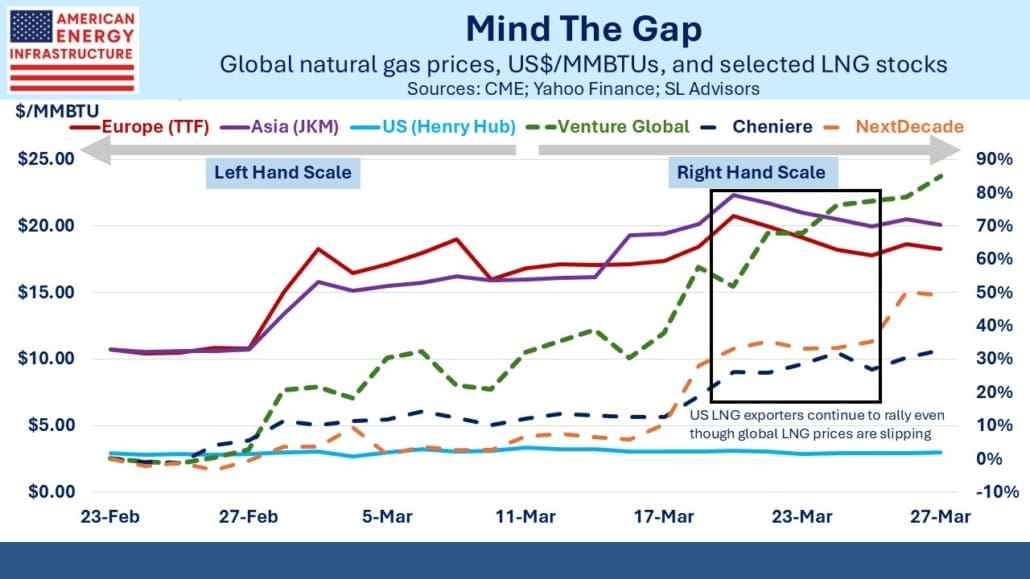
During the first couple of weeks of the war, markets focused on this short term opportunity. The spread between the US natural gas price and foreign benchmarks widened by 50%, creating a substantial profit opportunity for the two leading LNG exporters. Buyers like India whose shipments have been canceled by Qatar’s declaration of force majeure have to scramble to source alternative supplies.
On Friday Qatar extended the force majeure declaration to June.
Little thought was initially given to the longer term impact on Qatar as a supplier of LNG. The Iran War will end sooner or later. Qatar’s Ras Laffan LNG export terminal will start up again, albeit at 83% of capacity while repairs are made. The Strait of Hormuz will open for commercial shipping. But Iran will retain the ability to close it, or to once more target regional energy infrastructure. Those buyers who have long term contracts with Qatar must now consider the possibility of another disruption in the future.
For the first couple of weeks of the war, Cheniere and VG rallied, but NextDecade (NEXT) appreciated only modestly. Investors assessed the windfall gains from selling into an elevated spot market. VG will benefit more because they have greater available capacity. NEXT won’t start shipping LNG until next year, so has little if anything to gain from today’s high prices in Asia and Europe.
Around March 17, NEXT began to appreciate. Cheniere and VG went up further. This showed that LNG investors were looking beyond the next year and pricing in a benefit from US exporters offering buyers a more reliable supply source than Qatar.
Early last week, global benchmarks slipped, but VG continued higher while Cheniere and NEXT held their gains. This further showed that the market is beginning to price in the long-term challenges facing Qatar. Later in the week as the news showed prospects for a ceasefire receding, LNG benchmarks and US exporters rose together.
The news that the US expects the war to last another 2-4 weeks further delays the reopening of the Strait of Hormuz to energy shipments. Nobody knows when Qatar will restart LNG shipments, further benefitting US exporters.
Although LNG names have been the strongest performers in recent weeks, they’re not the only midstream names to benefit from the Iran War. Supplies of propane to Asia have been curtailed, which has hurt India more than any other country since a large portion of the population relies on it for cooking and heating. Enterprise Products Partners and Energy Transfer dominate US propane exports. Export capacity is constrained as for LNG, but they’re still able to profit from higher arbitrage margins. Targa Resources has similar exposure.
It’s also worth remembering that many pipelines operate under contracts governed by the Federal Energy Regulatory Commission (FERC) which link price increases to PPI. On Thursday, the IMF forecast US inflation would reach 4.2% this year. JPMorgan sees CPI peaking at 3.6% during 2Q26, dropping to 3.4% by the end of the year. Such forecasts rely on predicting crude oil prices, not easy at the best of times.
The inflation link to pipelines is another example of how an allocation to midstream can act as a powerful diversifier. If inflation remains elevated, most other sectors of the equity market will be under pressure.
US midstream energy infrastructure offers one of the few bright spots in equity markets.
We have two have funds that seek to profit from this environment:

Important Disclosures
The information provided is for informational purposes only and investors should determine for themselves whether a particular service, security or product is suitable for their investment needs. The information contained herein is not complete, may not be current, is subject to change, and is subject to, and qualified in its entirety by, the more complete disclosures, risk factors and other terms that are contained in the disclosure, prospectus, and offering. Certain information herein has been obtained from third party sources and, although believed to be reliable, has not been independently verified and its accuracy or completeness cannot be guaranteed. No representation is made with respect to the accuracy, completeness or timeliness of this information. Nothing provided on this site constitutes tax advice. Individuals should seek the advice of their own tax advisor for specific information regarding tax consequences of investments. Investments in securities entail risk and are not suitable for all investors. This site is not a recommendation nor an offer to sell (or solicitation of an offer to buy) securities in the United States or in any other jurisdiction.
References to indexes and benchmarks are hypothetical illustrations of aggregate returns and do not reflect the performance of any actual investment. Investors cannot invest in an index and do not reflect the deduction of the advisor’s fees or other trading expenses. There can be no assurance that current investments will be profitable. Actual realized returns will depend on, among other factors, the value of assets and market conditions at the time of disposition, any related transaction costs, and the timing of the purchase. Indexes and benchmarks may not directly correlate or only partially relate to portfolios managed by SL Advisors as they have different underlying investments and may use different strategies or have different objectives than portfolios managed by SL Advisors (e.g. The Alerian index is a group MLP securities in the oil and gas industries. Portfolios may not include the same investments that are included in the Alerian Index. The S & P Index does not directly relate to investment strategies managed by SL Advisers.)
This site may contain forward-looking statements relating to the objectives, opportunities, and the future performance of the U.S. market generally. Forward-looking statements may be identified by the use of such words as; “believe,” “expect,” “anticipate,” “should,” “planned,” “estimated,” “potential” and other similar terms. Examples of forward-looking statements include, but are not limited to, estimates with respect to financial condition, results of operations, and success or lack of success of any particular investment strategy. All are subject to various factors, including, but not limited to general and local economic conditions, changing levels of competition within certain industries and markets, changes in interest rates, changes in legislation or regulation, and other economic, competitive, governmental, regulatory and technological factors affecting a portfolio’s operations that could cause actual results to differ materially from projected results. Such statements are forward-looking in nature and involves a number of known and unknown risks, uncertainties and other factors, and accordingly, actual results may differ materially from those reflected or contemplated in such forward-looking statements. Prospective investors are cautioned not to place undue reliance on any forward-looking statements or examples. None of SL Advisors LLC or any of its affiliates or principals nor any other individual or entity assumes any obligation to update any forward-looking statements as a result of new information, subsequent events or any other circumstances. All statements made herein speak only as of the date that they were made. r
Certain hyperlinks or referenced websites on the Site, if any, are for your convenience and forward you to third parties’ websites, which generally are recognized by their top level domain name. Any descriptions of, references to, or links to other products, publications or services does not constitute an endorsement, authorization, sponsorship by or affiliation with SL Advisors LLC with respect to any linked site or its sponsor, unless expressly stated by SL Advisors LLC. Any such information, products or sites have not necessarily been reviewed by SL Advisors LLC and are provided or maintained by third parties over whom SL Advisors LLC exercise no control. SL Advisors LLC expressly disclaim any responsibility for the content, the accuracy of the information, and/or quality of products or services provided by or advertised on these third-party sites.
All investment strategies have the potential for profit or loss. Different types of investments involve varying degrees of risk, and there can be no assurance that any specific investment will be suitable or profitable for a client’s investment portfolio.
Past performance of the American Energy Independence Index is not indicative of future returns.
VG’s style is not for me. I invest in midstream infrastructure for its tax deferred high yields and conservative managements. EPD and even ET (with Kelcy Warren lurking in the background having the controlling unit holdings) are material–and comfortable– holdings for me.