LNG Investors Contemplate The Long Run
The disruption of Liquefied Natural Gas (LNG) exports from Qatar has a short term and long term consequence. As spot benchmark prices rose in Europe and Asia, traders focused on the near-term profit opportunity. LNG export terminals contract most of their capacity for long periods (10-20 years) to reduce their exposure to gas prices. Of the two major exporters, Cheniere is more conservative than Venture Global (VG). Cheniere has pre-sold 95% of their capacity through 2035.
VG has greater risk tolerance, with around 30-35% of their 2026 capacity not yet committed. Some spare capacity might be needed if unexpected downtime impacts facilities that are already committed. But VG is comfortable taking the spot market risk, for times like this when there is a major disruption.
VG was similarly positioned in 2022 when European gas supplies from Russia were cut. Some buyers claimed breach of contract and pursued arbitration cases against VG. So far, the outcomes have been mixed (see Nothing Ventured, Nothing Gained).
On Friday VG announced a settlement with Italian LNG importer Edison over the latter’s claim in arbitration. As more of these cases are resolved, the worst case outcome that worried many analysts is receding.
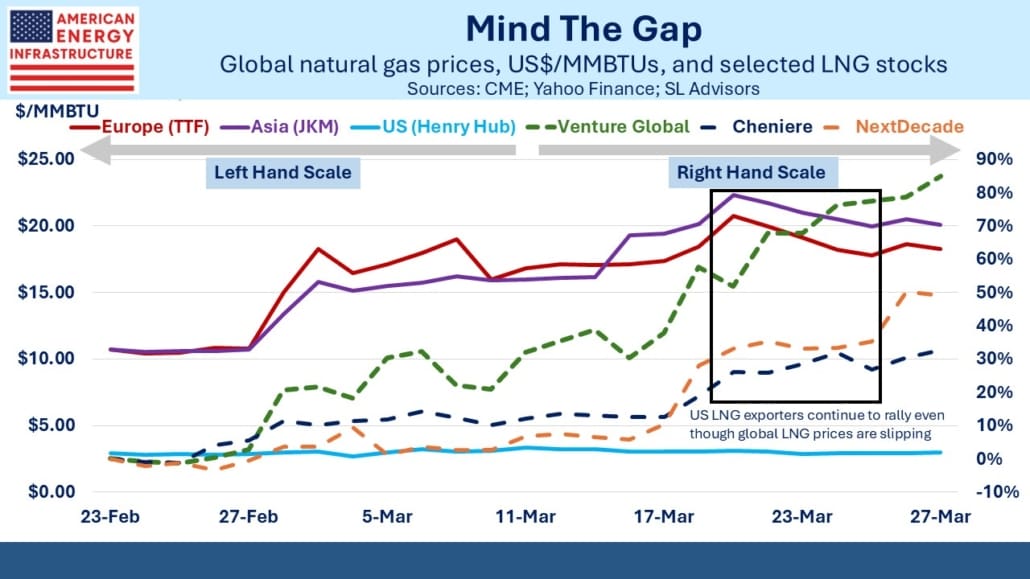
During the first couple of weeks of the war, markets focused on this short term opportunity. The spread between the US natural gas price and foreign benchmarks widened by 50%, creating a substantial profit opportunity for the two leading LNG exporters. Buyers like India whose shipments have been canceled by Qatar’s declaration of force majeure have to scramble to source alternative supplies.
On Friday Qatar extended the force majeure declaration to June.
Little thought was initially given to the longer term impact on Qatar as a supplier of LNG. The Iran War will end sooner or later. Qatar’s Ras Laffan LNG export terminal will start up again, albeit at 83% of capacity while repairs are made. The Strait of Hormuz will open for commercial shipping. But Iran will retain the ability to close it, or to once more target regional energy infrastructure. Those buyers who have long term contracts with Qatar must now consider the possibility of another disruption in the future.
For the first couple of weeks of the war, Cheniere and VG rallied, but NextDecade (NEXT) appreciated only modestly. Investors assessed the windfall gains from selling into an elevated spot market. VG will benefit more because they have greater available capacity. NEXT won’t start shipping LNG until next year, so has little if anything to gain from today’s high prices in Asia and Europe.
Around March 17, NEXT began to appreciate. Cheniere and VG went up further. This showed that LNG investors were looking beyond the next year and pricing in a benefit from US exporters offering buyers a more reliable supply source than Qatar.
Early last week, global benchmarks slipped, but VG continued higher while Cheniere and NEXT held their gains. This further showed that the market is beginning to price in the long-term challenges facing Qatar. Later in the week as the news showed prospects for a ceasefire receding, LNG benchmarks and US exporters rose together.
The news that the US expects the war to last another 2-4 weeks further delays the reopening of the Strait of Hormuz to energy shipments. Nobody knows when Qatar will restart LNG shipments, further benefitting US exporters.
Although LNG names have been the strongest performers in recent weeks, they’re not the only midstream names to benefit from the Iran War. Supplies of propane to Asia have been curtailed, which has hurt India more than any other country since a large portion of the population relies on it for cooking and heating. Enterprise Products Partners and Energy Transfer dominate US propane exports. Export capacity is constrained as for LNG, but they’re still able to profit from higher arbitrage margins. Targa Resources has similar exposure.
It’s also worth remembering that many pipelines operate under contracts governed by the Federal Energy Regulatory Commission (FERC) which link price increases to PPI. On Thursday, the IMF forecast US inflation would reach 4.2% this year. JPMorgan sees CPI peaking at 3.6% during 2Q26, dropping to 3.4% by the end of the year. Such forecasts rely on predicting crude oil prices, not easy at the best of times.
The inflation link to pipelines is another example of how an allocation to midstream can act as a powerful diversifier. If inflation remains elevated, most other sectors of the equity market will be under pressure.
US midstream energy infrastructure offers one of the few bright spots in equity markets.
We have two have funds that seek to profit from this environment: