
Worrying Inflation Forecasts


/
In early April JPMorgan reacted to Liberation Day by forecasting a recession in the second half of the year. They assumed the tariffs would cause a drop in business investment. They also raised their inflation forecast. They didn’t reckon on the President’s tariff flexibility, and so dropped their recession call following the 90 day moratorium agreed with China.
Nonetheless, it looks as if 10% tariffs will be the minimum to sell into the US. The Fed thinks this may boost inflation in the short term. They banished the word “transitory” in 2022 when the inflation spurt started to look permanent. But they may settle on “temporary” to explain tariff inflation.
Barry Knapp of Ironsides Macroeconomics believes tariffs won’t boost inflation because money supply growth is much lower than during the pandemic-inspired fiscal uber-stimulus. However, the budget negotiations in Congress don’t incorporate much fiscal discipline, hence the Moody’s downgrade.
Bond investors have long granted the US a free pass on our dismal budget trajectory. Lending the Federal government long term funds at 4-5% has never appealed to me, but foreign central banks, sovereign wealth funds and other institutions own $TNs of our debt.
Economist Ken Rogoff, who recently published Our Dollar, Your Problem estimates that the dollar’s reserve currency status reduces the yields on our bonds by around 0.5%. With $36TN of indebtedness that’s worth $180BN annually. The jump in yields that followed the downgrade won’t help.
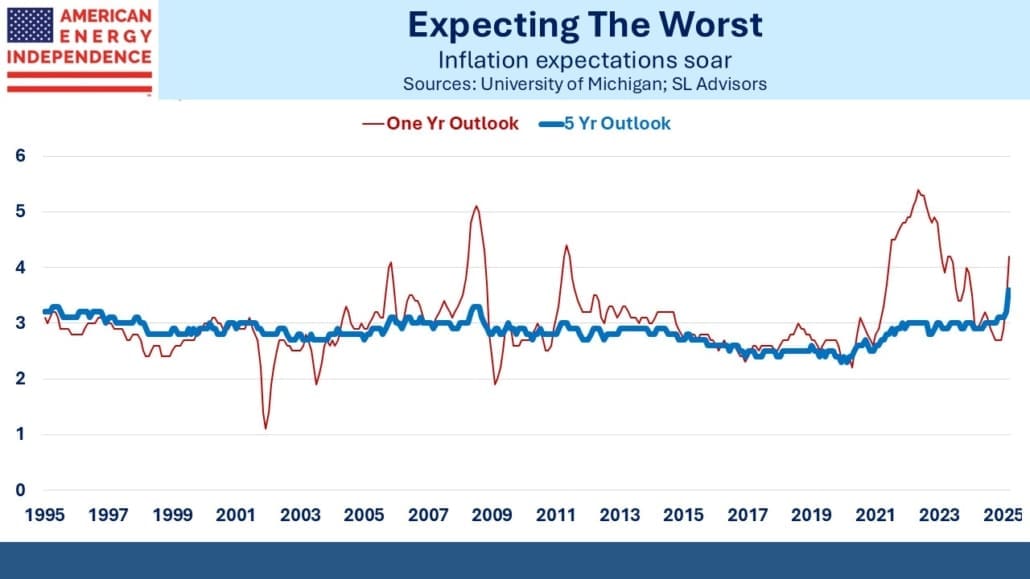
The University of Michigan consumer survey revealed a startling jump in inflation expectations last month (see Stagflation). A quarter of respondents think five-year inflation will exceed 10%. The average is 4.1%, the highest it’s been in over thirty years. That’s not good for those expecting the Fed to pursue multiple rate cuts this year.
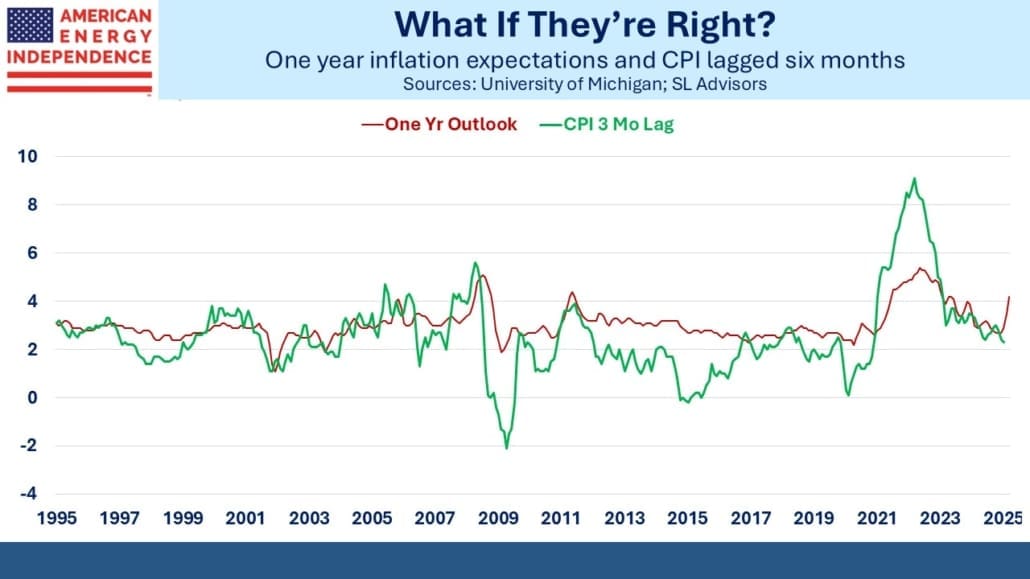
It turns out that the survey’s a good predictor. The one-year outlook and annual inflation three months later have a correlation of 0.7. It may be somewhat self-fulfilling in that consumers behave consistent with their expectations. As the chart shows, they track each other closely and actual inflation reliably follows the forecast.
Given his background in real estate and penchant for debt-financed tax cuts, Trump is unlikely to be too concerned about higher inflation. Your blogger’s investments are arranged accordingly.
For owners of pipelines, inflation isn’t the scourge that it is for most investors. Companies generally have pricing power because of limited alternatives, with the regulations designed to curb excesses while assuring an adequate return on invested capital.
In 2022 the ceiling on fee hikes for liquids pipelines was 13.3%, which supported subsequent earnings growth. The Bureau of Labor Statistics began publishing a natural gas pipeline transportation index three years ago. It’s volatile. The most recent year-on-year increase was 4.2%.
Forecasts of peak oil production from shale have weighed on midstream recently. But the outlook for natural gas production remains strong. Morgan Stanley reports that Enterprise Products Partners expects 1.5 Billion Cubic Feet per day (BCF/D) of additional associated gas from the Permian over the next two years. Targa Resources expect 0.8-1.2 BCF/D over the next one year.
In spite of this, Morgan Stanley’s E&P team thinks the domestic market will be short 3 BCF/D next year because of growing Liquefied Natural Gas (LNG) demand. The Golden Pass LNG export terminal owned by Qatar and Exxon Mobil is expected to begin production late this year or early 2026. It has a capacity of 2.4 BCF/D.
Although we often remind investors that pipelines are generally not that exposed to commodity prices, unmet demand for natural gas is unlikely to be an adverse scenario.
Taiwan closed down their last nuclear reactor recently and is seeking imports of LNG as a replacement. Following the Fukushima disaster in 2011, public concern about nuclear energy increased. Unfortunately, this has left the country almost completely dependent on imported hydrocarbons. In 2023 Taiwan relied on gas and coal for 80% of its electricity. Solar and wind were 8%.
Progressives must regard this as a policy win. They are best described by an Oscar Wilde quote: “Some cause happiness wherever they go; others, whenever they go.”
More accurate is to quote JPMorgan’s Mike Cambalest who wrote in March:
“What was Taiwan thinking by shutting down nuclear power which has fallen from 50% to 5% of generation? Taiwan is now one of the most energy dependent countries in the world, resulting in rising economic costs if China were to impose a blockade.”
Inflation and more natural gas demand are a good combination for midstream.
We have two have funds that seek to profit from this environment:

Important Disclosures
The information provided is for informational purposes only and investors should determine for themselves whether a particular service, security or product is suitable for their investment needs. The information contained herein is not complete, may not be current, is subject to change, and is subject to, and qualified in its entirety by, the more complete disclosures, risk factors and other terms that are contained in the disclosure, prospectus, and offering. Certain information herein has been obtained from third party sources and, although believed to be reliable, has not been independently verified and its accuracy or completeness cannot be guaranteed. No representation is made with respect to the accuracy, completeness or timeliness of this information. Nothing provided on this site constitutes tax advice. Individuals should seek the advice of their own tax advisor for specific information regarding tax consequences of investments. Investments in securities entail risk and are not suitable for all investors. This site is not a recommendation nor an offer to sell (or solicitation of an offer to buy) securities in the United States or in any other jurisdiction.
References to indexes and benchmarks are hypothetical illustrations of aggregate returns and do not reflect the performance of any actual investment. Investors cannot invest in an index and do not reflect the deduction of the advisor’s fees or other trading expenses. There can be no assurance that current investments will be profitable. Actual realized returns will depend on, among other factors, the value of assets and market conditions at the time of disposition, any related transaction costs, and the timing of the purchase. Indexes and benchmarks may not directly correlate or only partially relate to portfolios managed by SL Advisors as they have different underlying investments and may use different strategies or have different objectives than portfolios managed by SL Advisors (e.g. The Alerian index is a group MLP securities in the oil and gas industries. Portfolios may not include the same investments that are included in the Alerian Index. The S & P Index does not directly relate to investment strategies managed by SL Advisers.)
This site may contain forward-looking statements relating to the objectives, opportunities, and the future performance of the U.S. market generally. Forward-looking statements may be identified by the use of such words as; “believe,” “expect,” “anticipate,” “should,” “planned,” “estimated,” “potential” and other similar terms. Examples of forward-looking statements include, but are not limited to, estimates with respect to financial condition, results of operations, and success or lack of success of any particular investment strategy. All are subject to various factors, including, but not limited to general and local economic conditions, changing levels of competition within certain industries and markets, changes in interest rates, changes in legislation or regulation, and other economic, competitive, governmental, regulatory and technological factors affecting a portfolio’s operations that could cause actual results to differ materially from projected results. Such statements are forward-looking in nature and involves a number of known and unknown risks, uncertainties and other factors, and accordingly, actual results may differ materially from those reflected or contemplated in such forward-looking statements. Prospective investors are cautioned not to place undue reliance on any forward-looking statements or examples. None of SL Advisors LLC or any of its affiliates or principals nor any other individual or entity assumes any obligation to update any forward-looking statements as a result of new information, subsequent events or any other circumstances. All statements made herein speak only as of the date that they were made. r
Certain hyperlinks or referenced websites on the Site, if any, are for your convenience and forward you to third parties’ websites, which generally are recognized by their top level domain name. Any descriptions of, references to, or links to other products, publications or services does not constitute an endorsement, authorization, sponsorship by or affiliation with SL Advisors LLC with respect to any linked site or its sponsor, unless expressly stated by SL Advisors LLC. Any such information, products or sites have not necessarily been reviewed by SL Advisors LLC and are provided or maintained by third parties over whom SL Advisors LLC exercise no control. SL Advisors LLC expressly disclaim any responsibility for the content, the accuracy of the information, and/or quality of products or services provided by or advertised on these third-party sites.
All investment strategies have the potential for profit or loss. Different types of investments involve varying degrees of risk, and there can be no assurance that any specific investment will be suitable or profitable for a client’s investment portfolio.
Past performance of the American Energy Independence Index is not indicative of future returns.
Leave a Reply
Want to join the discussion?Feel free to contribute!