
The World’s Growing Gas Appetite


/
One of Joe Biden’s more destructive acts as president was the pause his administration imposed on new LNG export facilities. It impacted NextDecade (NEXT), but when Donald Trump came into office one of his first executive actions was to lift the pause. This enabled NEXT to get on with construction of its Rio Grande LNG export terminal in Brownsville, TX.
The color of the party in power has had little impact on returns to midstream investors. But it can affect the regulatory environment. After the shellacking the Republicans just received in the midterms, it’d be understandable if energy investors started contemplating a Democrat in the White House in two years.
Fears of an LNG export glut have receded this year, with Qatar’s inability to supply customers. Poland’s Orlen recently canceled a contract because of the continued force majeure. The US is increasingly valued as a reliable supplier whose shipments aren’t vulnerable to Iranian drones or missiles.
The fears of LNG oversupply always seemed at odds with the demand side. Liquefaction is the process that chills natural gas to around 1/600th of its volume so it can be loaded on an LNG tanker. At the other end, regassification converts the LNG back into usable gas. Much attention is focused on the growth in liquefaction capacity, but regassification is growing too.
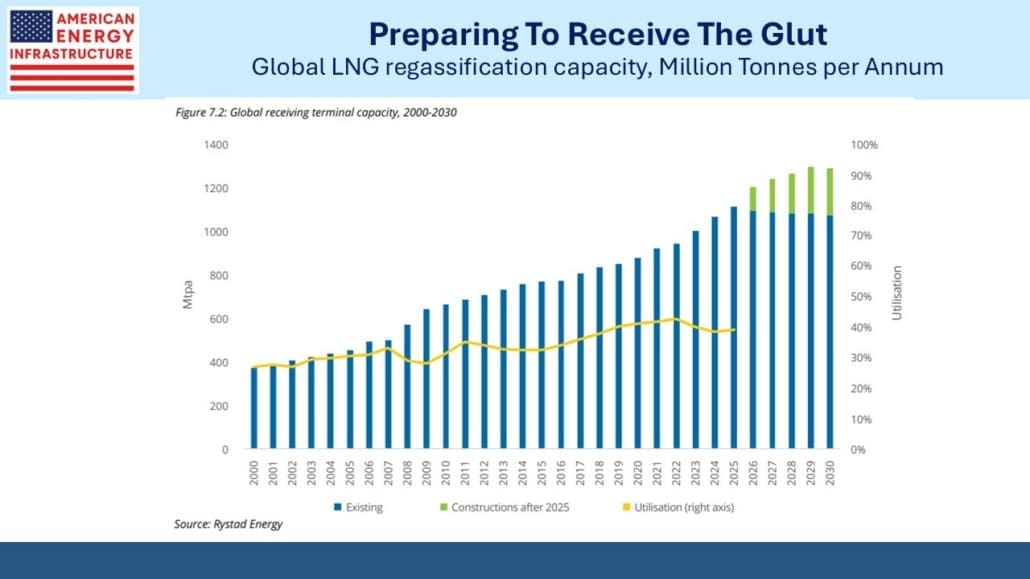
The International Gas Union 2026 World Report counts 1,113.5 Million Tonnes per Annum (MTPA) of regassification capacity, more than 2X the liquefaction capacity of 524.5 MTPA. 63 MTPA of receiving capacity was added last year. Consequently, receiving terminals operate at under 50% utilization.
It takes roughly the same amount of time to load as to unload an LNG tanker, so you might suppose global capacity of each would be in rough alignment.
Because of this, it might make more sense to worry about a supply shortage given the infrastructure already assembled in place by the importers.
At the end of last year over 800 vessels were available to move LNG around the globe. Half of these are less than a decade old, reflecting the recent strong growth of the industry. They made 6,870 trips in 2025. Another 107 LNG vessels were scheduled to be delivered this year. Construction takes around three years.
Climate change has slipped down the list of voters’ concerns, but it’s also one of the areas of biggest disagreement between the two parties. Over the next two years we’ll likely see US LNG exporters lock down permits and other authorizations in case a new administration shifts policy.
Midstream investors should draw some comfort from a recent story in Politico (see Trump’s plan to get the world hooked on US energy). The US is backing projects in Europe and Asia to increase their ability to import US LNG. These include gas pipelines in the Baltics, from the Aegean Sea through the Balkans and adding capacity in southern Italy. There’s also planned capacity additions to the Son My LNG Terminal in Vietnam to accommodate increased imports.
US backing is chiefly through loan guarantees. Especially in Asia, many potential buyers are non-investment grade. US LNG exporters prefer buyers with a strong credit rating because of the long-term nature of the Supply Purchase Agreements (SPAs) they sign.
Once built, these import facilities will have useful lives measured in decades. As is often the case, climate extremists focus their efforts on impeding the hydrocarbons they dislike. They fear that installed infrastructure will support years of use while investors earn back a return on their capital. This discredits the claims made by the same crowd that renewables are the cheapest form of power generation.
I recently listened to a Politico Energy podcast interview with Lena Moffitt of the Evergreen Foundation. Climate extremists have been quiet recently but listening to Ms Moffitt excitedly discuss all the dystopian plans her group has to control our lives following the midterms was a useful reminder of the damage her type can cause if unleashed. Even the solidly left Politico host Zach Colman seemed moderate by comparison.
Opinions on climate change are evolving to reflect the desire of developing countries to raise living standards and the vital role hydrocarbons will play in this. The COP31 climate change conference in Turkey has dropped any reference to phasing out hydrocarbons, breaking with past practice. OPEC is understandably opposed, and many poor countries prioritize affordable energy as they should. While renewables can play a role in this, nobody is seriously contemplating a future without natural gas.
The US is well positioned to help.
We have two funds that seek to profit from this environment:

Important Disclosures
The information provided is for informational purposes only and investors should determine for themselves whether a particular service, security or product is suitable for their investment needs. The information contained herein is not complete, may not be current, is subject to change, and is subject to, and qualified in its entirety by, the more complete disclosures, risk factors and other terms that are contained in the disclosure, prospectus, and offering. Certain information herein has been obtained from third party sources and, although believed to be reliable, has not been independently verified and its accuracy or completeness cannot be guaranteed. No representation is made with respect to the accuracy, completeness or timeliness of this information. Nothing provided on this site constitutes tax advice. Individuals should seek the advice of their own tax advisor for specific information regarding tax consequences of investments. Investments in securities entail risk and are not suitable for all investors. This site is not a recommendation nor an offer to sell (or solicitation of an offer to buy) securities in the United States or in any other jurisdiction.
References to indexes and benchmarks are hypothetical illustrations of aggregate returns and do not reflect the performance of any actual investment. Investors cannot invest in an index and do not reflect the deduction of the advisor’s fees or other trading expenses. There can be no assurance that current investments will be profitable. Actual realized returns will depend on, among other factors, the value of assets and market conditions at the time of disposition, any related transaction costs, and the timing of the purchase. Indexes and benchmarks may not directly correlate or only partially relate to portfolios managed by SL Advisors as they have different underlying investments and may use different strategies or have different objectives than portfolios managed by SL Advisors (e.g. The Alerian index is a group MLP securities in the oil and gas industries. Portfolios may not include the same investments that are included in the Alerian Index. The S & P Index does not directly relate to investment strategies managed by SL Advisers.)
This site may contain forward-looking statements relating to the objectives, opportunities, and the future performance of the U.S. market generally. Forward-looking statements may be identified by the use of such words as; “believe,” “expect,” “anticipate,” “should,” “planned,” “estimated,” “potential” and other similar terms. Examples of forward-looking statements include, but are not limited to, estimates with respect to financial condition, results of operations, and success or lack of success of any particular investment strategy. All are subject to various factors, including, but not limited to general and local economic conditions, changing levels of competition within certain industries and markets, changes in interest rates, changes in legislation or regulation, and other economic, competitive, governmental, regulatory and technological factors affecting a portfolio’s operations that could cause actual results to differ materially from projected results. Such statements are forward-looking in nature and involves a number of known and unknown risks, uncertainties and other factors, and accordingly, actual results may differ materially from those reflected or contemplated in such forward-looking statements. Prospective investors are cautioned not to place undue reliance on any forward-looking statements or examples. None of SL Advisors LLC or any of its affiliates or principals nor any other individual or entity assumes any obligation to update any forward-looking statements as a result of new information, subsequent events or any other circumstances. All statements made herein speak only as of the date that they were made. r
Certain hyperlinks or referenced websites on the Site, if any, are for your convenience and forward you to third parties’ websites, which generally are recognized by their top level domain name. Any descriptions of, references to, or links to other products, publications or services does not constitute an endorsement, authorization, sponsorship by or affiliation with SL Advisors LLC with respect to any linked site or its sponsor, unless expressly stated by SL Advisors LLC. Any such information, products or sites have not necessarily been reviewed by SL Advisors LLC and are provided or maintained by third parties over whom SL Advisors LLC exercise no control. SL Advisors LLC expressly disclaim any responsibility for the content, the accuracy of the information, and/or quality of products or services provided by or advertised on these third-party sites.
All investment strategies have the potential for profit or loss. Different types of investments involve varying degrees of risk, and there can be no assurance that any specific investment will be suitable or profitable for a client’s investment portfolio.
Past performance of the American Energy Independence Index is not indicative of future returns.
Leave a Reply
Want to join the discussion?Feel free to contribute!