The World’s Growing Gas Appetite
One of Joe Biden’s more destructive acts as president was the pause his administration imposed on new LNG export facilities. It impacted NextDecade (NEXT), but when Donald Trump came into office one of his first executive actions was to lift the pause. This enabled NEXT to get on with construction of its Rio Grande LNG export terminal in Brownsville, TX.
The color of the party in power has had little impact on returns to midstream investors. But it can affect the regulatory environment. After the shellacking the Republicans just received in the midterms, it’d be understandable if energy investors started contemplating a Democrat in the White House in two years.
Fears of an LNG export glut have receded this year, with Qatar’s inability to supply customers. Poland’s Orlen recently canceled a contract because of the continued force majeure. The US is increasingly valued as a reliable supplier whose shipments aren’t vulnerable to Iranian drones or missiles.
The fears of LNG oversupply always seemed at odds with the demand side. Liquefaction is the process that chills natural gas to around 1/600th of its volume so it can be loaded on an LNG tanker. At the other end, regassification converts the LNG back into usable gas. Much attention is focused on the growth in liquefaction capacity, but regassification is growing too.
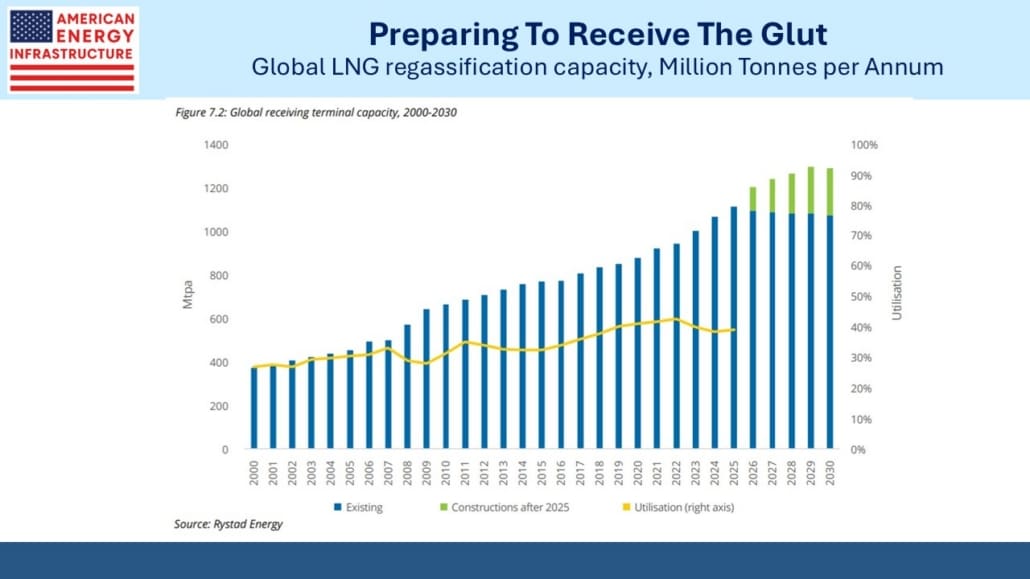
The International Gas Union 2026 World Report counts 1,113.5 Million Tonnes per Annum (MTPA) of regassification capacity, more than 2X the liquefaction capacity of 524.5 MTPA. 63 MTPA of receiving capacity was added last year. Consequently, receiving terminals operate at under 50% utilization.
It takes roughly the same amount of time to load as to unload an LNG tanker, so you might suppose global capacity of each would be in rough alignment.
Because of this, it might make more sense to worry about a supply shortage given the infrastructure already assembled in place by the importers.
At the end of last year over 800 vessels were available to move LNG around the globe. Half of these are less than a decade old, reflecting the recent strong growth of the industry. They made 6,870 trips in 2025. Another 107 LNG vessels were scheduled to be delivered this year. Construction takes around three years.
Climate change has slipped down the list of voters’ concerns, but it’s also one of the areas of biggest disagreement between the two parties. Over the next two years we’ll likely see US LNG exporters lock down permits and other authorizations in case a new administration shifts policy.
Midstream investors should draw some comfort from a recent story in Politico (see Trump’s plan to get the world hooked on US energy). The US is backing projects in Europe and Asia to increase their ability to import US LNG. These include gas pipelines in the Baltics, from the Aegean Sea through the Balkans and adding capacity in southern Italy. There’s also planned capacity additions to the Son My LNG Terminal in Vietnam to accommodate increased imports.
US backing is chiefly through loan guarantees. Especially in Asia, many potential buyers are non-investment grade. US LNG exporters prefer buyers with a strong credit rating because of the long-term nature of the Supply Purchase Agreements (SPAs) they sign.
Once built, these import facilities will have useful lives measured in decades. As is often the case, climate extremists focus their efforts on impeding the hydrocarbons they dislike. They fear that installed infrastructure will support years of use while investors earn back a return on their capital. This discredits the claims made by the same crowd that renewables are the cheapest form of power generation.
I recently listened to a Politico Energy podcast interview with Lena Moffitt of the Evergreen Foundation. Climate extremists have been quiet recently but listening to Ms Moffitt excitedly discuss all the dystopian plans her group has to control our lives following the midterms was a useful reminder of the damage her type can cause if unleashed. Even the solidly left Politico host Zach Colman seemed moderate by comparison.
Opinions on climate change are evolving to reflect the desire of developing countries to raise living standards and the vital role hydrocarbons will play in this. The COP31 climate change conference in Turkey has dropped any reference to phasing out hydrocarbons, breaking with past practice. OPEC is understandably opposed, and many poor countries prioritize affordable energy as they should. While renewables can play a role in this, nobody is seriously contemplating a future without natural gas.
The US is well positioned to help.
We have two funds that seek to profit from this environment: