
The Long Term Bullish LNG Story


/
The negative correlation between energy and the stock market that we highlighted last Sunday (see AI Moves The Energy Sector) continued last week, unsurprisingly given the news. We had thought global natural gas markets were more vulnerable than crude oil to conflict, and this turned out to be true.
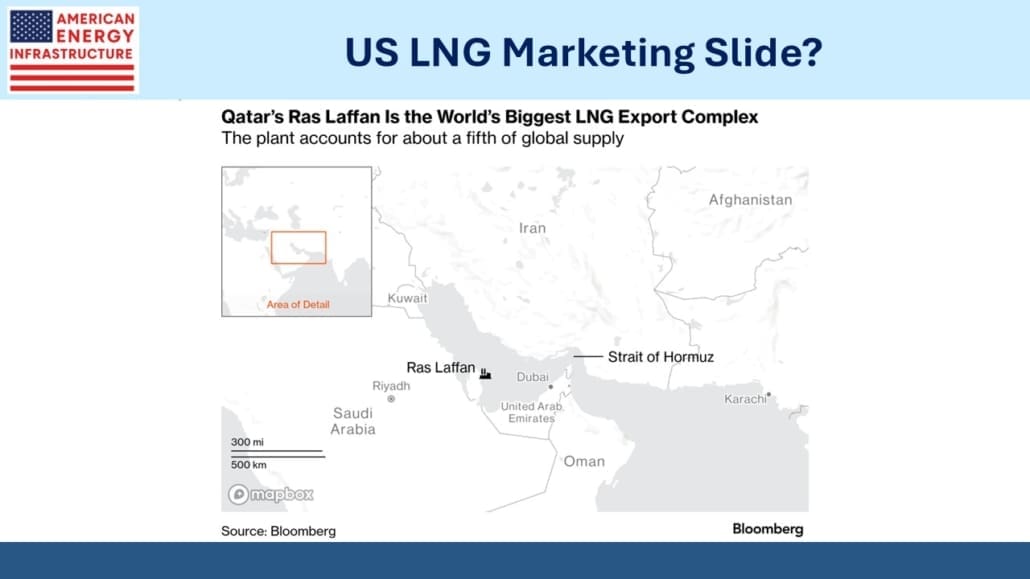
Qatar represents only 20% of global LNG trade and less than 3% of global gas consumption. So the closure on Monday of the Ras Lafan export complex, the world’s biggest LNG export facility, following an Iranian drone attack might have struck some as having only a minor impact on global supply.
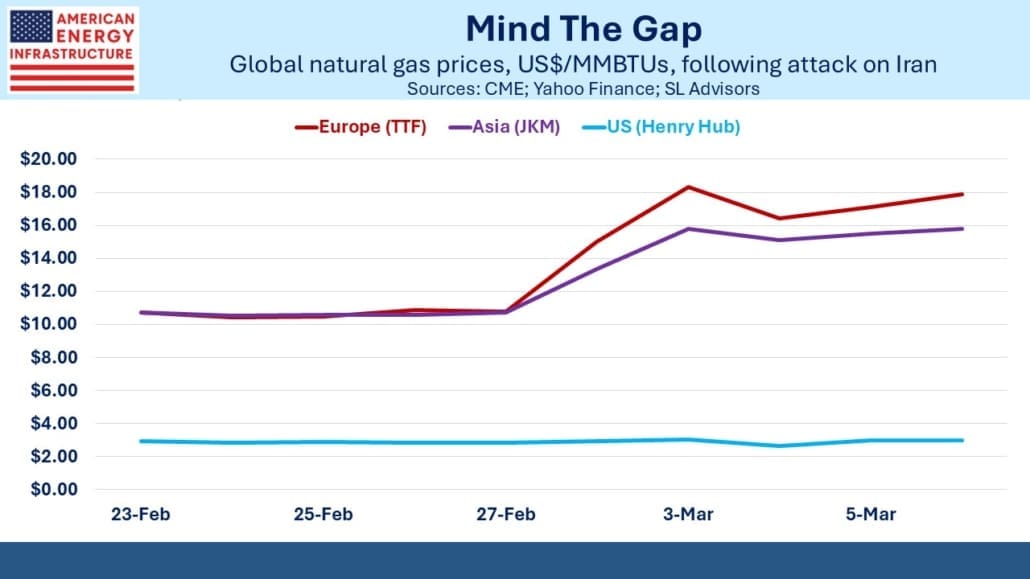
Nonetheless, by Tuesday the Asian JKM benchmark had jumped 47%. The European TTF doubled before slipping to close +58% for the week. The US Henry Hub benchmark rose 2%, reflecting that there was limited extra gas that could quickly move from North America.
Our liquefaction capacity is around 15-17 Billion Cubic Feet per Day (NCF/D). It’s rising and will likely reach 30 BCF/D by 2030, but it’s not a spigot.
Russia has helpfully suggested it might cut pipeline gas supplies to Europe, home of the world’s dumbest energy policies. Its Europe-bound LNG tankers appear to be rerouting around southern Africa and avoiding the Suez Canal after a tanker was sunk in the Mediterranean. Russia blamed a Ukrainian maritime drone.
The spike in global LNG prices shows that even though Qatar supplies a small portion of total demand, replacing it isn’t easy. It’s expected to be several weeks before liquefaction restarts at Qatar’s Ras Lafan.
Most US liquefaction capacity is contracted out, but Venture Global (VG) retains more spot market risk than most, and investors quickly priced in a windfall gain for the company in selling that spare capacity at high prices.
Iran’s missile capability is already being neutralized. But drones are a different matter, offering an asymmetric means of combat as we’ve seen in Ukraine over the past four years. Drones are cheap and can be launched from a small area. While militarily they don’t represent much of a threat to US forces, Iran could deploy them in a form of guerilla warfare from near the Persian Gulf.
Identifying and destroying the drone manufacturing and storage facilities in Iran will be challenging. We think investors may be underestimating how long it will take for shipping to return to the Persian Gulf. Commercial maritime insurance rates rose from 0.25% of the value of a ship to 3%, a 12X increase.
Charter rates for Very Large Crude Carriers have more than doubled. Energy supplies from the region may be impeded for some time.
If a sustained period of high oil prices causes a big drop in the market – say, 10% or more – that will likely lead to a truce, since the White House uses the S&P500 as a report card more than past administrations.
VG and Cheniere both rallied on the expectation of profiting from the near term price spike in natural gas. But there’s a long-run bullish story here too. The force majeure declared by Qatar on its LNG exports highlights that it’s in a dangerous neighborhood. LNG contracts are 10-20 years. You can imagine VG adding a map of the Persian Gulf to its marketing materials. How sure can an Asian buyer be that Qatar’s supplies over two decades will be unimpeded by regional conflict? No similar risk exists for US shipments.
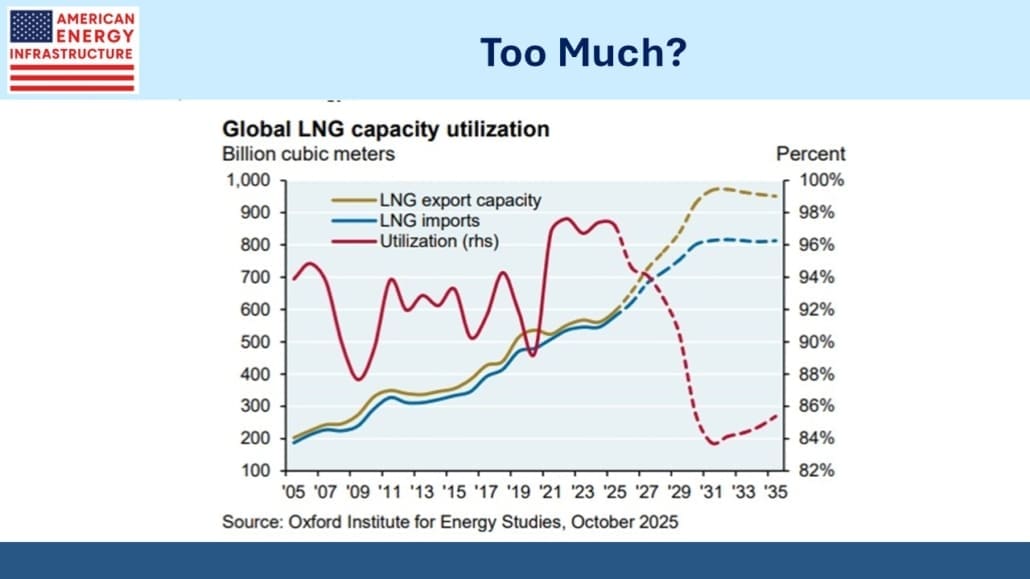
JPMorgan published their 16th Annual Energy Paper last week. Mike Cembalest, Chairman of Market and Investment Strategy for JP Morgan Asset Management, does fantastic work and his latest piece is no exception. Cembalest casts a wide net and does note the looming overcapacity in the LNG market. This is a common concern of investors. Energy Transfer halted their Lake Charles LNG project in part because of this, although rising construction costs were also a concern.
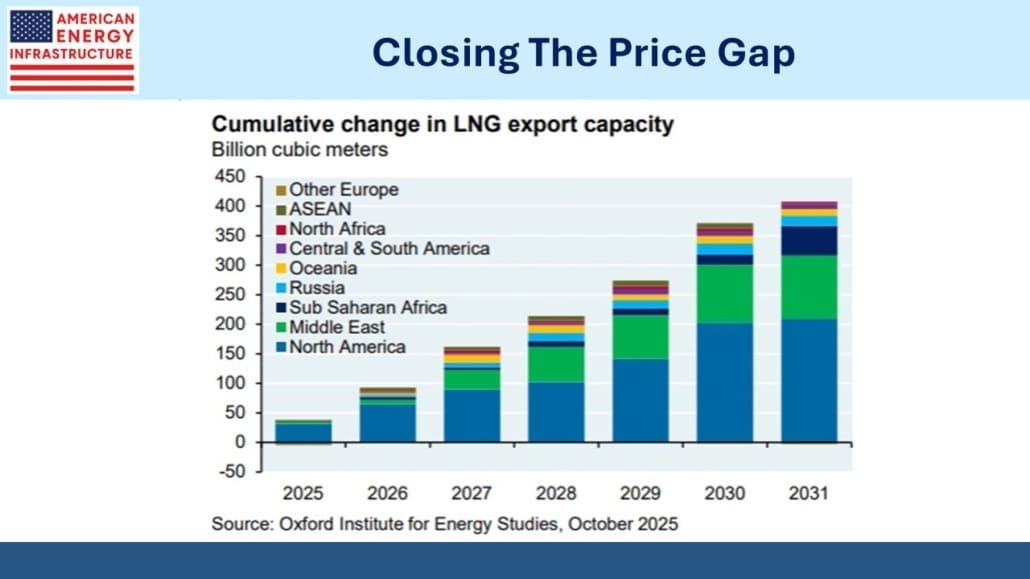
Regassification capacity (i.e. imports) is growing too, although the chart shows liquefaction (export capacity) growing faster over the next few years. US exporters such as VG and Cheniere contract out capacity via Sale/Purchase Agreements (SPAs) for 10-20 years, so if LNG prices do fall due to oversupply, the SPA counterparties are the ones with exposure. Just last week Trafigura signed a five year deal with VG. The loss of Qatar’s LNG shipments is an additional long term benefit to US and Australian exporters.
We think the over-capacity fear is overdone.
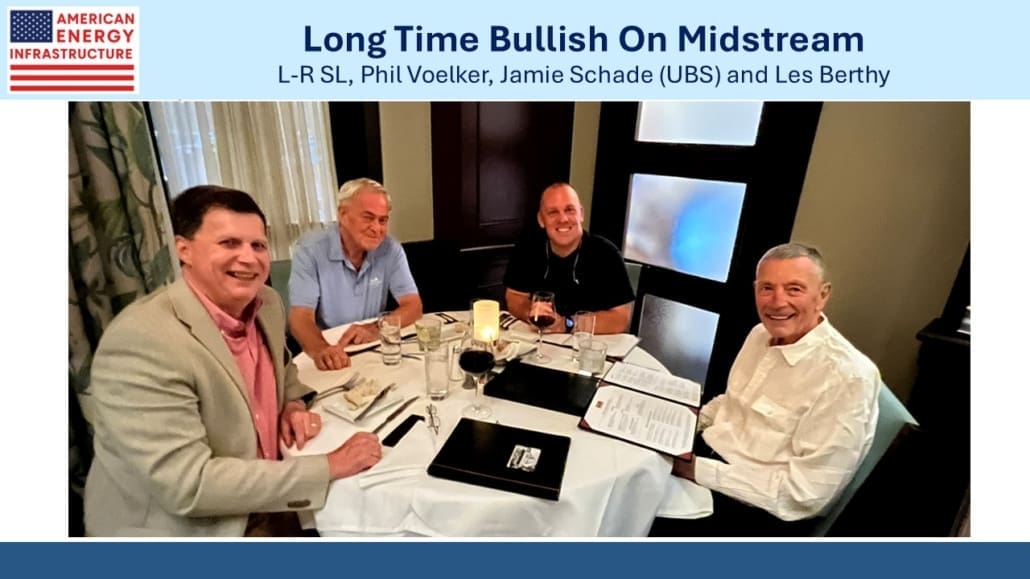
Naples, FL draws a lot of visitors this time of year. It was my good fortune to have dinner recently with Jamie Schade from Miamisburg, OH, along with his good friends Phil Voelker and Les Berthy. A fascinating conversation covered the outlook for energy markets and LNG but also allowed time for market anecdotes since we’re all in finance.
Jamie has been a long-time investor in midstream, including for one client who has a cost basis around a seventh of current levels (he invested during the pandemic in 2020). Jamie’s clients have been well served by his sustained interest in, and exposure to, the sector.
We have two have funds that seek to profit from this environment:

Important Disclosures
The information provided is for informational purposes only and investors should determine for themselves whether a particular service, security or product is suitable for their investment needs. The information contained herein is not complete, may not be current, is subject to change, and is subject to, and qualified in its entirety by, the more complete disclosures, risk factors and other terms that are contained in the disclosure, prospectus, and offering. Certain information herein has been obtained from third party sources and, although believed to be reliable, has not been independently verified and its accuracy or completeness cannot be guaranteed. No representation is made with respect to the accuracy, completeness or timeliness of this information. Nothing provided on this site constitutes tax advice. Individuals should seek the advice of their own tax advisor for specific information regarding tax consequences of investments. Investments in securities entail risk and are not suitable for all investors. This site is not a recommendation nor an offer to sell (or solicitation of an offer to buy) securities in the United States or in any other jurisdiction.
References to indexes and benchmarks are hypothetical illustrations of aggregate returns and do not reflect the performance of any actual investment. Investors cannot invest in an index and do not reflect the deduction of the advisor’s fees or other trading expenses. There can be no assurance that current investments will be profitable. Actual realized returns will depend on, among other factors, the value of assets and market conditions at the time of disposition, any related transaction costs, and the timing of the purchase. Indexes and benchmarks may not directly correlate or only partially relate to portfolios managed by SL Advisors as they have different underlying investments and may use different strategies or have different objectives than portfolios managed by SL Advisors (e.g. The Alerian index is a group MLP securities in the oil and gas industries. Portfolios may not include the same investments that are included in the Alerian Index. The S & P Index does not directly relate to investment strategies managed by SL Advisers.)
This site may contain forward-looking statements relating to the objectives, opportunities, and the future performance of the U.S. market generally. Forward-looking statements may be identified by the use of such words as; “believe,” “expect,” “anticipate,” “should,” “planned,” “estimated,” “potential” and other similar terms. Examples of forward-looking statements include, but are not limited to, estimates with respect to financial condition, results of operations, and success or lack of success of any particular investment strategy. All are subject to various factors, including, but not limited to general and local economic conditions, changing levels of competition within certain industries and markets, changes in interest rates, changes in legislation or regulation, and other economic, competitive, governmental, regulatory and technological factors affecting a portfolio’s operations that could cause actual results to differ materially from projected results. Such statements are forward-looking in nature and involves a number of known and unknown risks, uncertainties and other factors, and accordingly, actual results may differ materially from those reflected or contemplated in such forward-looking statements. Prospective investors are cautioned not to place undue reliance on any forward-looking statements or examples. None of SL Advisors LLC or any of its affiliates or principals nor any other individual or entity assumes any obligation to update any forward-looking statements as a result of new information, subsequent events or any other circumstances. All statements made herein speak only as of the date that they were made. r
Certain hyperlinks or referenced websites on the Site, if any, are for your convenience and forward you to third parties’ websites, which generally are recognized by their top level domain name. Any descriptions of, references to, or links to other products, publications or services does not constitute an endorsement, authorization, sponsorship by or affiliation with SL Advisors LLC with respect to any linked site or its sponsor, unless expressly stated by SL Advisors LLC. Any such information, products or sites have not necessarily been reviewed by SL Advisors LLC and are provided or maintained by third parties over whom SL Advisors LLC exercise no control. SL Advisors LLC expressly disclaim any responsibility for the content, the accuracy of the information, and/or quality of products or services provided by or advertised on these third-party sites.
All investment strategies have the potential for profit or loss. Different types of investments involve varying degrees of risk, and there can be no assurance that any specific investment will be suitable or profitable for a client’s investment portfolio.
Past performance of the American Energy Independence Index is not indicative of future returns.
Leave a Reply
Want to join the discussion?Feel free to contribute!