
AI Moves The Energy Sector


/
Forty years ago, when I was trading eurodollar interest rate futures, it was routine to respond to a sudden unexplained move in the market by calling the floor of the CME and talking to our broker. Caught up in the excitement of the loud heaving mass of brokers and locals in the pit*, he would breathlessly explain that, “Refco came in to sell 10,000 and Goldman followed with 15 after that. Cargill pulled their bid and it was all offered.”
This nugget of market intelligence was somehow intended to help guide me as I managed our interest rate risk. The broker was telling me what happened but had no idea why. This market color was almost completely useless, but somehow the broker and I felt that we were better off sharing the information.
Sometimes it feels like that when explaining moves in the energy sector. Prices fluctuate, and often out of all proportion to developments. There can be days with little news of importance, and yet pipeline stocks react as if there was.
Last week was one of those times. We recently highlighted the low correlation between energy and the overall market (see Midstream Dances To A Different Tune). There’s a great AI story for midstream since data centers will rely principally on natural gas to generate power. But it’s still a value sector, and the emotional turbulence of growth investors remains dominant.
The low correlation between energy and the market means their daily moves are less in sync. February showed this dramatically: midstream and the S&P500 moved in the same direction on fewer than half the days of the month. In other words, a bad AI day was more likely than not a good day for midstream.
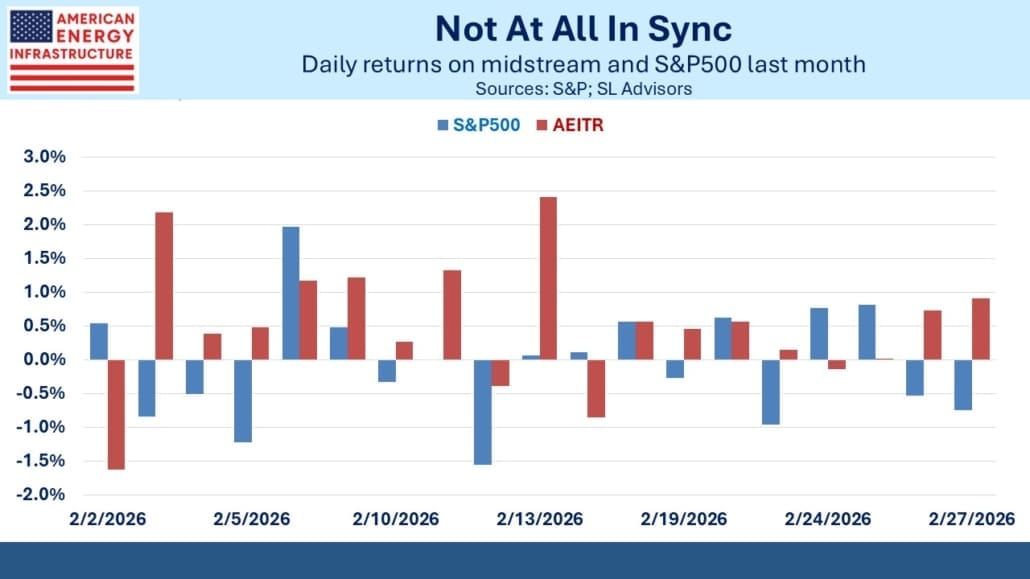
Over the past decade, changes in the American Energy Infrastructure Index (AEITR) have matched the market’s daily direction over two thirds of the time. Last month it was only 37%, 7 out of 19 trading days. It’s as if when AI stocks are down traders rush for the security of midstream with its stable cash flows. When AI stocks are up they dump these slow moving cash machines. I doubt such manic behavior is very satisfying or profitable.
The driver of returns in energy lies outside the sector.
Midstream wasn’t completely the marionette to the AI puppeteer. Cheniere reported strong earnings, repurchasing $1BN in stock during 4Q25, more than expected, making it $2.7BN for the year. They also announced authorization for $10BN more in repurchases through 2030.
Cheniere expects Asian LNG demand to grow at 12-15% through 2030, which would take it from 270 Million Metric Tonnes (MMTs) to 400. Global LNG trade last year was around 430 MMTs.
Nonetheless, we think Cheniere’s buyback program suggests their capex plans may slow somewhat, a development welcomed by investors concerned about excess capacity among LNG exporters in the years ahead. Cheniere rose over 5% on Thursday following their earnings release and conference call.
Kinetik (KNTK) is an acquisition target of Western Gas (WES), and the interest has prompted KNTK to explore a sale process, inviting other companies to make proposals. The stock has rallied 14% since the news of WES’ interest first broke.
The American Energy Infrastructure Index (AEITR) is +20% YTD and the S&P500 is flat, approximately reversing last year’s relative performance (+2% and +18% respectively).
Regular readers know we often refer to the American Energy Independence Index. We started publishing it in 2017 because we recognized that the market was missing a truly representative index for midstream energy infrastructure, one that wasn’t dominated by Master Limited Partnerships (MLPs) but also didn’t omit them entirely.
The AI revolution is boosting the demand for natural gas to generate power, benefiting those midstream companies that focus on gas. America’s shale revolution is also creating more opportunities to export Liquefied Natural Gas (LNG). The large price difference between the US and overseas markets is driving a substantial increase in US liquefaction capacity to meet foreign demand.
These two trends are more beneficial to midstream gas companies than those focused on oil, and investors are recognizing the opportunity to benefit from these twin growth stories. Therefore, we have modified the AEITR to become the American Energy Infrastructure Index, with an overweight towards names that we believe will benefit from increased gas consumption for power and LNG exports. The ETF that seeks to track this index will similarly rebalance at the end of the first quarter.
We are long term bulls on US natural gas consumption. Our index and our investments are aligned with this outlook.
*for those too young to remember, the Chicago futures exchanges were once cavernous rooms with several “pits”, consisting of ledges arranged in an octagon that descended in steps towards the center. Brokers were arranged around the periphery where they could easily see and communicate with their colleagues on the phone with clients, and locals (independent market makers) were within although the best spots were near the brokers executing the biggest volume. In this tightly packed environment, physical heft offered a commercial advantage. It’s now all computerized and impersonal.
We have two have funds that seek to profit from this environment:

Important Disclosures
The information provided is for informational purposes only and investors should determine for themselves whether a particular service, security or product is suitable for their investment needs. The information contained herein is not complete, may not be current, is subject to change, and is subject to, and qualified in its entirety by, the more complete disclosures, risk factors and other terms that are contained in the disclosure, prospectus, and offering. Certain information herein has been obtained from third party sources and, although believed to be reliable, has not been independently verified and its accuracy or completeness cannot be guaranteed. No representation is made with respect to the accuracy, completeness or timeliness of this information. Nothing provided on this site constitutes tax advice. Individuals should seek the advice of their own tax advisor for specific information regarding tax consequences of investments. Investments in securities entail risk and are not suitable for all investors. This site is not a recommendation nor an offer to sell (or solicitation of an offer to buy) securities in the United States or in any other jurisdiction.
References to indexes and benchmarks are hypothetical illustrations of aggregate returns and do not reflect the performance of any actual investment. Investors cannot invest in an index and do not reflect the deduction of the advisor’s fees or other trading expenses. There can be no assurance that current investments will be profitable. Actual realized returns will depend on, among other factors, the value of assets and market conditions at the time of disposition, any related transaction costs, and the timing of the purchase. Indexes and benchmarks may not directly correlate or only partially relate to portfolios managed by SL Advisors as they have different underlying investments and may use different strategies or have different objectives than portfolios managed by SL Advisors (e.g. The Alerian index is a group MLP securities in the oil and gas industries. Portfolios may not include the same investments that are included in the Alerian Index. The S & P Index does not directly relate to investment strategies managed by SL Advisers.)
This site may contain forward-looking statements relating to the objectives, opportunities, and the future performance of the U.S. market generally. Forward-looking statements may be identified by the use of such words as; “believe,” “expect,” “anticipate,” “should,” “planned,” “estimated,” “potential” and other similar terms. Examples of forward-looking statements include, but are not limited to, estimates with respect to financial condition, results of operations, and success or lack of success of any particular investment strategy. All are subject to various factors, including, but not limited to general and local economic conditions, changing levels of competition within certain industries and markets, changes in interest rates, changes in legislation or regulation, and other economic, competitive, governmental, regulatory and technological factors affecting a portfolio’s operations that could cause actual results to differ materially from projected results. Such statements are forward-looking in nature and involves a number of known and unknown risks, uncertainties and other factors, and accordingly, actual results may differ materially from those reflected or contemplated in such forward-looking statements. Prospective investors are cautioned not to place undue reliance on any forward-looking statements or examples. None of SL Advisors LLC or any of its affiliates or principals nor any other individual or entity assumes any obligation to update any forward-looking statements as a result of new information, subsequent events or any other circumstances. All statements made herein speak only as of the date that they were made. r
Certain hyperlinks or referenced websites on the Site, if any, are for your convenience and forward you to third parties’ websites, which generally are recognized by their top level domain name. Any descriptions of, references to, or links to other products, publications or services does not constitute an endorsement, authorization, sponsorship by or affiliation with SL Advisors LLC with respect to any linked site or its sponsor, unless expressly stated by SL Advisors LLC. Any such information, products or sites have not necessarily been reviewed by SL Advisors LLC and are provided or maintained by third parties over whom SL Advisors LLC exercise no control. SL Advisors LLC expressly disclaim any responsibility for the content, the accuracy of the information, and/or quality of products or services provided by or advertised on these third-party sites.
All investment strategies have the potential for profit or loss. Different types of investments involve varying degrees of risk, and there can be no assurance that any specific investment will be suitable or profitable for a client’s investment portfolio.
Past performance of the American Energy Independence Index is not indicative of future returns.
I still have my Chemical Futures & Option trading jacket in my closet.
How much did the floor brokers used to charge us to have an open phone line just so that we could hear and almost sportscaster like play-by-play from some guy standing at the edge of the pit? Listening to the noise from the pit? Just so we could hear when the folks in the pits started shouting and somehow animalistically infer that there was some news we hadn’t received yet.
I must admit I kind of enjoyed that. It was like listening to a ball game on the radio.