
Scotland Taps Its Windy Coastline


/
Last week’s blog post about inflation (see Estimating Your Retirement Spending) resonated with quite a few financial advisors. Several noted that persuading clients to accept sufficient exposure to stocks with the goal of maintaining purchasing power is one of their biggest challenges. The examples showing that many retirees will find their spending increases faster than stated inflation was especially well received.
A former colleague from JPMorgan offered some useful insight into housing costs. 40% of homeowners don’t have a mortgage, a group that is overwhelmingly in or near retirement. This insulates them from the approximately third of the CPI that seeks to capture the cost of shelter through the weird concept of Owners’ Equivalent Rent. Its weaknesses are regularly chronicled here (see Why You Can’t Trust Reported Inflation Numbers).
The top 5% of households by income referenced in last week’s blog are even more likely to be insulated from housing inflation and in many cases downsize – although as I was reminded, some towards the higher end of this cohort increase their household expenses by adding a second home.
Another reader also noted that the biggest wealth transfer in history is unfolding as baby boomers pass on their wealth to the next generation. For those fortunate beneficiaries, the concerns over retirement purchasing power will be less acute.
The prior week’s blog post on private equity’s discovery of midstream also drew comments (see Private Capital Sees A Cheap Public Market). We think the market doesn’t fully appreciate the cashflow reliability inherent in many midstream businesses. This is what’s drawing in outside capital, with structures that seek to isolate this benefit without imposing any meaningfully higher risk on existing investors.
JPMorgan found that investors in Oneok were critical of a structure that used capital with an IRR of 7.25% or possibly higher to reduce debt yielding around 5%, although the reduced leverage does justify this for some.
Williams Companies (WMB) took a different approach in their partnership with Blackstone by carving out a portion of Behind The Meter (BTM) deals into a separate entity. This approach allows for a valuation of specific assets, potentially at a higher level than when embedded within the overall corporate structure. We think there will be more examples of this which should ultimately help the sector resolve to a higher valuation.
Higher crude oil prices garnered headlines last week, along with record prices for diesel. The continued move higher in global LNG prices has been just as impressive if less widely reported. The European TTF benchmark is above $26 per Million BTU compared with the US at below $3. Exploiting the vast arbitrage is available to those with spare liquefaction capacity, notably Venture Global. Their strategy of retaining some capacity for themselves is allowing them to profit more effectively from today’s opportunity than Cheniere, which has committed 95% through 2035. The two companies offer a different risk profile and exposure to LNG price differentials.
But both stand to benefit over the long run, along with NextDecade from Qatar’s protracted inability to ship LNG out of the Persian Gulf. US hydrocarbon exporters more broadly should see a boost over the long term, including Enterprise Products Partners and Targa Resources for their ability to supply LPGs.
My wife and I are in Europe, home of the world’s most dysfunctional energy policies and consequently some of the highest electricity prices. European natural gas stocks have been running below normal levels for this time of year while prices have inconveniently moved up. Replenishing those stocks in time for winter will likely require government subsidies to avoid the political damage of even higher household fuel bills.
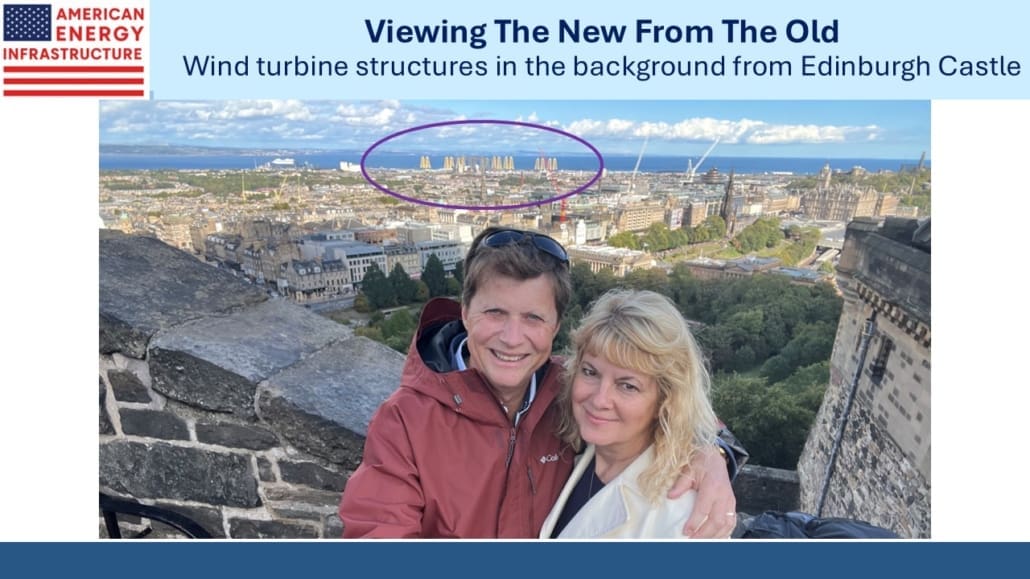
Like much of Europe, Edinburgh, where we visited last week, consumes energy more sparingly. Hotel corridors have motion sensitive lighting. The electric hand-dryers in the washrooms shut off more quickly. Windpower has been relatively successful in the UK, providing over a quarter of the country’s electricity and on some days all of it. Coal has been completely phased out.
Scotland generates more than it can use, and the infrastructure to transmit the excess south to England remains inadequate. Regional pricing doesn’t reflect local abundance, so Scots grumble about subsidizing their Sassenach neighbors with cheap windpower.

Britain’s surrounding waters are reliably windy. We saw several jacket foundations, the steel yellow lattice structures that support wind turbines, lined up on the port in Leith ready to be moved offshore. They’re built in China where coal is the dominant form of energy and shipped from the other side of the world. For decades the North Sea has provided oil and gas. Now it’s also providing electricity.
Household electricity prices in the UK are roughly double the US average, while industry pays two and a half times as much. Renewables are expensive in most of the places they’re deployed at scale around the world, although the US also benefits from cheap natural gas. Around a quarter of UK power comes from gas, but given the prices noted above it’s expensive. With coal reserves exhausted, windpower seems like a sensible option.
Thanks to the shale revolution, America remains the home of cheap energy.

We have two funds that seek to profit from this environment:

Important Disclosures
The information provided is for informational purposes only and investors should determine for themselves whether a particular service, security or product is suitable for their investment needs. The information contained herein is not complete, may not be current, is subject to change, and is subject to, and qualified in its entirety by, the more complete disclosures, risk factors and other terms that are contained in the disclosure, prospectus, and offering. Certain information herein has been obtained from third party sources and, although believed to be reliable, has not been independently verified and its accuracy or completeness cannot be guaranteed. No representation is made with respect to the accuracy, completeness or timeliness of this information. Nothing provided on this site constitutes tax advice. Individuals should seek the advice of their own tax advisor for specific information regarding tax consequences of investments. Investments in securities entail risk and are not suitable for all investors. This site is not a recommendation nor an offer to sell (or solicitation of an offer to buy) securities in the United States or in any other jurisdiction.
References to indexes and benchmarks are hypothetical illustrations of aggregate returns and do not reflect the performance of any actual investment. Investors cannot invest in an index and do not reflect the deduction of the advisor’s fees or other trading expenses. There can be no assurance that current investments will be profitable. Actual realized returns will depend on, among other factors, the value of assets and market conditions at the time of disposition, any related transaction costs, and the timing of the purchase. Indexes and benchmarks may not directly correlate or only partially relate to portfolios managed by SL Advisors as they have different underlying investments and may use different strategies or have different objectives than portfolios managed by SL Advisors (e.g. The Alerian index is a group MLP securities in the oil and gas industries. Portfolios may not include the same investments that are included in the Alerian Index. The S & P Index does not directly relate to investment strategies managed by SL Advisers.)
This site may contain forward-looking statements relating to the objectives, opportunities, and the future performance of the U.S. market generally. Forward-looking statements may be identified by the use of such words as; “believe,” “expect,” “anticipate,” “should,” “planned,” “estimated,” “potential” and other similar terms. Examples of forward-looking statements include, but are not limited to, estimates with respect to financial condition, results of operations, and success or lack of success of any particular investment strategy. All are subject to various factors, including, but not limited to general and local economic conditions, changing levels of competition within certain industries and markets, changes in interest rates, changes in legislation or regulation, and other economic, competitive, governmental, regulatory and technological factors affecting a portfolio’s operations that could cause actual results to differ materially from projected results. Such statements are forward-looking in nature and involves a number of known and unknown risks, uncertainties and other factors, and accordingly, actual results may differ materially from those reflected or contemplated in such forward-looking statements. Prospective investors are cautioned not to place undue reliance on any forward-looking statements or examples. None of SL Advisors LLC or any of its affiliates or principals nor any other individual or entity assumes any obligation to update any forward-looking statements as a result of new information, subsequent events or any other circumstances. All statements made herein speak only as of the date that they were made. r
Certain hyperlinks or referenced websites on the Site, if any, are for your convenience and forward you to third parties’ websites, which generally are recognized by their top level domain name. Any descriptions of, references to, or links to other products, publications or services does not constitute an endorsement, authorization, sponsorship by or affiliation with SL Advisors LLC with respect to any linked site or its sponsor, unless expressly stated by SL Advisors LLC. Any such information, products or sites have not necessarily been reviewed by SL Advisors LLC and are provided or maintained by third parties over whom SL Advisors LLC exercise no control. SL Advisors LLC expressly disclaim any responsibility for the content, the accuracy of the information, and/or quality of products or services provided by or advertised on these third-party sites.
All investment strategies have the potential for profit or loss. Different types of investments involve varying degrees of risk, and there can be no assurance that any specific investment will be suitable or profitable for a client’s investment portfolio.
Past performance of the American Energy Independence Index is not indicative of future returns.
Leave a Reply
Want to join the discussion?Feel free to contribute!