
Midstream Earnings Reinforce Outlook


/
1Q earnings have been coming in to heightened expectations following strong equity performance so far this year. Energy Transfer (ET), Targa Resources (TRGP) and Cheniere (CEI) all beat median Street EBITDA forecasts and raised full year guidance. AI-driven demand for natural gas to power data centers remains an important theme.
ET has described the volume of gas required for data centers as a “generational opportunity”). Among many operational records at ET was NGL exports (mainly ethane and propane) up 19%. They raised the midpoint of full year Adjusted EBITDA guidance by 4% (from $17.65BN to $18.6BN).
ET has reported numerous discussions about providing Behind The Meter (BTM) gas solutions for data centers looking to bypass the grid. This sidesteps the growing negative publicity about new climate-controlled warehouses with thousands of computers driving electricity prices higher. Co-CEO Thomas Long announced BTM agreements with the Nexus Hubbard AI campus in Texas and to a new facility in Arkansas. Each is for 150 Million Cubic Feet per Day.
Cheniere CEO Jack Fusco referred to the “tragic consequences” of the weaponization of energy supplies on their 1Q earnings call, including the loss of exports from Qatar. He noted the advantages of rich LNG buyers compared to “energy-hungry emerging economies”
Naturally Cheniere profited from such misfortune, with EBITDA +25%. Full year EBITDA guidance was raised by 8% and Distributable Cash Flow by almost 9%. They exported 688 Trillion BTUs of Liquefied Natural Gas (LNG), equivalent to 7.4 Billion Cubic Feet per Day (BCF/D).
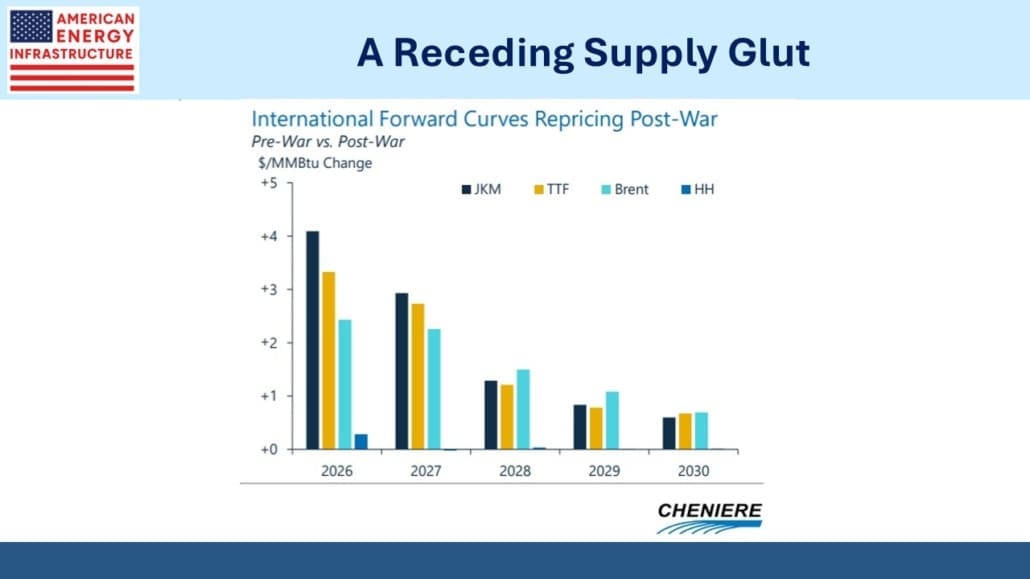
Global LNG prices remain in backwardation (i.e. lower prices forecast in the future), priced for a near term re-opening of trade flows through the Strait of Hormuz. CFO Zach Davis expressed surprise at this, given that European inventories are low, Russian imports are being halted and Asian demand cuts have already taken place. He allowed that shoulder season, when demand is generally low and inventories are built up in anticipation of summer a/c demand in the northern hemisphere, might be keeping a lid on prices.
But at Cheniere they certainly think there’s upside price risk over the next six months. We concur. Cheniere’s full year guidance also has room for further upward revisions.
Management stopped short of noting that the disruption of shipments from Qatar will harm their reputation for reliability for many years to come. Chief Commercial Officer Anatol Feygin did note, “…how attractive the long-term SPA from Cheniere Energy, Inc. is to those that can meet Zach’s stringent credit requirements.”
Nonetheless, Cheniere’s stock was –5.6% on Thursday, and fell further on Friday. They reported a net loss for the quarter of $3.5BN, including a non-cash charge of $4.8BN. Adjusted Net Income was $1BN. Consolidated Adjusted EBITDA was $2.3BN (+25%) and Distributable Cash Flow was $1.7BN (+31%).
Energy has been weak on fears of a peace deal with Iran, so it’s hard to separate out the response to earnings from the overall market. The $4.8BN charge relates to how Cheniere accounts for its Integrated Production Marketing agreements (IPMs).
An IPM is the opposite side of a Sale Purchase Agreement (SPA). IPMs are generally signed with domestic gas producers, and SPAs with foreign buyers. The SPAs get all the attention, because it’s their future cashflows that underpin the construction of new liquefaction capacity. They’re almost all with investment grade counterparties.
Cheniere’s business model is to charge a liquefaction fee and avoid commodity price risk. They might sign an SPA with an Asian utility to deliver gas at the JKM benchmark, and an IPM to buy gas from a US company on the same basis. This is how domestic gas producers are able to take advantage of global LNG prices that even before the Iran War were $8 or so above the US Henry Hub benchmark.
Under GAAP, IPMs and SPAs receive different accounting treatment. The IPMs are classified as derivatives, requiring quarterly mark to market. Because global prices rose in 1Q and Cheniere has contracted to buy gas from US producers at those higher prices, this results in a loss. But an SPA is a revenue contract and isn’t marked to market. If it was, there should be an offsetting gain. Instead, they’ll recoup this loss as deliveries take place.
It’s possible some market participants were surprised by this. On the earnings call it didn’t draw any questions from analysts, but Bloomberg described it as a “surprise derivatives loss.” It does mean that Cheniere won’t be added to the S&P500 in the near term because inclusion requires that the most recent four quarters be profitable.
There has been some discussion that S&P may relax that rule to accommodate newly listed AI companies (i.e. Anthropic), allowing them to go into the S&P soon after their IPO.
The earnings report led to Cheniere’s biggest absolute move of the year, although it’s still +28% YTD.
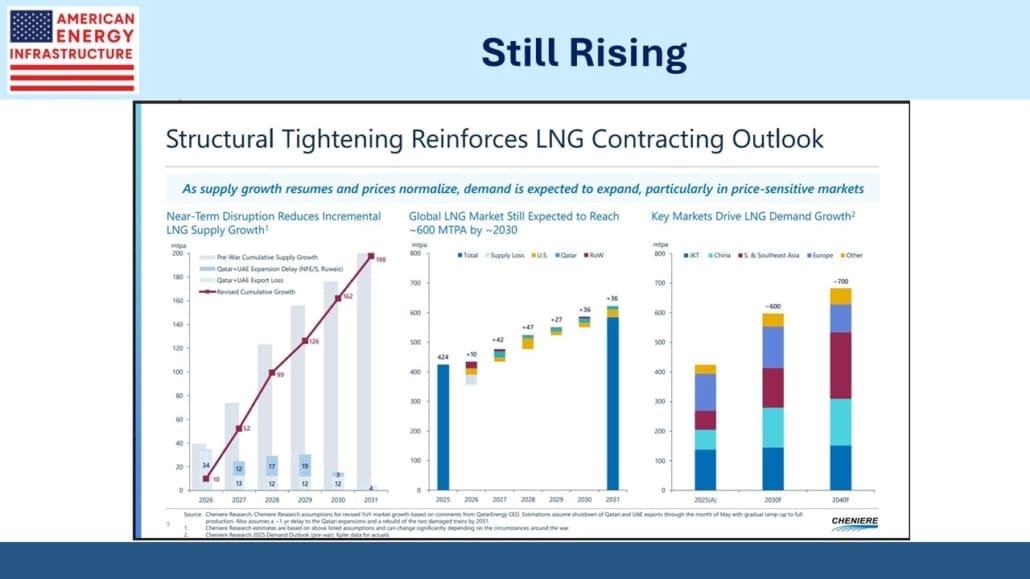
The supply glut of LNG that worried many analysts is quickly receding. Companies involved in the storage and transportation of US gas are well positioned.
We have two have funds that seek to profit from this environment:

Important Disclosures
The information provided is for informational purposes only and investors should determine for themselves whether a particular service, security or product is suitable for their investment needs. The information contained herein is not complete, may not be current, is subject to change, and is subject to, and qualified in its entirety by, the more complete disclosures, risk factors and other terms that are contained in the disclosure, prospectus, and offering. Certain information herein has been obtained from third party sources and, although believed to be reliable, has not been independently verified and its accuracy or completeness cannot be guaranteed. No representation is made with respect to the accuracy, completeness or timeliness of this information. Nothing provided on this site constitutes tax advice. Individuals should seek the advice of their own tax advisor for specific information regarding tax consequences of investments. Investments in securities entail risk and are not suitable for all investors. This site is not a recommendation nor an offer to sell (or solicitation of an offer to buy) securities in the United States or in any other jurisdiction.
References to indexes and benchmarks are hypothetical illustrations of aggregate returns and do not reflect the performance of any actual investment. Investors cannot invest in an index and do not reflect the deduction of the advisor’s fees or other trading expenses. There can be no assurance that current investments will be profitable. Actual realized returns will depend on, among other factors, the value of assets and market conditions at the time of disposition, any related transaction costs, and the timing of the purchase. Indexes and benchmarks may not directly correlate or only partially relate to portfolios managed by SL Advisors as they have different underlying investments and may use different strategies or have different objectives than portfolios managed by SL Advisors (e.g. The Alerian index is a group MLP securities in the oil and gas industries. Portfolios may not include the same investments that are included in the Alerian Index. The S & P Index does not directly relate to investment strategies managed by SL Advisers.)
This site may contain forward-looking statements relating to the objectives, opportunities, and the future performance of the U.S. market generally. Forward-looking statements may be identified by the use of such words as; “believe,” “expect,” “anticipate,” “should,” “planned,” “estimated,” “potential” and other similar terms. Examples of forward-looking statements include, but are not limited to, estimates with respect to financial condition, results of operations, and success or lack of success of any particular investment strategy. All are subject to various factors, including, but not limited to general and local economic conditions, changing levels of competition within certain industries and markets, changes in interest rates, changes in legislation or regulation, and other economic, competitive, governmental, regulatory and technological factors affecting a portfolio’s operations that could cause actual results to differ materially from projected results. Such statements are forward-looking in nature and involves a number of known and unknown risks, uncertainties and other factors, and accordingly, actual results may differ materially from those reflected or contemplated in such forward-looking statements. Prospective investors are cautioned not to place undue reliance on any forward-looking statements or examples. None of SL Advisors LLC or any of its affiliates or principals nor any other individual or entity assumes any obligation to update any forward-looking statements as a result of new information, subsequent events or any other circumstances. All statements made herein speak only as of the date that they were made. r
Certain hyperlinks or referenced websites on the Site, if any, are for your convenience and forward you to third parties’ websites, which generally are recognized by their top level domain name. Any descriptions of, references to, or links to other products, publications or services does not constitute an endorsement, authorization, sponsorship by or affiliation with SL Advisors LLC with respect to any linked site or its sponsor, unless expressly stated by SL Advisors LLC. Any such information, products or sites have not necessarily been reviewed by SL Advisors LLC and are provided or maintained by third parties over whom SL Advisors LLC exercise no control. SL Advisors LLC expressly disclaim any responsibility for the content, the accuracy of the information, and/or quality of products or services provided by or advertised on these third-party sites.
All investment strategies have the potential for profit or loss. Different types of investments involve varying degrees of risk, and there can be no assurance that any specific investment will be suitable or profitable for a client’s investment portfolio.
Past performance of the American Energy Independence Index is not indicative of future returns.
Leave a Reply
Want to join the discussion?Feel free to contribute!