
Is Crude At A Tipping Point?


/
It has struck us for some time that crude prices continue to reflect an overly optimistic view about when normal shipping will resume in the Strait of Hormuz. There is no acceptable military solution available to the US. The Iranian threat will stop when Iran so decides. Nonetheless, every positive social media utterance from President Trump draws algorithmic selling of crude oil futures and related energy stocks.
In late May Bernstein hosted executives from both Exxon Mobil and Chevron at their 42nd Annual Strategic Decisions Conference. Energy insiders have long been warning about the price risks caused by depleting oil inventories. Nonetheless, the transcript was startling.
XOM SVP Neil Chapman said, “We’re approaching unheard of inventory levels…going to hit really low levels in two weeks or three weeks. But once you get to that point, then you’ll see prices shoot up.” Chapman thinks Brent crude could soon reach $150-160.
Chevron CEO Mike Wirth warned that, “…the buffers and the shock absorbers are being steadily drawn down and the ability of the market to absorb this imbalance is drastically diminished today versus where we started.” He added, “,,,there’s more upward pressure that I would expect as we get into June and certainly into July.”
Neil Chapman felt that the loss of Persian Gulf supply has been partly offset by large volumes of sanctioned crude from Venezuela and Russia that was already in ships and became available to buyers. Much of that has now gone. China also stopped building their substantial supplies of stored crude.
Mike Wirth expects that even after shipments return to normal through the Strait of Hormuz, rebuilding strategic stocks that have been drawn down will increase demand, boosting prices.
Trafigura also warned that inventories were dangerously low when reporting a doubling in quarterly profits on Thursday.
When the Strait opens up, you could see a rush to rebuild stocks that would push prices higher. Many operators might worry that any peace deal is fragile and rush to take advantage of supplies while they can. There’s little point in building inventories when supply is constrained. It would be ironic and not a little frustrating to the White House if they announced a deal to re-open the Strait and oil prices rose. It seems to us a plausible result.
Trading is driven by algorithms that sweep news stories faster and more efficiently than any human. When I was trading interest rate futures in the 80s and 90s, occasionally a story would break that allowed a profitable trade for those with fast enough reactions. That time long ago passed.
I wonder if the transcript from a sell-side conference doesn’t receive the same type of AI analysis as the regular posts from our president. Executives at America’s two biggest energy companies both see a plausible risk for oil prices to jump 50% in a month or two. That offers more important insight into future prices than the regular promises from the White House that the Strait will soon open.
Investors often ask me what percentage of my investable assets are in midstream energy. It’s a high percentage, balanced with a healthy dollop of treasury bills. Why not diversify? During the pandemic a concentration in energy wasn’t a pleasant experience, but the sector rebounded strongly and the 14.1% ten year return on the American Energy Infrastructure Index (AEITR) is steadily closing in on the S&P500’s 15.6%.
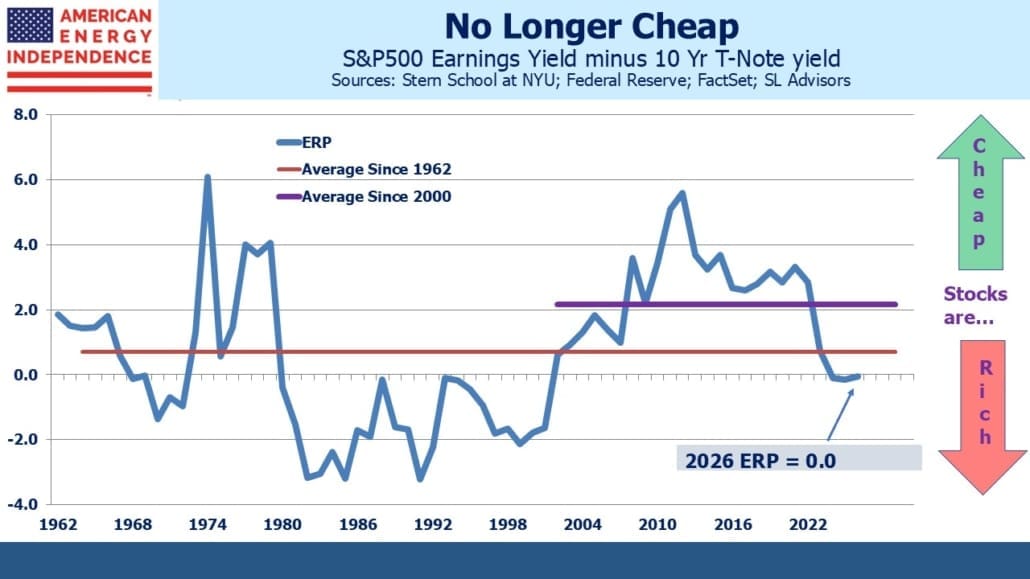
With current valuations it’s not clear that diversifying towards the S&P500 would be helpful. The Equity Risk Premium (ERP) shows stocks to be at their most expensive in a quarter century. On a relative valuation basis I find the cash flow multiple in midstream more compelling.
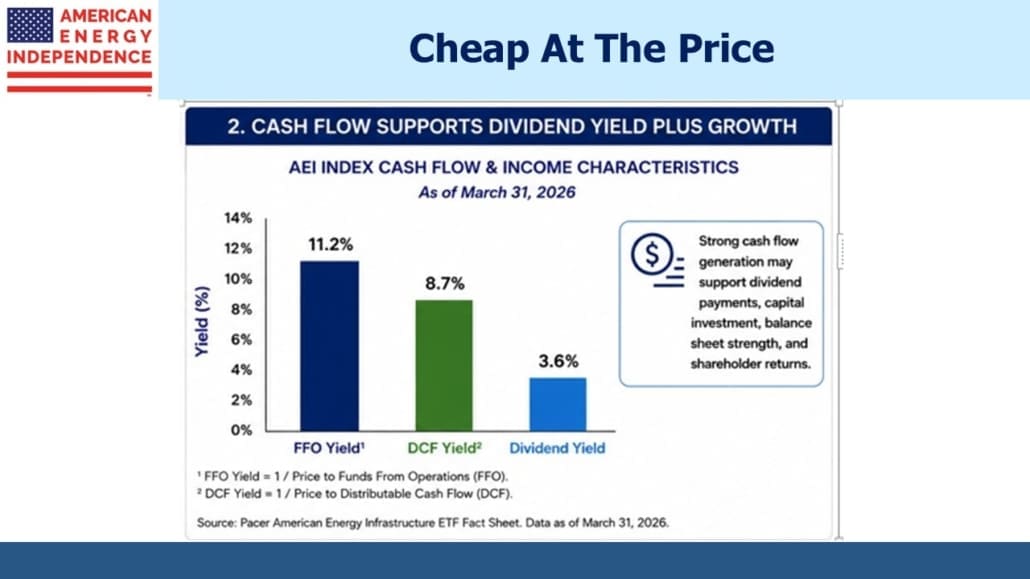
The ERP isn’t a great timing tool. It’s been showing stocks as overvalued for at least three years. During this time earnings have grown at double digits, justifying historic purchases. Factset shows 2026 earnings growth of 23% and 15% next year, which supports today’s apparently lofty valuations. The AEITR’s cash flow yield is over 2X the S&P500, reflecting the latter’s growth orientation but also the bullish outlook of so many investors.
The big four hyperscalers (Google, Meta, Amazon and Microsoft) are projected to have depreciation expense of $200BN next year. All the numbers related to AI are superlative, and there’s a case the revenues will easily justify valuations. But if things don’t work out as currently priced, to quote a long-time friend who used to run government bond trading, “Down’s a long way.”
We prefer the predictable cashflows of midstream energy stocks.
We have two have funds that seek to profit from this environment:

Important Disclosures
The information provided is for informational purposes only and investors should determine for themselves whether a particular service, security or product is suitable for their investment needs. The information contained herein is not complete, may not be current, is subject to change, and is subject to, and qualified in its entirety by, the more complete disclosures, risk factors and other terms that are contained in the disclosure, prospectus, and offering. Certain information herein has been obtained from third party sources and, although believed to be reliable, has not been independently verified and its accuracy or completeness cannot be guaranteed. No representation is made with respect to the accuracy, completeness or timeliness of this information. Nothing provided on this site constitutes tax advice. Individuals should seek the advice of their own tax advisor for specific information regarding tax consequences of investments. Investments in securities entail risk and are not suitable for all investors. This site is not a recommendation nor an offer to sell (or solicitation of an offer to buy) securities in the United States or in any other jurisdiction.
References to indexes and benchmarks are hypothetical illustrations of aggregate returns and do not reflect the performance of any actual investment. Investors cannot invest in an index and do not reflect the deduction of the advisor’s fees or other trading expenses. There can be no assurance that current investments will be profitable. Actual realized returns will depend on, among other factors, the value of assets and market conditions at the time of disposition, any related transaction costs, and the timing of the purchase. Indexes and benchmarks may not directly correlate or only partially relate to portfolios managed by SL Advisors as they have different underlying investments and may use different strategies or have different objectives than portfolios managed by SL Advisors (e.g. The Alerian index is a group MLP securities in the oil and gas industries. Portfolios may not include the same investments that are included in the Alerian Index. The S & P Index does not directly relate to investment strategies managed by SL Advisers.)
This site may contain forward-looking statements relating to the objectives, opportunities, and the future performance of the U.S. market generally. Forward-looking statements may be identified by the use of such words as; “believe,” “expect,” “anticipate,” “should,” “planned,” “estimated,” “potential” and other similar terms. Examples of forward-looking statements include, but are not limited to, estimates with respect to financial condition, results of operations, and success or lack of success of any particular investment strategy. All are subject to various factors, including, but not limited to general and local economic conditions, changing levels of competition within certain industries and markets, changes in interest rates, changes in legislation or regulation, and other economic, competitive, governmental, regulatory and technological factors affecting a portfolio’s operations that could cause actual results to differ materially from projected results. Such statements are forward-looking in nature and involves a number of known and unknown risks, uncertainties and other factors, and accordingly, actual results may differ materially from those reflected or contemplated in such forward-looking statements. Prospective investors are cautioned not to place undue reliance on any forward-looking statements or examples. None of SL Advisors LLC or any of its affiliates or principals nor any other individual or entity assumes any obligation to update any forward-looking statements as a result of new information, subsequent events or any other circumstances. All statements made herein speak only as of the date that they were made. r
Certain hyperlinks or referenced websites on the Site, if any, are for your convenience and forward you to third parties’ websites, which generally are recognized by their top level domain name. Any descriptions of, references to, or links to other products, publications or services does not constitute an endorsement, authorization, sponsorship by or affiliation with SL Advisors LLC with respect to any linked site or its sponsor, unless expressly stated by SL Advisors LLC. Any such information, products or sites have not necessarily been reviewed by SL Advisors LLC and are provided or maintained by third parties over whom SL Advisors LLC exercise no control. SL Advisors LLC expressly disclaim any responsibility for the content, the accuracy of the information, and/or quality of products or services provided by or advertised on these third-party sites.
All investment strategies have the potential for profit or loss. Different types of investments involve varying degrees of risk, and there can be no assurance that any specific investment will be suitable or profitable for a client’s investment portfolio.
Past performance of the American Energy Independence Index is not indicative of future returns.
Leave a Reply
Want to join the discussion?Feel free to contribute!