
Energy Markets Remain Tight


/
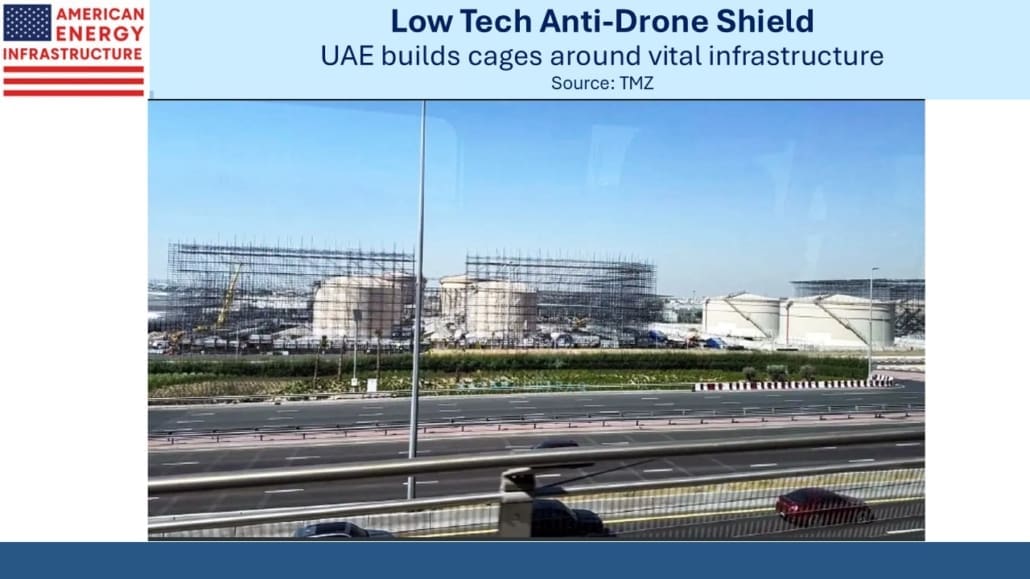
In the United Arab Emirates, they’ve started building metal cages to protect vital energy infrastructure from Iranian drone attacks. It’s probably inspired by the netting that Ukraine has been erecting over streets to protect its population from drones.
In a sign of the impact AI is having on how we use the internet, AI-generated images of the UAE cages proliferate. They range from highly credible to dystopian. The image shown here is, we believe, a real one.
Russia has also started protecting its oil facilities with netting or other low-tech material to impede drones.
Like Russia’s invasion of Ukraine, the Iran War is drifting into a stalemate. Every week that passes with limited egress through the Strait of Hormuz serves to strengthen the market position of America’s oil and gas exporters.
The strongest evidence of the war’s limited impact is the price of crude oil, which has confounded many forecasters by remaining stubbornly below $100 and less than $15 above its pre-war level.
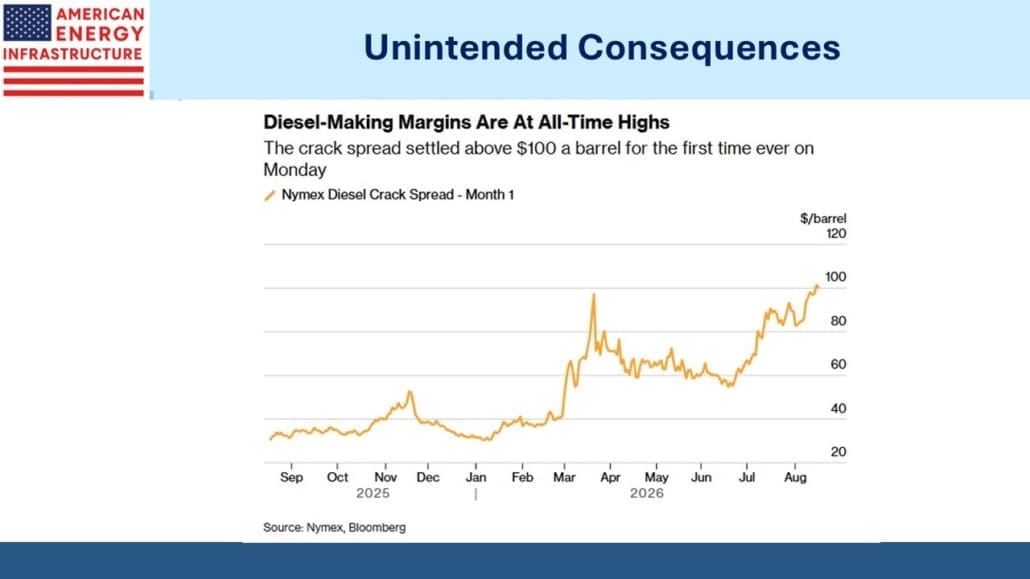
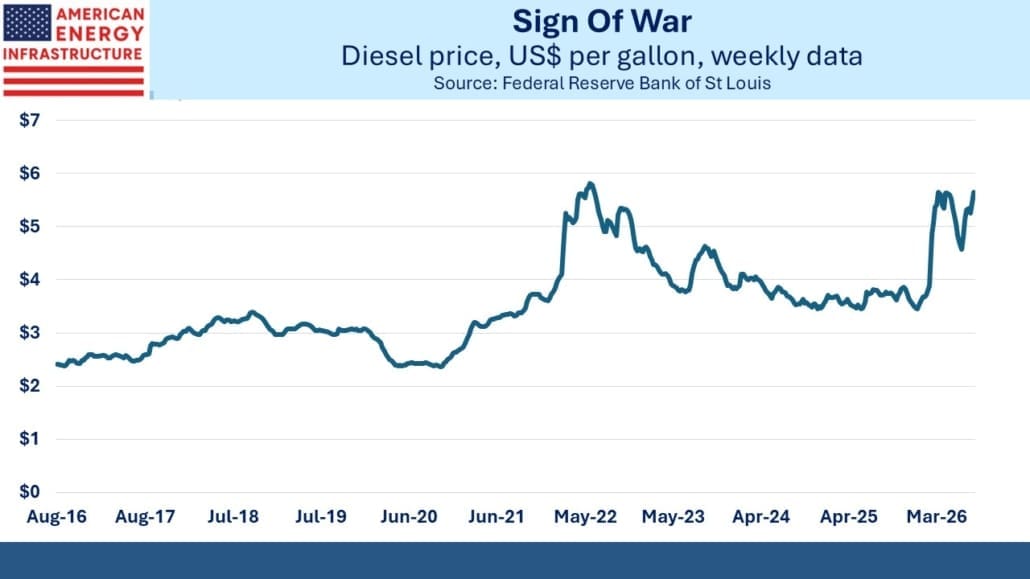
Crude oil is the only hydrocarbon product signaling equanimity.
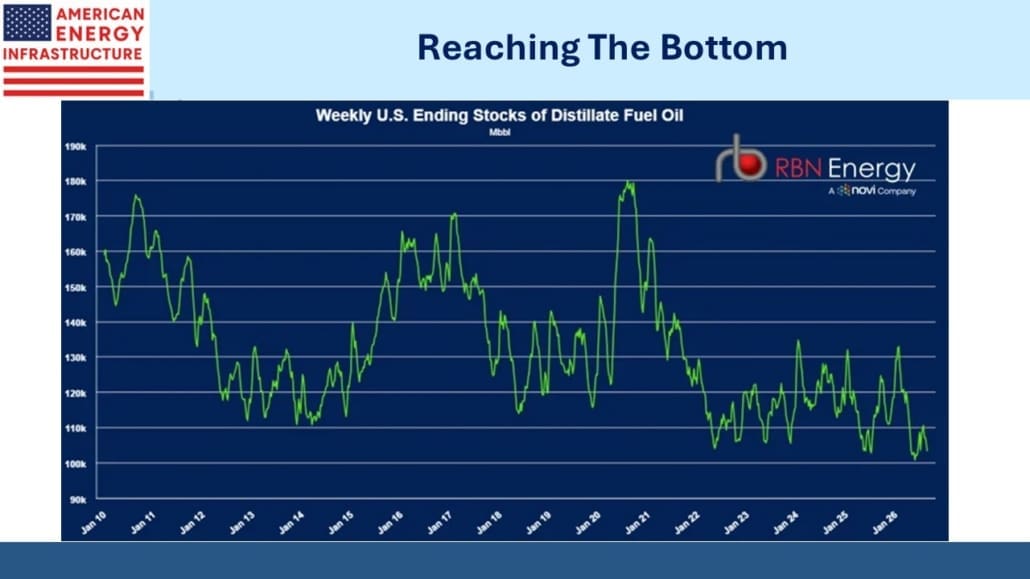
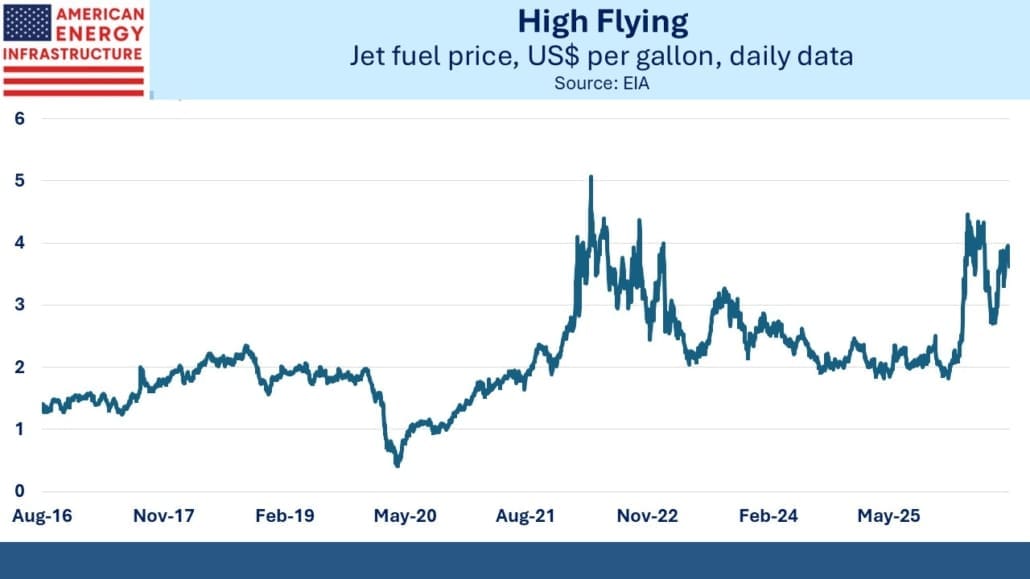
Refined products such as jet fuel and diesel have remained elevated because of reduced global refining capacity. Ukraine’s attacks on Russian energy infrastructure have stopped their diesel exports, driving refining margins for others to a record high. The EIA reports that US stocks of Distillate Fuel Oil (almost all diesel) are close to the lowest in over a decade.
Middle East refineries have reduced output of many products including diesel and jet fuel because of Iranian attacks on shipping. RBN Energy reports that global refinery runs were down by 5.1 Million Barrels per Day in 2Q26 compared with the prior year.
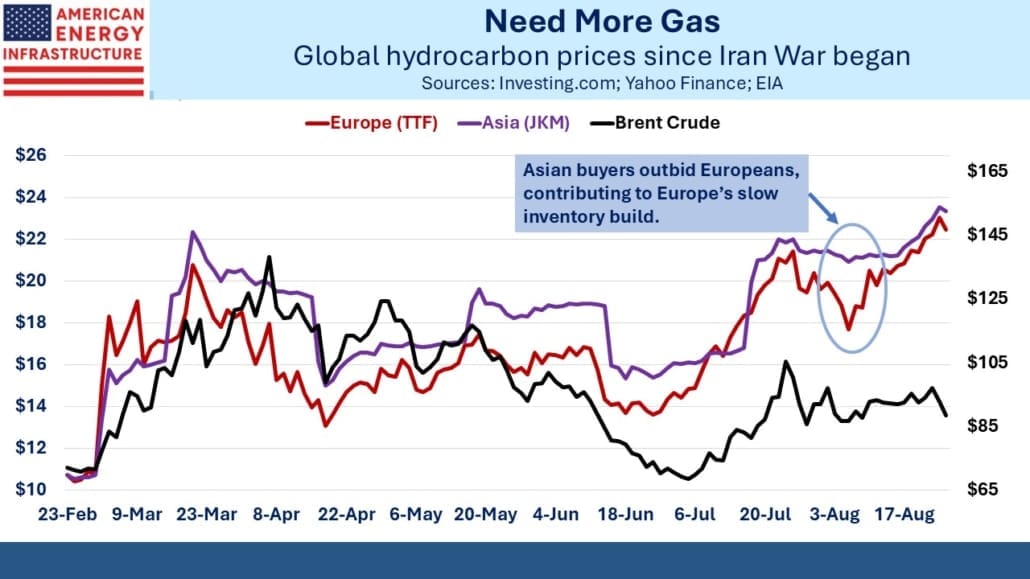
The ongoing maritime disruption has also hurt Qatar’s exports of Liquefied Natural Gas (LNG), which are reportedly down 96%. They’ve managed 18 shipments since the war began compared with 509 over the same period last year. It’s why the European and Asian LNG benchmarks are the highest they’ve been since the conflict began, unlike crude oil.
Global LNG prices are now more than double their pre-war level. Europe’s inventories are also lower than usual for this time of year, partly because they held back on pricing in recent weeks which shifted flows to Asia.
It seems unlikely Qatar will return to previous volumes of LNG shipments anytime soon. Both the US and Iran seem content to wait for the other side to offer concessions. Trump may regard the mid-terms as a logical decision point, and could adopt a tougher stance after that with little near term political risk.
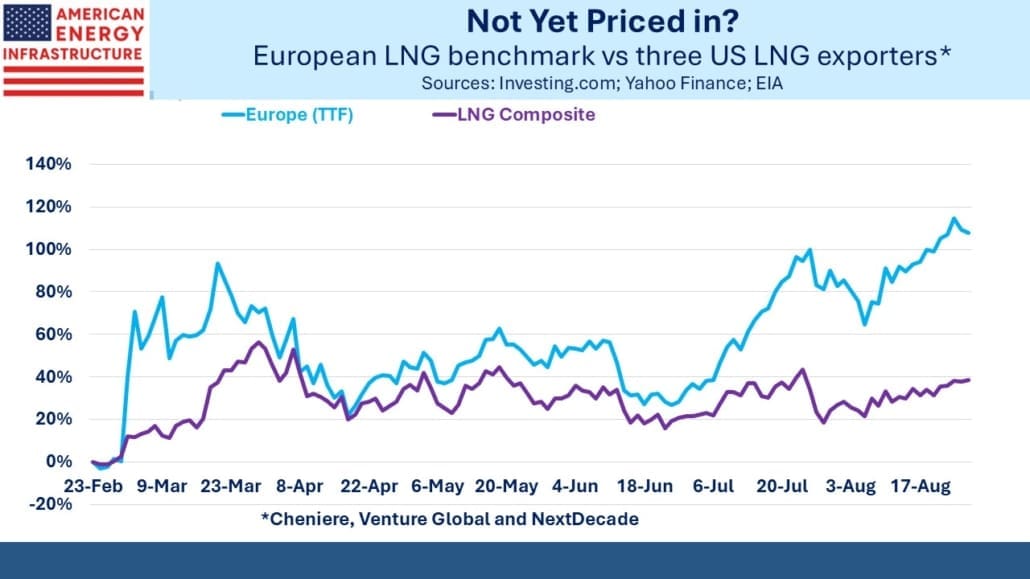
Because of this, the prospects for Cheniere, Venture Global and NextDecade are the best they’ve been in living memory. Yet the stocks remain cheaper than they were in March, when the conflict was in its opening stages.
Last week I noted that few Republicans I talk to regard the decision to attack Iran as a success. Then a client I’ve known for almost twenty years and whose opinion I respect, provided an alternative perspective. He noted that together with Israel we have substantially degraded Iran’s military, killed enough leaders that the new cohort can never feel safe, removed any imminent nuclear threat, decimated their economy and seen their neighbors further align with us due to Iranian attacks.
We’ve done all this with minimal US casualties and only a modest jump in crude. The continued closure of the Strait was not anticipated, but there has been limited negative impact on the US economy.
That doesn’t seem too bad – and it’s boosted the prospects for US energy exporters.
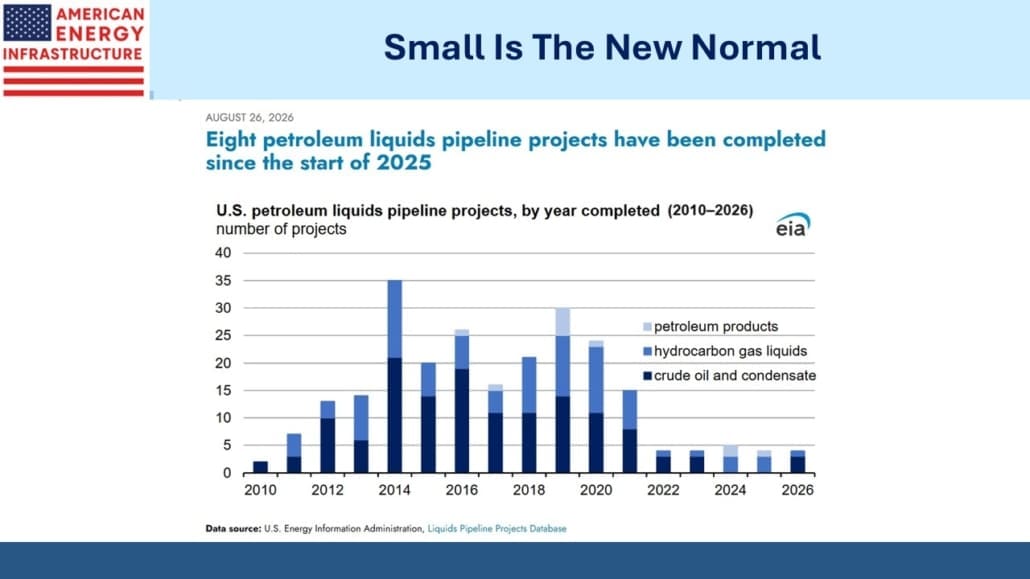
In recent years, the midstream industry has pivoted towards more modest projects with less execution risk. The shale boom of 2014-18 produced mixed results for investors. Then Covid briefly hit energy consumption.
Legal and regulatory impediments followed with the Biden administration, most famously with the chronically late and over budget Mountain Valley Pipeline which only crossed the finish line when West Virginia Senator Joe Manchin insisted on legislation to smooth its passage in exchange for supporting an increase in the debt ceiling.
The liquids pipelines added since 2025 in the EIA chart were all either within Texas or were expansions of existing pipelines which are generally harder to challenge in court.
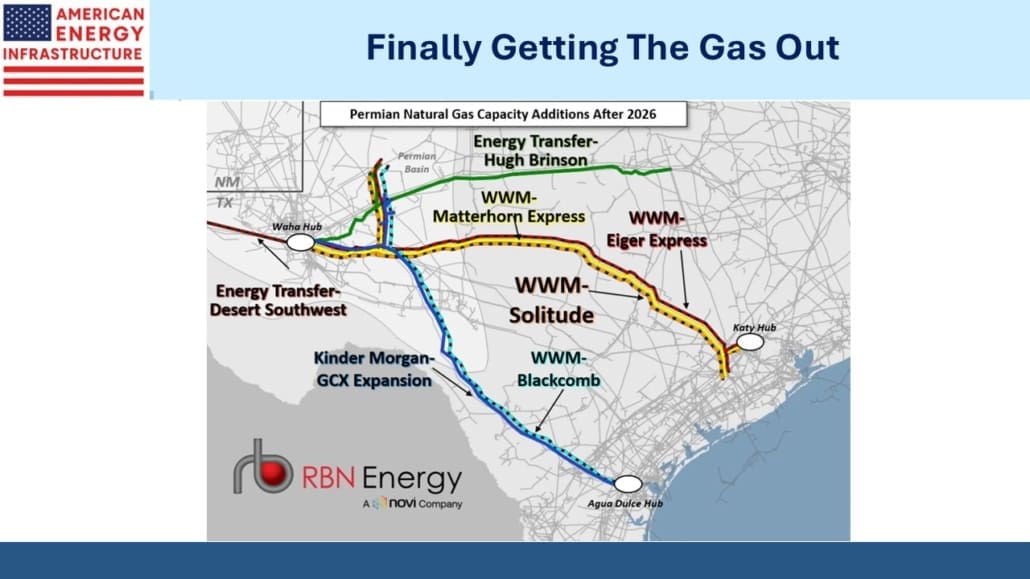
There have been some bigger projects to move natural gas – notably improving takeaway capacity from the Permian Waha hub in west Texas where gas has at times traded at a negative price because of too much of it chasing limited pipeline capacity. That problem is now largely fixed, enabling more gas to power data centers and feed LNG export terminals on the Gulf coast.
Midstream’s approach to capex is very different than a decade ago. Projects are de-risked, generally smaller and have more predictable cashflows. Boring is good.
We have two funds that seek to profit from this environment:

Important Disclosures
The information provided is for informational purposes only and investors should determine for themselves whether a particular service, security or product is suitable for their investment needs. The information contained herein is not complete, may not be current, is subject to change, and is subject to, and qualified in its entirety by, the more complete disclosures, risk factors and other terms that are contained in the disclosure, prospectus, and offering. Certain information herein has been obtained from third party sources and, although believed to be reliable, has not been independently verified and its accuracy or completeness cannot be guaranteed. No representation is made with respect to the accuracy, completeness or timeliness of this information. Nothing provided on this site constitutes tax advice. Individuals should seek the advice of their own tax advisor for specific information regarding tax consequences of investments. Investments in securities entail risk and are not suitable for all investors. This site is not a recommendation nor an offer to sell (or solicitation of an offer to buy) securities in the United States or in any other jurisdiction.
References to indexes and benchmarks are hypothetical illustrations of aggregate returns and do not reflect the performance of any actual investment. Investors cannot invest in an index and do not reflect the deduction of the advisor’s fees or other trading expenses. There can be no assurance that current investments will be profitable. Actual realized returns will depend on, among other factors, the value of assets and market conditions at the time of disposition, any related transaction costs, and the timing of the purchase. Indexes and benchmarks may not directly correlate or only partially relate to portfolios managed by SL Advisors as they have different underlying investments and may use different strategies or have different objectives than portfolios managed by SL Advisors (e.g. The Alerian index is a group MLP securities in the oil and gas industries. Portfolios may not include the same investments that are included in the Alerian Index. The S & P Index does not directly relate to investment strategies managed by SL Advisers.)
This site may contain forward-looking statements relating to the objectives, opportunities, and the future performance of the U.S. market generally. Forward-looking statements may be identified by the use of such words as; “believe,” “expect,” “anticipate,” “should,” “planned,” “estimated,” “potential” and other similar terms. Examples of forward-looking statements include, but are not limited to, estimates with respect to financial condition, results of operations, and success or lack of success of any particular investment strategy. All are subject to various factors, including, but not limited to general and local economic conditions, changing levels of competition within certain industries and markets, changes in interest rates, changes in legislation or regulation, and other economic, competitive, governmental, regulatory and technological factors affecting a portfolio’s operations that could cause actual results to differ materially from projected results. Such statements are forward-looking in nature and involves a number of known and unknown risks, uncertainties and other factors, and accordingly, actual results may differ materially from those reflected or contemplated in such forward-looking statements. Prospective investors are cautioned not to place undue reliance on any forward-looking statements or examples. None of SL Advisors LLC or any of its affiliates or principals nor any other individual or entity assumes any obligation to update any forward-looking statements as a result of new information, subsequent events or any other circumstances. All statements made herein speak only as of the date that they were made. r
Certain hyperlinks or referenced websites on the Site, if any, are for your convenience and forward you to third parties’ websites, which generally are recognized by their top level domain name. Any descriptions of, references to, or links to other products, publications or services does not constitute an endorsement, authorization, sponsorship by or affiliation with SL Advisors LLC with respect to any linked site or its sponsor, unless expressly stated by SL Advisors LLC. Any such information, products or sites have not necessarily been reviewed by SL Advisors LLC and are provided or maintained by third parties over whom SL Advisors LLC exercise no control. SL Advisors LLC expressly disclaim any responsibility for the content, the accuracy of the information, and/or quality of products or services provided by or advertised on these third-party sites.
All investment strategies have the potential for profit or loss. Different types of investments involve varying degrees of risk, and there can be no assurance that any specific investment will be suitable or profitable for a client’s investment portfolio.
Past performance of the American Energy Independence Index is not indicative of future returns.
Leave a Reply
Want to join the discussion?Feel free to contribute!