
Energy Is The New Market Leader


/
January was a good month for midstream energy infrastructure. The American Energy Infrastructure Index was +9%, the 10th best month of the past decade and the best since November 2024. For those who like simple statistical patterns, over the past ten years the direction of January’s performance has correctly predicted the full year 70% of the time.
Put another way, annual performance and January’s are both usually up.
Energy is back in favor. The S&P500 Energy Sector (XLE) was +14% last month. Exxon Mobil (XOM) and Chevron (CVX) represent 42% of its holdings, and investors have been encouraged by rising oil production even with soft prices. Continued efficiency improvements are boosting sentiment, perhaps helped by signs that CVX can increase Venezuelan oil output without following the White House’s desire that they ramp up capex there.
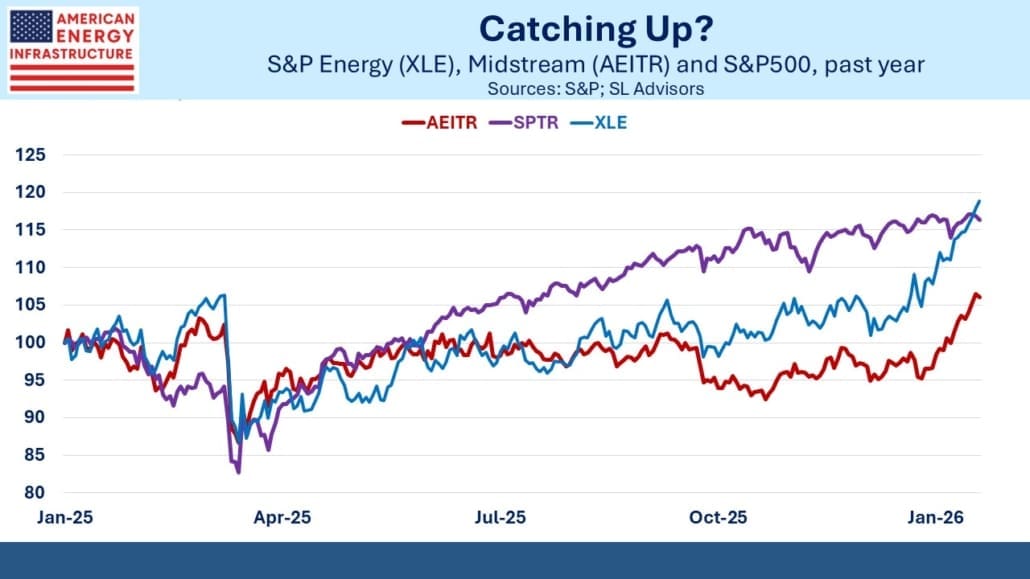
XLE fund flows were consistently negative last year. Perhaps the strong start to the year will draw in buyers to upstream and midstream who like to see good price action before committing capital. Over the past twelve months it’s now beating the market.
The news for midstream was generally good in January, although to us the sparkling performance was a belated recognition of the already positive fundamentals. ChatGPT guided me to a wildly bullish article from an obscure website (see The Gilded Age of Infrastructure: Why 2026 is the Breakout Year for US Midstream and Energy).
Venture Global stood out at +43%, buoyed by a positive arbitration outcome (see Energy Leads The Market). Energy Transfer responded to the strong seasonal pattern that usually boosts MLPs. Even though Winter Storm Fern doesn’t seem to have created the type of energy market dislocations seen five years ago that netted them $2.4BN, ET held on to the gain registered in anticipation.
Last week Abu Dhabi’s state oil company ADNOC added 7.6% to its stake in Phase Two of NextDecade’s Rio Grande LNG export terminal. ADNOC acquired the stake from Global Infrastructure Partners by exercising an option they acquired back in May 2024 when they invested in Phase One.
ADNOC is presumably pleased with the progress to date.
Natural gas oriented capex plans from Kinder Morgan and Energy Transfer were both positively received. The underlying demand from LNG exports and power generation for data centers is no less compelling than for the past couple of years. But perhaps when hyperscaler Microsoft can shed in value half the midstream’s entire market cap, as the stock did following earnings on Thursday, it can reflect favorably on an un-hyped sector.
Although Winter Storm Fern didn’t result in the widespread loss of power that Uri caused five years ago, it did once again highlight vulnerabilities in the reliability of the country’s grid.
New England relied on fuel oil to generate as much as 40% of its electricity. Other than in the Middle East where crude is cheap and abundant, oil isn’t used for power generation. Progressive energy policies in Massachusetts and across the region have raised prices and the risk of disruption for little discernible benefit.
The North American Electric Reliability Corporation (NERC) released their 2025 Long Term Reliability Assessment in January. They found that 13 of the 23 assessment areas will face resource adequacy challenges over the next decade. Grid planning takes place over years, so while warnings such as this rarely appear urgent, much of the US faces a growing risk that power supply will become less reliable.
There can be no doubt that left wing energy policies are the cause. NERC blames the increased investment in solar and the requisite battery backup along with decreasing investment in reliable gas-fired power. This is reducing the overall capacity utilization of the nation’s power–generating assets, creating grid complexity because of the increased reliance on intermittent generation and raising costs.
The PJM Grid, the country’s biggest which extends from the md-Atlantic as far west as Illinois and includes New Jersey, our summer home, is rated as High Risk from 2029. Recently elected NJ governor Mikie Sherril looks set to continue Phil Murphy’s misguided policies based on recent executive orders she issued to favor renewables. A mandate that 100% of electricity be generated from carbon-free sources by 2035 has disincentivized any investment in gas-powered generation.
There are some encouraging signs. NERC found that retirements of peak seasonal capacity, while still high at 105 Gigawatts (GW), were down by 10 GW from a year earlier as some power plants had their useful lives extended. PJM and other grids such as MISO (midwest) and ERCOT (Texas) have started addressing the biggest vulnerabilities noted by NERC and implementing plans to curtail power to certain users.
Underlying these challenges is the growing demand from data centers, some of which are accepting that at times of high usage they’ll need to rely on alternatives, such as diesel.
Natural gas looks like a clear winner as grid operators and customers look for reliable power. It’s why we’re invested there.
We have two funds that seek to profit from this environment:

Important Disclosures
The information provided is for informational purposes only and investors should determine for themselves whether a particular service, security or product is suitable for their investment needs. The information contained herein is not complete, may not be current, is subject to change, and is subject to, and qualified in its entirety by, the more complete disclosures, risk factors and other terms that are contained in the disclosure, prospectus, and offering. Certain information herein has been obtained from third party sources and, although believed to be reliable, has not been independently verified and its accuracy or completeness cannot be guaranteed. No representation is made with respect to the accuracy, completeness or timeliness of this information. Nothing provided on this site constitutes tax advice. Individuals should seek the advice of their own tax advisor for specific information regarding tax consequences of investments. Investments in securities entail risk and are not suitable for all investors. This site is not a recommendation nor an offer to sell (or solicitation of an offer to buy) securities in the United States or in any other jurisdiction.
References to indexes and benchmarks are hypothetical illustrations of aggregate returns and do not reflect the performance of any actual investment. Investors cannot invest in an index and do not reflect the deduction of the advisor’s fees or other trading expenses. There can be no assurance that current investments will be profitable. Actual realized returns will depend on, among other factors, the value of assets and market conditions at the time of disposition, any related transaction costs, and the timing of the purchase. Indexes and benchmarks may not directly correlate or only partially relate to portfolios managed by SL Advisors as they have different underlying investments and may use different strategies or have different objectives than portfolios managed by SL Advisors (e.g. The Alerian index is a group MLP securities in the oil and gas industries. Portfolios may not include the same investments that are included in the Alerian Index. The S & P Index does not directly relate to investment strategies managed by SL Advisers.)
This site may contain forward-looking statements relating to the objectives, opportunities, and the future performance of the U.S. market generally. Forward-looking statements may be identified by the use of such words as; “believe,” “expect,” “anticipate,” “should,” “planned,” “estimated,” “potential” and other similar terms. Examples of forward-looking statements include, but are not limited to, estimates with respect to financial condition, results of operations, and success or lack of success of any particular investment strategy. All are subject to various factors, including, but not limited to general and local economic conditions, changing levels of competition within certain industries and markets, changes in interest rates, changes in legislation or regulation, and other economic, competitive, governmental, regulatory and technological factors affecting a portfolio’s operations that could cause actual results to differ materially from projected results. Such statements are forward-looking in nature and involves a number of known and unknown risks, uncertainties and other factors, and accordingly, actual results may differ materially from those reflected or contemplated in such forward-looking statements. Prospective investors are cautioned not to place undue reliance on any forward-looking statements or examples. None of SL Advisors LLC or any of its affiliates or principals nor any other individual or entity assumes any obligation to update any forward-looking statements as a result of new information, subsequent events or any other circumstances. All statements made herein speak only as of the date that they were made. r
Certain hyperlinks or referenced websites on the Site, if any, are for your convenience and forward you to third parties’ websites, which generally are recognized by their top level domain name. Any descriptions of, references to, or links to other products, publications or services does not constitute an endorsement, authorization, sponsorship by or affiliation with SL Advisors LLC with respect to any linked site or its sponsor, unless expressly stated by SL Advisors LLC. Any such information, products or sites have not necessarily been reviewed by SL Advisors LLC and are provided or maintained by third parties over whom SL Advisors LLC exercise no control. SL Advisors LLC expressly disclaim any responsibility for the content, the accuracy of the information, and/or quality of products or services provided by or advertised on these third-party sites.
All investment strategies have the potential for profit or loss. Different types of investments involve varying degrees of risk, and there can be no assurance that any specific investment will be suitable or profitable for a client’s investment portfolio.
Past performance of the American Energy Independence Index is not indicative of future returns.
Leave a Reply
Want to join the discussion?Feel free to contribute!