
Oil Markets Price In Higher For Longer


/
Since the Iran War began at the end of February, oil analysts and industry professionals have been warning that the price of crude was increasingly likely to move sharply higher. Storage is depleted. Tanker traffic through the Strait of Hormuz fluctuates with the success of Iranian attacks.
Spot crude was recently back at the highs of March, but no higher. Reported flows through the Strait of Hormuz have approached pre-war levels. Headline oil prices fall on optimistic presidential tweets and rise again on drone strikes. Oil is high but somehow enough supply seems to reach the market that the most dire forecasts have so far been wrong.
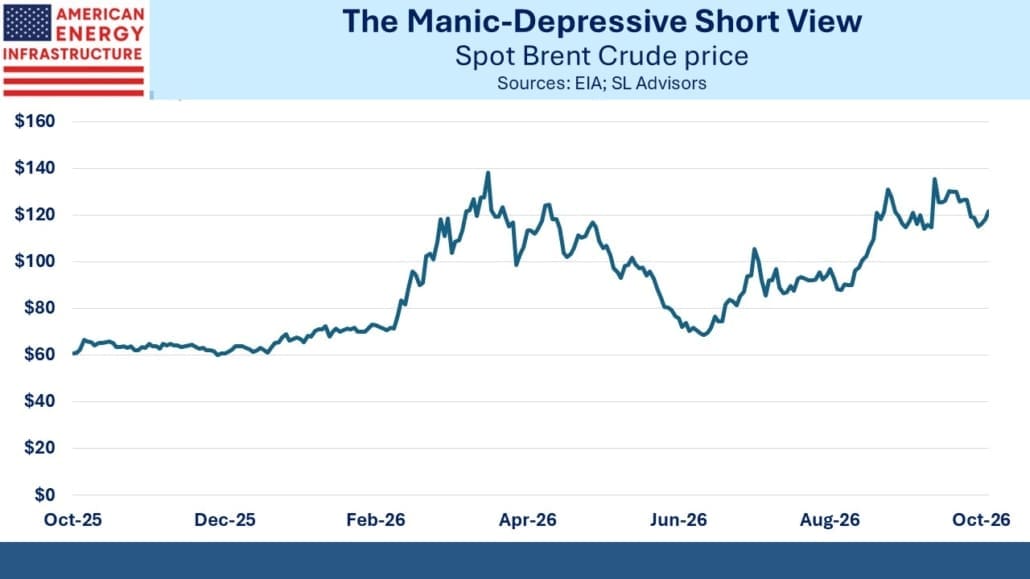
Military activity has been eerily quiet. The removal of US dependents out of the Middle East is another sign that a major strike on Iran is coming after the mid-terms. At that point diesel prices will have lost their influence. The rally in spot crude on Friday reflects this shifting expectation.
With little attention, longer term crude prices have been moving up, and for a different reason. Jeff Currie, formerly of Goldman Sachs and now with Carlyle, recently pointed this out. For example, the June 2027 Brent futures contract is now well above the highs of March.
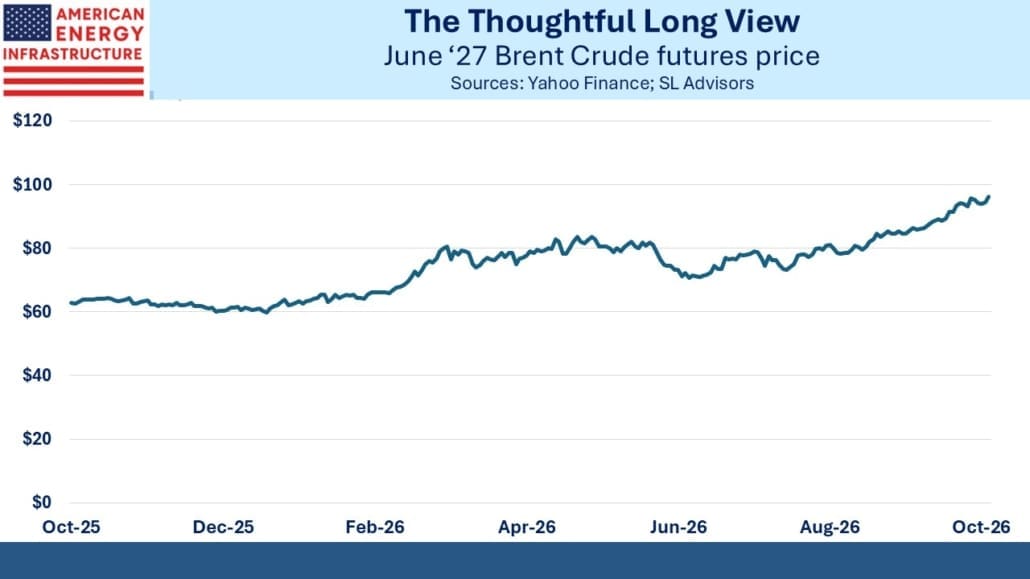
The two price points represent very different perspectives. Spot crude is acutely sensitive to unexpected changes in supply and demand. It is the headline price, responsive to every tweet and missile. It’s more correlated with the prices of gasoline, diesel and other refined products.
By contrast, an Iranian strike on a tanker or a Houthi drone hit on Saudi infrastructure have limited impact on the June 2027 price, which moves with less urgency. Spot conveys the emotion of the market, while the price next summer reflects the result of more thoughtful analysis by market participants.
The steady ascent of the June futures contract hasn’t made headlines but should be of more concern to policymakers. For months the market has priced oil as if supply disruptions would soon be resolved. What’s happening now is a growing acknowledgment that we won’t get back to a pre-war state for some time, if at all.
The resilience of Iran’s capability to strike at shipping suggests that traders are pricing in their more permanent influence over the Strait. While flows from the Persian Gulf have in recent weeks approached the levels that prevailed before February 28, the market is showing that the risk of a setback is going up.
It’s subtle; plain to see for energy executives and policymakers who follow such things, but not front page news. Refined products’ prices are high. The market structure suggests they may become the new normal.
We continue to believe that the stock prices of LNG exporters don’t reflect their long term boost from the closure of the Strait. Even after it re-opens, the threat from Iran will remain indefinitely, or at least as long as the country is run by religious fanatics. The reliability of US energy exports isn’t fully incorporated in the prices of exporters.
However, it is recognized by Qatar, who signed a deal with Cheniere last week to buy 4 Million Tonnes Per Annum (MTPA) of LNG through 2054. What could be a more powerful statement about the relative attractiveness of US supplies than one of our biggest competitors committing to buy from us for almost the next three decades?
How does a new Asian buyer considering a choice between Qatari and US supplies opt for the former under such circumstances?
Will Qatar even go ahead with their planned expansion of their Ras Laffen complex when they themselves are opting for the reliability of US supplies?
Qatar is also in negotiations to buy 3 MTPA from Venture Global.
The threat of a glut of LNG in coming years must be receding for even the most bearish analysts. Qatar, once expected to be a source of the glut, is committing to long term purchases from America to ensure they have sufficient supplies. Qatar regularly buys shipments on the open market to make up for their own inability to honor commitments due to the closure of the Strait.
The less thoughtful observers have not previously considered the change in Qatar’s competitive position.



Last week we traveled across the southwest, to Arizona, New Mexico and Texas seeing friends and clients. Mike Osland in Scottsdale has been a long-time investor in midstream energy, to the undoubted benefit of his clients. Every time I see him he graciously hosts me for a round of golf where the strokes our relative handicaps afford me are always inadequate.
Aaron Irving in Carlsbad, NM counts many energy sector employees among his clients. Aaron even managed to arrange a visit to an oil rig, a memorable day that will be chronicled in next week’s blog.
Later that day we attended the Carlsbad Mayor’s Energy Summit and met Tyler Romans who recently joined Aaron’s business. New Mexico’s regulatory approach to the energy sector is often compared unfavorably with pro-energy Texas, a common topic at the dinner.
Bill Edwards in San Antonio was my ski instructor in Vail for nearly 25 years and has been a client almost as long. Any skiing ability I have is due to Bill. We’ve had many wonderful trips together.
We enjoyed dinners with each, and their charming wives.
We have two funds that seek to profit from this environment:

Important Disclosures
The information provided is for informational purposes only and investors should determine for themselves whether a particular service, security or product is suitable for their investment needs. The information contained herein is not complete, may not be current, is subject to change, and is subject to, and qualified in its entirety by, the more complete disclosures, risk factors and other terms that are contained in the disclosure, prospectus, and offering. Certain information herein has been obtained from third party sources and, although believed to be reliable, has not been independently verified and its accuracy or completeness cannot be guaranteed. No representation is made with respect to the accuracy, completeness or timeliness of this information. Nothing provided on this site constitutes tax advice. Individuals should seek the advice of their own tax advisor for specific information regarding tax consequences of investments. Investments in securities entail risk and are not suitable for all investors. This site is not a recommendation nor an offer to sell (or solicitation of an offer to buy) securities in the United States or in any other jurisdiction.
References to indexes and benchmarks are hypothetical illustrations of aggregate returns and do not reflect the performance of any actual investment. Investors cannot invest in an index and do not reflect the deduction of the advisor’s fees or other trading expenses. There can be no assurance that current investments will be profitable. Actual realized returns will depend on, among other factors, the value of assets and market conditions at the time of disposition, any related transaction costs, and the timing of the purchase. Indexes and benchmarks may not directly correlate or only partially relate to portfolios managed by SL Advisors as they have different underlying investments and may use different strategies or have different objectives than portfolios managed by SL Advisors (e.g. The Alerian index is a group MLP securities in the oil and gas industries. Portfolios may not include the same investments that are included in the Alerian Index. The S & P Index does not directly relate to investment strategies managed by SL Advisers.)
This site may contain forward-looking statements relating to the objectives, opportunities, and the future performance of the U.S. market generally. Forward-looking statements may be identified by the use of such words as; “believe,” “expect,” “anticipate,” “should,” “planned,” “estimated,” “potential” and other similar terms. Examples of forward-looking statements include, but are not limited to, estimates with respect to financial condition, results of operations, and success or lack of success of any particular investment strategy. All are subject to various factors, including, but not limited to general and local economic conditions, changing levels of competition within certain industries and markets, changes in interest rates, changes in legislation or regulation, and other economic, competitive, governmental, regulatory and technological factors affecting a portfolio’s operations that could cause actual results to differ materially from projected results. Such statements are forward-looking in nature and involves a number of known and unknown risks, uncertainties and other factors, and accordingly, actual results may differ materially from those reflected or contemplated in such forward-looking statements. Prospective investors are cautioned not to place undue reliance on any forward-looking statements or examples. None of SL Advisors LLC or any of its affiliates or principals nor any other individual or entity assumes any obligation to update any forward-looking statements as a result of new information, subsequent events or any other circumstances. All statements made herein speak only as of the date that they were made. r
Certain hyperlinks or referenced websites on the Site, if any, are for your convenience and forward you to third parties’ websites, which generally are recognized by their top level domain name. Any descriptions of, references to, or links to other products, publications or services does not constitute an endorsement, authorization, sponsorship by or affiliation with SL Advisors LLC with respect to any linked site or its sponsor, unless expressly stated by SL Advisors LLC. Any such information, products or sites have not necessarily been reviewed by SL Advisors LLC and are provided or maintained by third parties over whom SL Advisors LLC exercise no control. SL Advisors LLC expressly disclaim any responsibility for the content, the accuracy of the information, and/or quality of products or services provided by or advertised on these third-party sites.
All investment strategies have the potential for profit or loss. Different types of investments involve varying degrees of risk, and there can be no assurance that any specific investment will be suitable or profitable for a client’s investment portfolio.
Past performance of the American Energy Independence Index is not indicative of future returns.
Leave a Reply
Want to join the discussion?Feel free to contribute!