
More Pain Over There Than Here


/
We spent last week traveling in Austria with friends. The impact of the Iran War felt closer – and not just because an Iranian missile could theoretically hit Vienna. This part of the world is highly energy dependent. They rely on imports for just over half of their primary energy, and about the same share of their natural gas, with the US being the biggest provider. Half of its electricity comes from hydropower.
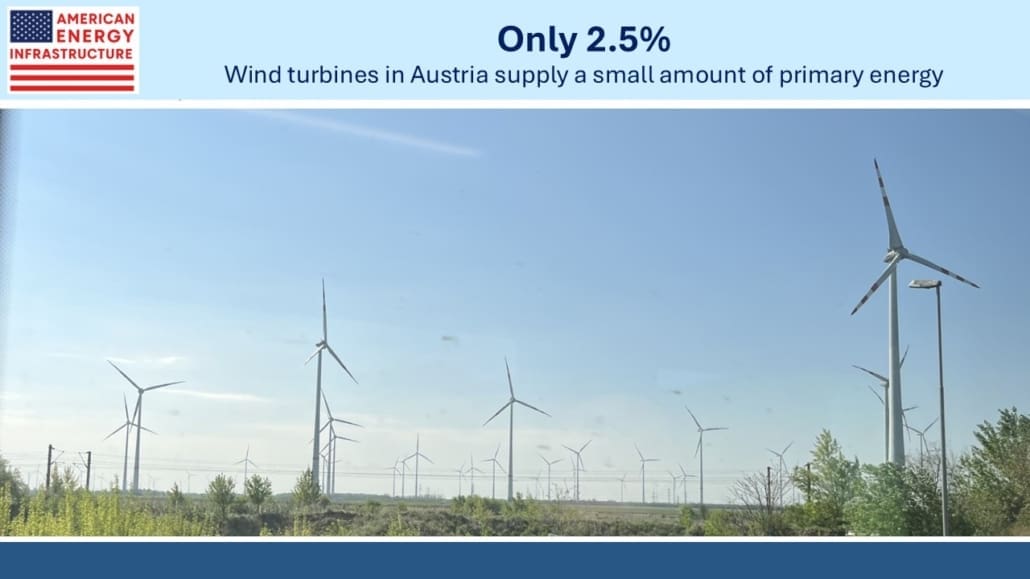
We saw wind turbines covering the countryside on a day trip to Bratislava. Wind provides about 12% of Austria’s power. However, since electricity is only 11-12% of their primary energy, wind is around 2.5% of that. Like most countries, they’ve found that it’s easier to increase renewables than to boost electrification.
EVs were often seen in Vienna, but we didn’t see any of the 3,000 charging stations operated by Wien Energie. Electricity prices are 80% higher than the US average and double Florida’s, unburdened as it is by blue state policies.
Europe is feeling the effects of the Iran War more keenly than the US, where the most visible impact has been to push gasoline above $4 per gallon. Globally, natural gas prices moved higher again last week and now sit halfway between their pre-war level and the highs reached in early March. Crude oil has similarly pulled back from its highs earlier last month, although spot transactions are at $20 or more per barrel above front month futures.
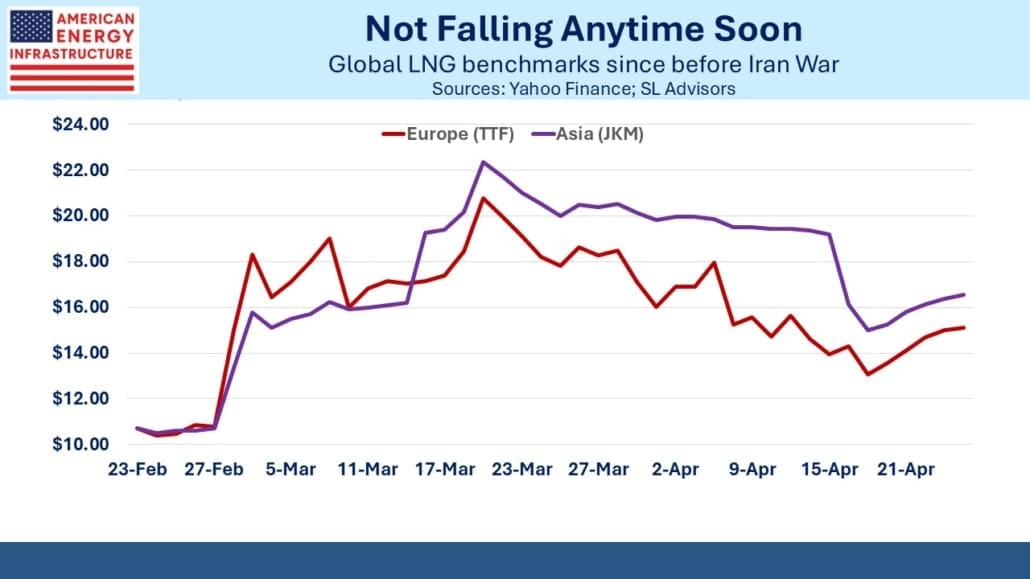
Europe is feeling the loss of LNG shipments from Qatar. Increased US deliveries have helped but only to a point. Industrial production, already in long term decline due to green energy policies, has suffered further. Voluntary energy saving measures are common across Europe. The EU has recommended countries reduce highway speed limits by at least 10 kph, but so far governments are relying on moral suasion to lower energy consumption.
Europe’s dysfunctional energy and security strategies are elegantly combined in the news that Russia has stopped sending crude oil from Kazakhstan to a refinery just outside Berlin, because Germany is Ukraine’s largest arms supplier. The PCK refinery supplies 90% of the region’s gasoline, jet fuel and heating oil.
The operations of PCK were taken over by Germany from Russia’s Rosneft as punishment for the invasion of Ukraine. Nonetheless, oil continued to flow since it suited both countries. The recent jump in prices has boosted Russia’s oil revenues, evidently allowing them to be more selective about whom they supply.
German policy, and by extension EU policy, has been to rely on Russia for energy and the US for protection from Russia. They need to revise their thinking.
Poland’s leader recently wondered, “…whether US is ‘loyal’ to Europe’s defense” a question which would prompt most Americans to ask what we’re getting in return.

Financial markets remain sanguine about the closure of the Strait of Hormuz. The economic pain is spreading. Beyond the obvious loss of oil and gas shipments, fertilizer and sulfuric acid are among those vital products whose prices have risen sharply. Sulfur is widely used in the production of fertilizer.
However, neither the US nor Iran seems motivated to open the Strait up. It’s increasingly clear that both countries would need to agree for normal shipping traffic to resume.
US farmers, who are generally in red states, are grumbling. Political commentators think unencumbered energy trade must resume before Memorial weekend to avoid having an impact on November’s midterms, but the US economy has as many winners as losers from elevated oil. This is the message from the stock market.
Kinder Morgan (KMI) kicked off pipeline earnings with a solid report last week, beating expectations in each business segment. Management raised full year EBITDA guidance by 3%.
The challenge for KMI’s peers may be meeting heightened forecasts from sell-side analysts. KMI now expects US natural gas demand to reach 150 Billion Cubic Feet per Day (BCF/D) by 2031, driven by LNG exports and data centers. The Energy Information Administration expects 110 BCF/D of demand this year.
In the same vein, the INGAA Foundation which advocates for the natural gas industry believes the US will need to add 70 BCF/D in new pipeline capacity by 2050. Gas is a growth business.

Finally, we extend our heartfelt congratulations to longtime friend and client Bill Shepherd, who turned 100 on April 25th. Bill is proud of his English roots, something we share and have often discussed over the years. If an unfailingly pleasant demeanor and good cheer promote longevity, it is little wonder that Bill has reached this milestone.
We have two have funds that seek to profit from this environment:

Important Disclosures
The information provided is for informational purposes only and investors should determine for themselves whether a particular service, security or product is suitable for their investment needs. The information contained herein is not complete, may not be current, is subject to change, and is subject to, and qualified in its entirety by, the more complete disclosures, risk factors and other terms that are contained in the disclosure, prospectus, and offering. Certain information herein has been obtained from third party sources and, although believed to be reliable, has not been independently verified and its accuracy or completeness cannot be guaranteed. No representation is made with respect to the accuracy, completeness or timeliness of this information. Nothing provided on this site constitutes tax advice. Individuals should seek the advice of their own tax advisor for specific information regarding tax consequences of investments. Investments in securities entail risk and are not suitable for all investors. This site is not a recommendation nor an offer to sell (or solicitation of an offer to buy) securities in the United States or in any other jurisdiction.
References to indexes and benchmarks are hypothetical illustrations of aggregate returns and do not reflect the performance of any actual investment. Investors cannot invest in an index and do not reflect the deduction of the advisor’s fees or other trading expenses. There can be no assurance that current investments will be profitable. Actual realized returns will depend on, among other factors, the value of assets and market conditions at the time of disposition, any related transaction costs, and the timing of the purchase. Indexes and benchmarks may not directly correlate or only partially relate to portfolios managed by SL Advisors as they have different underlying investments and may use different strategies or have different objectives than portfolios managed by SL Advisors (e.g. The Alerian index is a group MLP securities in the oil and gas industries. Portfolios may not include the same investments that are included in the Alerian Index. The S & P Index does not directly relate to investment strategies managed by SL Advisers.)
This site may contain forward-looking statements relating to the objectives, opportunities, and the future performance of the U.S. market generally. Forward-looking statements may be identified by the use of such words as; “believe,” “expect,” “anticipate,” “should,” “planned,” “estimated,” “potential” and other similar terms. Examples of forward-looking statements include, but are not limited to, estimates with respect to financial condition, results of operations, and success or lack of success of any particular investment strategy. All are subject to various factors, including, but not limited to general and local economic conditions, changing levels of competition within certain industries and markets, changes in interest rates, changes in legislation or regulation, and other economic, competitive, governmental, regulatory and technological factors affecting a portfolio’s operations that could cause actual results to differ materially from projected results. Such statements are forward-looking in nature and involves a number of known and unknown risks, uncertainties and other factors, and accordingly, actual results may differ materially from those reflected or contemplated in such forward-looking statements. Prospective investors are cautioned not to place undue reliance on any forward-looking statements or examples. None of SL Advisors LLC or any of its affiliates or principals nor any other individual or entity assumes any obligation to update any forward-looking statements as a result of new information, subsequent events or any other circumstances. All statements made herein speak only as of the date that they were made. r
Certain hyperlinks or referenced websites on the Site, if any, are for your convenience and forward you to third parties’ websites, which generally are recognized by their top level domain name. Any descriptions of, references to, or links to other products, publications or services does not constitute an endorsement, authorization, sponsorship by or affiliation with SL Advisors LLC with respect to any linked site or its sponsor, unless expressly stated by SL Advisors LLC. Any such information, products or sites have not necessarily been reviewed by SL Advisors LLC and are provided or maintained by third parties over whom SL Advisors LLC exercise no control. SL Advisors LLC expressly disclaim any responsibility for the content, the accuracy of the information, and/or quality of products or services provided by or advertised on these third-party sites.
All investment strategies have the potential for profit or loss. Different types of investments involve varying degrees of risk, and there can be no assurance that any specific investment will be suitable or profitable for a client’s investment portfolio.
Past performance of the American Energy Independence Index is not indicative of future returns.
Leave a Reply
Want to join the discussion?Feel free to contribute!