
The Long Term LNG Outlook Keeps Improving


/
LNG export terminals usually have the ability to export more than their nameplate capacity. This is how we exported a record 18.8 Billion Cubic Feet Per Day (BCF/D) of natural gas in March, compared with FERC’s estimated sustainable limit of 14.6-15 BCF/D.
Venture Global’s (VG) Plaquemines facility was the strongest at exceeding stated capacity. Cheniere’s Sabine Pass and Corpus Christi terminals were also above. This allowed both companies to take advantage of the spike in European LNG prices caused by the disruption of flows through the Strait of Hormuz.
VG expects more long term tightness in the LNG market over the long run (i.e. past 2030). Cheniere sees the need for increased supply but has a more cautious outlook. Reflecting these different opinions, VG keeps 30% or so of its liquefaction capacity uncommitted, which looks good at times like this. Cheniere keeps less than 5%. VG has more volatile earnings and stock price but expects to generate higher returns per unit of capacity than their rival.
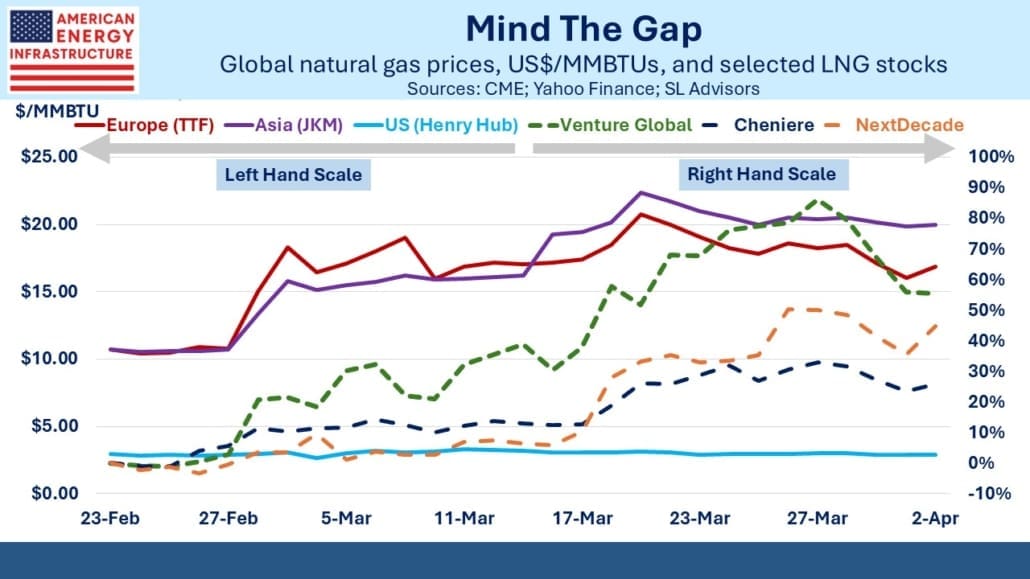
Consequently, as the European TTF benchmark dipped last week, VG pulled back sharply and disproportionately in response to the move in spot prices. It creates trading opportunities for those so inclined.
The longer term outlook for these two companies and global LNG demand in general remains strong. The EU is extraordinarily naive in their energy strategy. For years Germany has relentlessly promoted solar and wind. Under former Chancellor Angela Merkel, they decided to shut down their nuclear reactors in 2011, with the last unit closing in 2023.
Germany’s Economy Minister recently called for a rethink.
The EU has long insisted that natural gas consumption was temporary, to be phased out as part of their climate change goals. This prevented them from signing long-term contracts. Morgan Stanley says their last Qatari LNG cargo will be received on April 13th, after which they will lose 9% of their supply. They see European LNG prices reaching €90 per MWh by the fall, which would be up 80% from current levels and triple their pre-war price.
The bloc produces 43% of its primary energy consumption, because renewables are too expensive and inadequate to meet their needs. They are the most successful at de-carbonizing their economy, but at an enormous cost in output and energy security.
With imports from the Persian Gulf disrupted, the EU Energy Commissioner is warning that fuel rationing may be necessary. Having depended on the US for a credible defense against Russian aggression for decades, they don’t have the military capability to unblock the Strait of Hormuz and free up their energy imports.
President Trump’s flip comment that Europe should come and get its own oil is, as usual, outside the norms of discourse among national leaders but nonetheless highlights the EU’s strategic weakness.
VG, Cheniere and NextDecade (NEXT) are among the beneficiaries. VG CEO Mike Sabel is, “…tremendously optimistic about the middle- and long-term strength of the market.”
Cheniere has long argued that U.S. LNG is a reliable, flexible supplier that will benefit from any supply disruptions.
Other than the LNG exporters, midstream management teams have generally been quiet about how the Iran war is boosting their bottom-lines. US propane exports are running at 1.9 Million Barrels per Day (MMB/D), up a modest 3.8% year-on-year. Enterprise Products Partners and Energy Transfer, who do most of this business, have said little publicly since the war began.
Neither natural gas nor propane prices in the US are showing any response to tightening supplies globally, reflecting the regional nature of these markets and the difficulty of sharply increasing exports over the short run. Energy executives are probably happy to avoid headlines with gasoline prices ratcheting higher. The President’s TV speech on Wednesday did little to calm markets, and Iran continues to show resilience in its ability to hit back.
The Economist and the Financial Times, two publications I have enjoyed for decades, recently examined the effect of US tariffs a year after their implementation and arrived at opposite conclusions. This need not be surprising, except that both use manufacturing data to support their view.
The Economist (see “Liberation Year” has not freed American factories) notes that the US has shed 100K manufacturing jobs since Trump took office, even though the point was to boost domestic production. By contrast, the Financial Times (see The case for Trump’s tariffs looks strong a year on from ‘liberation day’) highlights that industrial production is +1.6% over the past year following decades of decline. They see a resurgence in manufacturing employment, pointing out that manufacturing jobs shrank by 93K since tariffs took place eleven months ago, compared with 167K over the eleven months prior.
Purchasing manager surveys show “increasing optimism” according to the FT, while the Economist finds the same survey, “…suggests that the sector spent most of 2025 in recession.”
Both articles overlook the biggest impact of tariffs, which was to impose a consumption tax on imported goods. This boosted customs duties by $185BN last year versus 2024. Given our fiscal outlook, such prudence is welcome if uncharacteristic. Moreover, Trump hails the extra revenue as sourced from foreigners while both the New York Federal Reserve and the Congressional Budget Office find the burden overwhelmingly falls on US consumers.
A populist president has imposed a highly regressive tax that is paid disproportionately by low and middle income Americans and is barely noticed by the 1% (at least among those I know living in Naples, FL).
That he has pulled this off while maintaining his populist credentials is quite a feat.
We have two have funds that seek to profit from this environment:

Important Disclosures
The information provided is for informational purposes only and investors should determine for themselves whether a particular service, security or product is suitable for their investment needs. The information contained herein is not complete, may not be current, is subject to change, and is subject to, and qualified in its entirety by, the more complete disclosures, risk factors and other terms that are contained in the disclosure, prospectus, and offering. Certain information herein has been obtained from third party sources and, although believed to be reliable, has not been independently verified and its accuracy or completeness cannot be guaranteed. No representation is made with respect to the accuracy, completeness or timeliness of this information. Nothing provided on this site constitutes tax advice. Individuals should seek the advice of their own tax advisor for specific information regarding tax consequences of investments. Investments in securities entail risk and are not suitable for all investors. This site is not a recommendation nor an offer to sell (or solicitation of an offer to buy) securities in the United States or in any other jurisdiction.
References to indexes and benchmarks are hypothetical illustrations of aggregate returns and do not reflect the performance of any actual investment. Investors cannot invest in an index and do not reflect the deduction of the advisor’s fees or other trading expenses. There can be no assurance that current investments will be profitable. Actual realized returns will depend on, among other factors, the value of assets and market conditions at the time of disposition, any related transaction costs, and the timing of the purchase. Indexes and benchmarks may not directly correlate or only partially relate to portfolios managed by SL Advisors as they have different underlying investments and may use different strategies or have different objectives than portfolios managed by SL Advisors (e.g. The Alerian index is a group MLP securities in the oil and gas industries. Portfolios may not include the same investments that are included in the Alerian Index. The S & P Index does not directly relate to investment strategies managed by SL Advisers.)
This site may contain forward-looking statements relating to the objectives, opportunities, and the future performance of the U.S. market generally. Forward-looking statements may be identified by the use of such words as; “believe,” “expect,” “anticipate,” “should,” “planned,” “estimated,” “potential” and other similar terms. Examples of forward-looking statements include, but are not limited to, estimates with respect to financial condition, results of operations, and success or lack of success of any particular investment strategy. All are subject to various factors, including, but not limited to general and local economic conditions, changing levels of competition within certain industries and markets, changes in interest rates, changes in legislation or regulation, and other economic, competitive, governmental, regulatory and technological factors affecting a portfolio’s operations that could cause actual results to differ materially from projected results. Such statements are forward-looking in nature and involves a number of known and unknown risks, uncertainties and other factors, and accordingly, actual results may differ materially from those reflected or contemplated in such forward-looking statements. Prospective investors are cautioned not to place undue reliance on any forward-looking statements or examples. None of SL Advisors LLC or any of its affiliates or principals nor any other individual or entity assumes any obligation to update any forward-looking statements as a result of new information, subsequent events or any other circumstances. All statements made herein speak only as of the date that they were made. r
Certain hyperlinks or referenced websites on the Site, if any, are for your convenience and forward you to third parties’ websites, which generally are recognized by their top level domain name. Any descriptions of, references to, or links to other products, publications or services does not constitute an endorsement, authorization, sponsorship by or affiliation with SL Advisors LLC with respect to any linked site or its sponsor, unless expressly stated by SL Advisors LLC. Any such information, products or sites have not necessarily been reviewed by SL Advisors LLC and are provided or maintained by third parties over whom SL Advisors LLC exercise no control. SL Advisors LLC expressly disclaim any responsibility for the content, the accuracy of the information, and/or quality of products or services provided by or advertised on these third-party sites.
All investment strategies have the potential for profit or loss. Different types of investments involve varying degrees of risk, and there can be no assurance that any specific investment will be suitable or profitable for a client’s investment portfolio.
Past performance of the American Energy Independence Index is not indicative of future returns.
Typical deceitful European response – “windfall” profit tax on energy companies inorder to cover for their ignorant energy policies. The EU will trade with the “devils” such as Russia and Iranian mullahs (with sanctioned Russian and Iranian oil refined in India and Turkey and imported into the UE). No surprise – extort the private sector for revenue to subsidize their grossly inefficient liberal socialism. The EU/UK are stagnant, aging, inefficient and corrupt societies.