
Midstream Earnings Delight Once Again


/
Energy Transfer (ET) is the name most widely owned among those financial advisors we know with direct investments in the sector. It is perennially cheap, and it’s a frequent topic of conversation. It’s also a significant position of ours, so it was especially pleasing to see their strong second quarter earnings.
As well as beating expectations across all business segments, ET raised full year EBITDA guidance from a midpoint of $18.7BN to $19BN. Power demand is an important driver of new projects. Much of their gas backlog is in energy-friendly Texas, where environmental extremists don’t have much luck in slowing projects through lawsuits.
ET raised their distribution by 3%, to a 6.7% yield where it’s more than 2X covered by Distributable Cash Flow (DCF). Even with a 24% one year total return, this still looks cheap to us although the MLP discount because of the K1 means it’s destined to remain cheap compared to its c-corp peers.
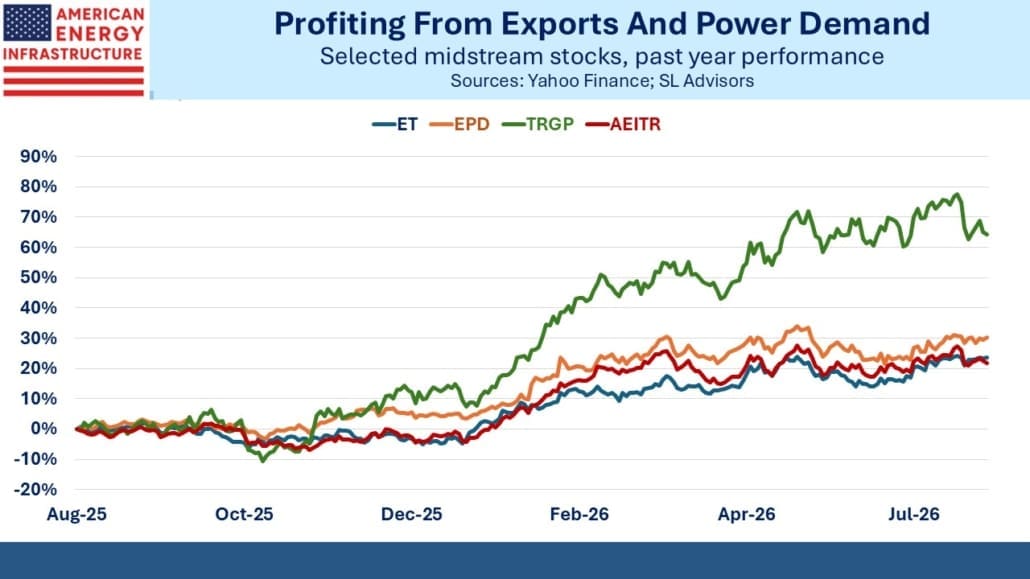
Targa Resources (TRGP) stock has the best one-year performance at +64%. The company’s vertical integration is routinely cited by analysts as their great strength. JPMorgan likes TRGP’s, “fully integrated well-to-dock Permian NGL value chain” as a differentiated growth story for years to come. Management teams often refer to “multiple opportunities to touch the molecule”, meaning they can charge a fee at each stage.
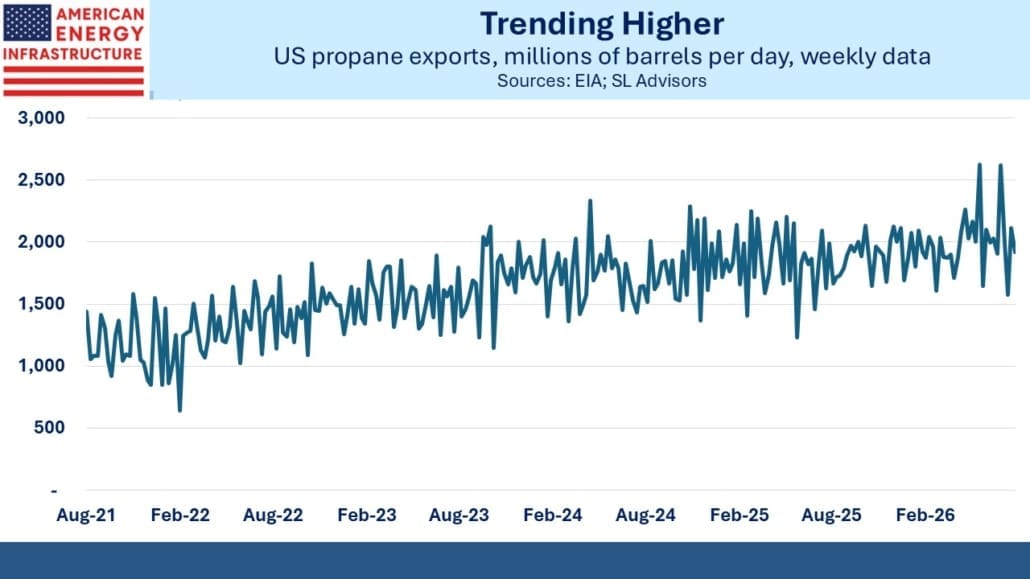
Natural Gas Liquids (NGLs) get less attention than oil and gas, but US exports of propane and butane (together Liquefied Petroleum Gas or LPG) are growing strongly with propane exports above 2 Million Barrels per Day (MMB/D), an almost doubling over the past five years. TRGP has exploited this. Over half our propane exports head to Asia with Japan, China, South Korea and India all important buyers.
TRGP is guiding to EBITDA growth of 17% this year although Thursday’s earnings report suggested they could do slightly better. JPMorgan is modeling 20% annual growth in per share DCF (applying an MLP valuation metric to a corporation for easy comparisons).
The +29% one-year return delivered by Enterprise Products Partners (EPD), while not as good as TRGP reflects the reliability of their underlying business. EPD has long been the dominant exporter of US NGLs, and growing demand has boosted their business as well. EPD has a similar MLP valuation discount to ET and currently yields 6% with 1.7X coverage.
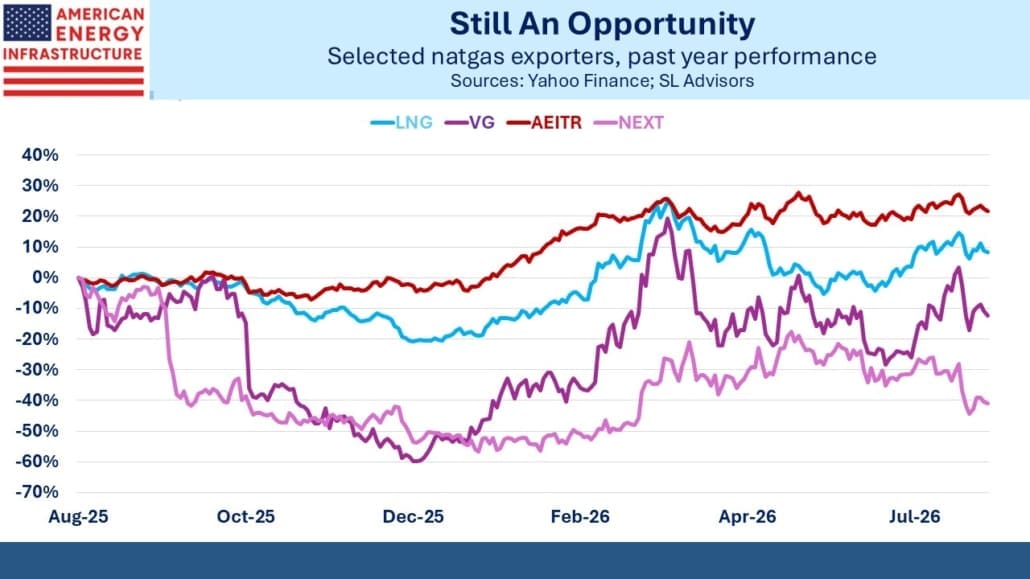
What continues to surprise us is the relative underperformance of the natural gas exporters. Propane exporters like EPD and TRGP have excited investors more than exporters of methane. Consequently, Cheniere (LNG), Venture Global (VG) and NextDecade (NEXT) all lagged the sector’s benchmark, the American Energy Infrastructure Index (AEITR), over the past year.
Once war with Iran broke out, they closed the gap somewhat, but we continue to think the market is underestimating their long-term advantage. Qatar’s reputation as a reliable provider of liquefied natural gas has been permanently damaged by its inability to resume regular shipments for over five months.
All three stocks react to daily swings in the Asian and European benchmarks. While VG is able to profit from the arbitrage against US prices, LNG has very limited spot capacity and NEXT isn’t even exporting yet. They all stand to benefit from Qatar’s facilities being permanently at risk of attack by Iran. Qatar’s existing counterparties must wish they had signed up with exporters unthreatened by Iran, like the US.
VG and NEXT are both still down over the past year and LNG is only +11%, even though the market environment for all of them has improved.
Cheniere’s 2Q earnings report on Thursday beat expectations, boosted EBITDA guidance and projected higher volumes. It’s hard to recall an earnings report where they haven’t done this, and with 95% of their liquefaction capacity pre-sold it’s even more impressive. Since the war with Iran started at the end of February, LNG is +12% and has outperformed its sector by 9%, a tepid reaction from investors towards one of the biggest winners of the conflict.
VG is +33% since the end of February. The performance gap between the two stocks shows that investors are focused on the near-term arbitrage opportunity caused by Qatar’s force majeure. The long-term disadvantage of relying on gas shipments within range of Iranian missiles hasn’t yet resonated with the market.
NEXT is –40% over the past year. The perceived threat from outdated fears of a global gas glut still hasn’t completely dissipated, although it’s +23% since hostilities began. They expect to begin commercial deliveries early next year. The start of tangible revenues should attract more discerning investors.
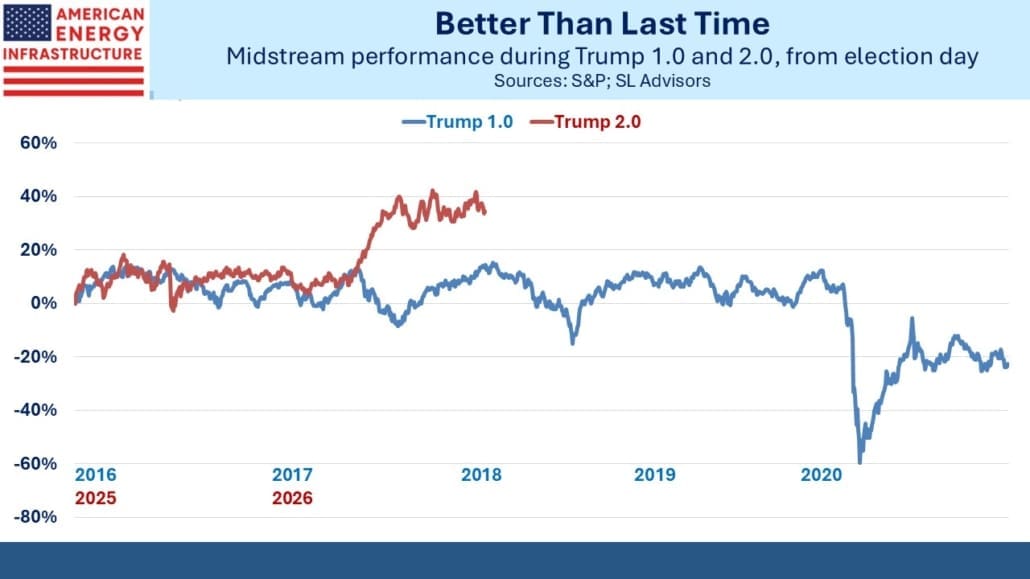
Meanwhile, midstream investors are doing better under Trump 2.0 than Trump 1.0, albeit with the unintentional support of White House policies.
We have two funds that seek to profit from this environment:

Important Disclosures
The information provided is for informational purposes only and investors should determine for themselves whether a particular service, security or product is suitable for their investment needs. The information contained herein is not complete, may not be current, is subject to change, and is subject to, and qualified in its entirety by, the more complete disclosures, risk factors and other terms that are contained in the disclosure, prospectus, and offering. Certain information herein has been obtained from third party sources and, although believed to be reliable, has not been independently verified and its accuracy or completeness cannot be guaranteed. No representation is made with respect to the accuracy, completeness or timeliness of this information. Nothing provided on this site constitutes tax advice. Individuals should seek the advice of their own tax advisor for specific information regarding tax consequences of investments. Investments in securities entail risk and are not suitable for all investors. This site is not a recommendation nor an offer to sell (or solicitation of an offer to buy) securities in the United States or in any other jurisdiction.
References to indexes and benchmarks are hypothetical illustrations of aggregate returns and do not reflect the performance of any actual investment. Investors cannot invest in an index and do not reflect the deduction of the advisor’s fees or other trading expenses. There can be no assurance that current investments will be profitable. Actual realized returns will depend on, among other factors, the value of assets and market conditions at the time of disposition, any related transaction costs, and the timing of the purchase. Indexes and benchmarks may not directly correlate or only partially relate to portfolios managed by SL Advisors as they have different underlying investments and may use different strategies or have different objectives than portfolios managed by SL Advisors (e.g. The Alerian index is a group MLP securities in the oil and gas industries. Portfolios may not include the same investments that are included in the Alerian Index. The S & P Index does not directly relate to investment strategies managed by SL Advisers.)
This site may contain forward-looking statements relating to the objectives, opportunities, and the future performance of the U.S. market generally. Forward-looking statements may be identified by the use of such words as; “believe,” “expect,” “anticipate,” “should,” “planned,” “estimated,” “potential” and other similar terms. Examples of forward-looking statements include, but are not limited to, estimates with respect to financial condition, results of operations, and success or lack of success of any particular investment strategy. All are subject to various factors, including, but not limited to general and local economic conditions, changing levels of competition within certain industries and markets, changes in interest rates, changes in legislation or regulation, and other economic, competitive, governmental, regulatory and technological factors affecting a portfolio’s operations that could cause actual results to differ materially from projected results. Such statements are forward-looking in nature and involves a number of known and unknown risks, uncertainties and other factors, and accordingly, actual results may differ materially from those reflected or contemplated in such forward-looking statements. Prospective investors are cautioned not to place undue reliance on any forward-looking statements or examples. None of SL Advisors LLC or any of its affiliates or principals nor any other individual or entity assumes any obligation to update any forward-looking statements as a result of new information, subsequent events or any other circumstances. All statements made herein speak only as of the date that they were made. r
Certain hyperlinks or referenced websites on the Site, if any, are for your convenience and forward you to third parties’ websites, which generally are recognized by their top level domain name. Any descriptions of, references to, or links to other products, publications or services does not constitute an endorsement, authorization, sponsorship by or affiliation with SL Advisors LLC with respect to any linked site or its sponsor, unless expressly stated by SL Advisors LLC. Any such information, products or sites have not necessarily been reviewed by SL Advisors LLC and are provided or maintained by third parties over whom SL Advisors LLC exercise no control. SL Advisors LLC expressly disclaim any responsibility for the content, the accuracy of the information, and/or quality of products or services provided by or advertised on these third-party sites.
All investment strategies have the potential for profit or loss. Different types of investments involve varying degrees of risk, and there can be no assurance that any specific investment will be suitable or profitable for a client’s investment portfolio.
Past performance of the American Energy Independence Index is not indicative of future returns.
Leave a Reply
Want to join the discussion?Feel free to contribute!