
A Healthy Correction


/
Normally I regard a “healthy correction” after a long rally as the description of those uninvolved. There’s nothing healthy about a market drop for the longs, regardless of if it was preceded by an extended rally, as is the case for energy this year. A sell-off under any circumstances is only good for shorts and market commentators bereft of more imaginative descriptions.
Nonetheless, the softening of global Liquefied Natural Gas (LNG) benchmarks, which was the catalyst for a sharp drop in the associated stocks, should not be unwelcome to investors.
A reporter asked me the other day what I worry about. I sleep pretty well, but the typical response of a midstream investor to that question is “demand destruction.” High prices are good in energy to a point, but eventually consumers start considering alternatives.
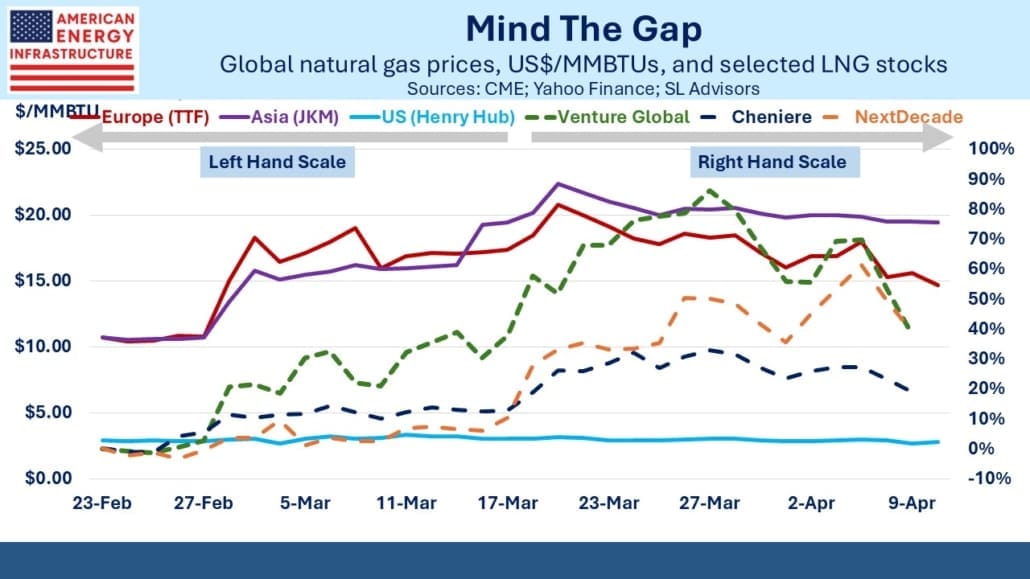
This is why last week’s drop in LNG prices was good for the long term. Exporters want global prices that are just below the point at which buyers start switching to alternatives. Several countries in Asia have increased their use of coal. Japan has given older, less efficient coal plants more freedom to operate. Thailand is restarting previously decommissioned coal power stations. India and the Philippines are planning to use more coal this summer. Meanwhile, NextDecade has filed with the Federal Energy Regulatory Commission (FERC) for a higher maximum work force at their Rio Grande facility in Texas. They’re seeking a cap of 7,500 (versus 5,225 currently) and the ability to work 24/7 on the construction site. An earlier completion date will boost cashflows.
In Europe, the switch to coal has been more muted because the region has been phasing out such power plants. Thermal coal prices are up around 15%, far less than LNG. None of this is going to help reduce emissions, but Russia’s invasion of Ukraine along with the closure of the Strait of Hormuz have made energy security a bigger concern. The EU has pursued the most aggressive decarbonization plans at the expense of secure energy supplies.
Regulations have been far-reaching, including a requirement next year that European importers of natural gas be able to verify the amount flared or leaked from the specific well(s) providing their supplies. Non-compliance could expose non-EU exporting companies to penalties as high as 20% of global revenues.
Unsurprisingly, this has hindered the bloc’s ability to find suppliers willing to risk such a penalty. With their energy strategy in shreds, the EU Commission’s director-general for energy Ditte Juul Jorgensen has promised “flexibilities”, since for most people keeping the lights on ranks above moderating greenhouse gas emissions. Europe’s airlines are also warning that supplies of jet fuel are running low with systemic shortages likely within three weeks. US exports to Europe are increasing.
Several investors have asked if the disruption to energy supplies will boost renewables. There’s no sign of it yet, but while solar and wind face many disadvantages from intermittency to cost and land use, they do provide energy security. We have long felt that this is driving China’s enormous investment in renewables, more than any concern about emissions, since they continue to consume more than half the world’s coal.
Higher energy prices will raise the construction costs of windmills and solar panels, but it still shouldn’t be surprising to see the biggest energy importers considering their supply mix.
Last week UK Prime Minister Keir Starmer said, “I’m fed up with the fact that families across the country see their bills go up and down on energy…because of the actions of Putin or Trump across the world,” Britain gets 30% of its electricity from wind, but that works out to be only 6-7% of its primary energy. For all the positive press left wing media heaps on solar and wind, they provide a small part of every country’s total energy needs.
Following Friday’s 3.3% CPI print, it’s worth remembering that midstream energy infrastructure is one of the few sectors with a business model that incorporates inflation protection. Several years ago Wells Fargo estimated that at least half the industry’s EBITDA benefitted from automatic price escalators on fees linked to PPI. Interstate oil and gas pipelines most commonly operate under this regime. Enterprise Products (EPD), Energy Transfer (ET), Williams (WMB), and MPLX often highlight this in their presentations. Other analysis has estimated that well over 60% of the industry’s EBITDA benefits from the PPI link. It’s an under-appreciated feature of the sector. Illustrating the sector’s strong cashflows, last month WMB raised its dividend by 5% quarter-on-quarter.
Look at last week’s weakening of LNG prices as some needed demand stimulus.
We have two have funds that seek to profit from this environment:

Important Disclosures
The information provided is for informational purposes only and investors should determine for themselves whether a particular service, security or product is suitable for their investment needs. The information contained herein is not complete, may not be current, is subject to change, and is subject to, and qualified in its entirety by, the more complete disclosures, risk factors and other terms that are contained in the disclosure, prospectus, and offering. Certain information herein has been obtained from third party sources and, although believed to be reliable, has not been independently verified and its accuracy or completeness cannot be guaranteed. No representation is made with respect to the accuracy, completeness or timeliness of this information. Nothing provided on this site constitutes tax advice. Individuals should seek the advice of their own tax advisor for specific information regarding tax consequences of investments. Investments in securities entail risk and are not suitable for all investors. This site is not a recommendation nor an offer to sell (or solicitation of an offer to buy) securities in the United States or in any other jurisdiction.
References to indexes and benchmarks are hypothetical illustrations of aggregate returns and do not reflect the performance of any actual investment. Investors cannot invest in an index and do not reflect the deduction of the advisor’s fees or other trading expenses. There can be no assurance that current investments will be profitable. Actual realized returns will depend on, among other factors, the value of assets and market conditions at the time of disposition, any related transaction costs, and the timing of the purchase. Indexes and benchmarks may not directly correlate or only partially relate to portfolios managed by SL Advisors as they have different underlying investments and may use different strategies or have different objectives than portfolios managed by SL Advisors (e.g. The Alerian index is a group MLP securities in the oil and gas industries. Portfolios may not include the same investments that are included in the Alerian Index. The S & P Index does not directly relate to investment strategies managed by SL Advisers.)
This site may contain forward-looking statements relating to the objectives, opportunities, and the future performance of the U.S. market generally. Forward-looking statements may be identified by the use of such words as; “believe,” “expect,” “anticipate,” “should,” “planned,” “estimated,” “potential” and other similar terms. Examples of forward-looking statements include, but are not limited to, estimates with respect to financial condition, results of operations, and success or lack of success of any particular investment strategy. All are subject to various factors, including, but not limited to general and local economic conditions, changing levels of competition within certain industries and markets, changes in interest rates, changes in legislation or regulation, and other economic, competitive, governmental, regulatory and technological factors affecting a portfolio’s operations that could cause actual results to differ materially from projected results. Such statements are forward-looking in nature and involves a number of known and unknown risks, uncertainties and other factors, and accordingly, actual results may differ materially from those reflected or contemplated in such forward-looking statements. Prospective investors are cautioned not to place undue reliance on any forward-looking statements or examples. None of SL Advisors LLC or any of its affiliates or principals nor any other individual or entity assumes any obligation to update any forward-looking statements as a result of new information, subsequent events or any other circumstances. All statements made herein speak only as of the date that they were made. r
Certain hyperlinks or referenced websites on the Site, if any, are for your convenience and forward you to third parties’ websites, which generally are recognized by their top level domain name. Any descriptions of, references to, or links to other products, publications or services does not constitute an endorsement, authorization, sponsorship by or affiliation with SL Advisors LLC with respect to any linked site or its sponsor, unless expressly stated by SL Advisors LLC. Any such information, products or sites have not necessarily been reviewed by SL Advisors LLC and are provided or maintained by third parties over whom SL Advisors LLC exercise no control. SL Advisors LLC expressly disclaim any responsibility for the content, the accuracy of the information, and/or quality of products or services provided by or advertised on these third-party sites.
All investment strategies have the potential for profit or loss. Different types of investments involve varying degrees of risk, and there can be no assurance that any specific investment will be suitable or profitable for a client’s investment portfolio.
Past performance of the American Energy Independence Index is not indicative of future returns.
Leave a Reply
Want to join the discussion?Feel free to contribute!