Energy Leads The Market
There were several positive news stories last week that helped propel the American Energy Infrastructure Index (AEITR) to +7% YTD, well ahead of the S&P500 which is +1%. Kinder Morgan’s (KMI) earnings unusually beat expectations. Moreover, their increased backlog of projects didn’t scare investors as much as it should given their perennially low Return On Invested Capital (ROIC, see Not All Growth Projects Are Good ). Most of their capex is in natural gas infrastructure. Investors concluded that even KMI must be able to generate an attractive ROIC providing gas to power data centers.
Venture Global (VG) prevailed in an arbitration dispute with Spain’s Repsol. They’ve won two (the first was Shell), lost one (BP) and settled one (Sinopec). Four remain outstanding. The worst fears following September’s loss to BP are not being realized. Consequently, the stock has rebounded 45% YTD.
VG’s plausible worst case if all the arbitration cases went against them including successful appeals by Shell and Repsol is around $6BN. The standard for challenging arbitration rulings is higher than in US civil courts. Industry lawyers think they’re unlikely to be successful.
Even after VG’s recovery this year, its market cap is still about $7.5BN below where it was in early September, before the Shell ruling. We think it looks cheap.
European LNG prices have been strong, which has increased the differential with the US Henry Hub benchmark. This increases the profit opportunity for LNG export terminals able to use some of their uncontracted liquefaction capacity to sell on the spot market (see Quantifying The Gas Arb). NextDecade (NEXT) seems to respond to this even though their Rio Grande facility won’t begin operations until late this year at the earliest. NEXT dipped early in the month but is now flat YTD.
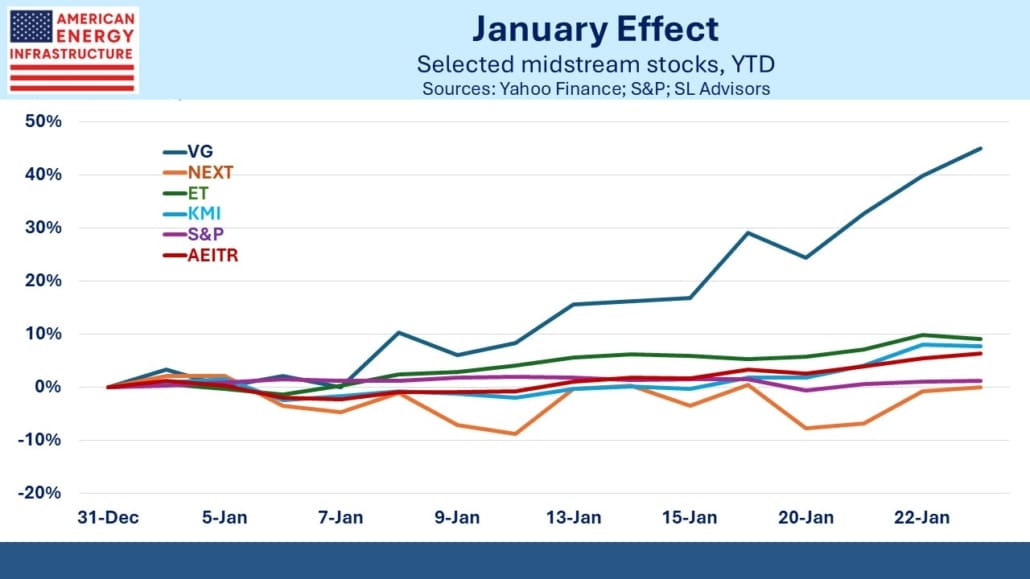
Energy Transfer (ET) has responded to the January effect that tends to boost MLPs (see What A Difference A Year Makes). Five years ago ET enjoyed a $2.4BN windfall gain from the disruption to the Texas gas market caused by Winter Storm Uri. As you read this on a Sunday morning, ET holders are wondering whether there will be a repeat. The Texas legislature responded to Uri with new laws on improved weather resilience and reliability.
We’ll soon see how effective that was.
Mitsubishi purchased the pipeline assets of Aethon in the Haynesville shale in Texas last week for $7.5BN, showing that foreign investors continue to find attractive valuations in this sector. They expect to profit from the world’s growing need for power.
US pipeline construction is set to reach an 18 year high this year, led by gas projects in Texas, Louisiana and Oklahoma. These will add around 18 Billion Cubic Feet per Day (BCF/D) of capacity and are intended to meet the twin demand drivers of data centers and LNG exports.
Capital is flowing into the sector, thanks to attractive valuations and unremarkable retail flows. Energy is the 2nd best performing S&P sector this year, just behind Materials.
In November, the Energy Information Administration (EIA) boosted their forecast of US oil production to 13.6 Million Barrels per Day (MMB/D). US drillers continue to find efficiencies, allowing output to remain firmer than last year’s declining crude price would otherwise dictate. The EIA reaffirmed their 13.6MMB/D forecast in a recent Short Term Energy Outlook, roughly flat with last year.
Presidential ruminations and dropped threats related to Greenland showed that midstream energy is less exposed than the broader market.
New Jersey’s recently elected Democrat governor Mikie Sherrill showed that the progressive drift in the Garden State continues. Voters evidently don’t mind reduced quality of life and affordability caused by high taxes and widespread construction of apartment buildings that are turning suburban towns into urban areas.
Sherrill wasted no time in signing an executive order promoting solar power and storage, instead of tapping into the vast supplies of gas in neighboring Pennsylvania. Over time, electricity will become more expensive and less reliable for NJ.
Elon Musk was interviewed in Davos last week by Blackrock’s Larry Fink. Musk thinks the production of AI chips will far outpace our ability to generate enough power to use them. He thinks space-based data centers, positioned to receive solar power 24×7, are “a no-brainer.”
Musk also offered some advice for living life, which might also be applied to golf: it’s better to be optimistic and wrong than pessimistic and right.
Finally, I am generally not an early adopter of new technology, so my latest ChatGPT discovery may strike savvier readers as ho-hum. Thanks to John O’Sullivan, friend and regular blog reader, I recently learned that the subscription version will create a daily email with news updates on the stocks we care about. It’s infinitely customizable, so through iterative feedback can be refined as needed. It helps research the blog, but the human touch will remain ascendant.
We have two have funds that seek to profit from this environment: