Pipelines Get Adult Supervision…Private Equity

Last week’s blog (see Plain Talk, Fuzzy Math) showed how Plains All American (PAA) miscalculates its cost of equity capital. Equity is the key component in a company’s Weighted Average Cost of Capital (WACC). In the presentation from their investor day, it was too low. We received several comments from readers and investors on the topic. The energy industry has been plagued with executives who value growth in assets over achieving an appropriate Return On Invested Capital (ROIC). Profits come from ensuring that a company’s assets earn a return higher than the cost of financing them, or that ROIC > WACC.
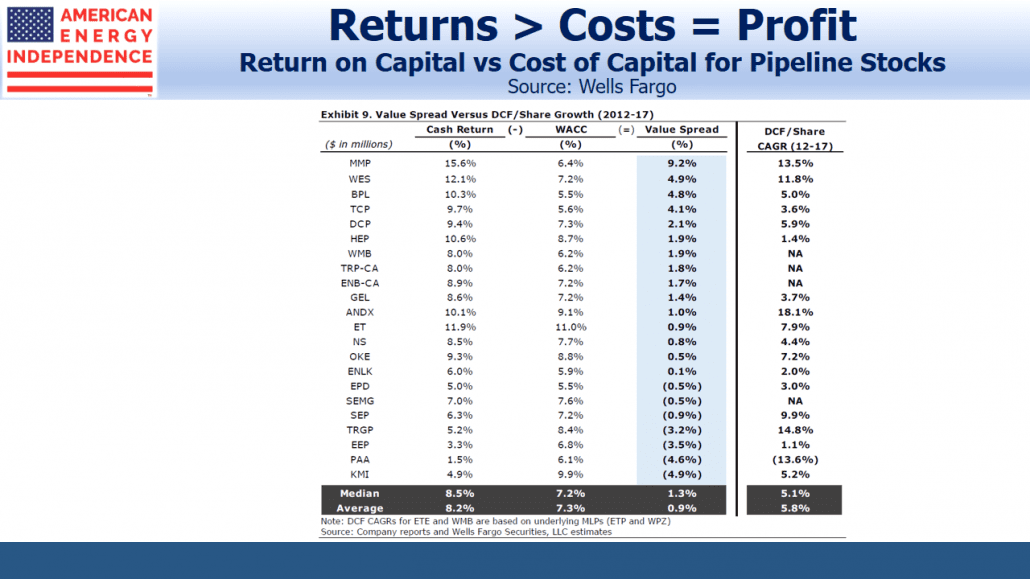
Return of Capital v Cost of Capital for pipeline companies

In one meeting with PAA, we asked if they’d considered selling themselves, since there’s a case that the company’s worth more in another’s hands. “Not yet ready to retire” was the answer. Financial discipline comes in many forms.

In too many cases, a CEO’s pay is directly linked to a company’s size. Per share operating metrics and capital efficiency ought to dominate. Management teams often strive for growth, which can conflict with an owner’s desire to earn a good return. Identifying companies where interests are more clearly aligned with investors is worthwhile.

Calculating ROIC for energy infrastructure businesses is tricky. Projects are funded over several years, and project-based returns are generally not disclosed. Therefore, some judgment is required. Wells Fargo made a serious attempt at calculating company-specific ROIC figures last year. A couple of companies (Enterprise Products and Plains) preferred their own methodology over that used by Wells Fargo, and their objections were duly noted in the research report. We explained in last week’s blog why we disagreed with PAA’s approach.
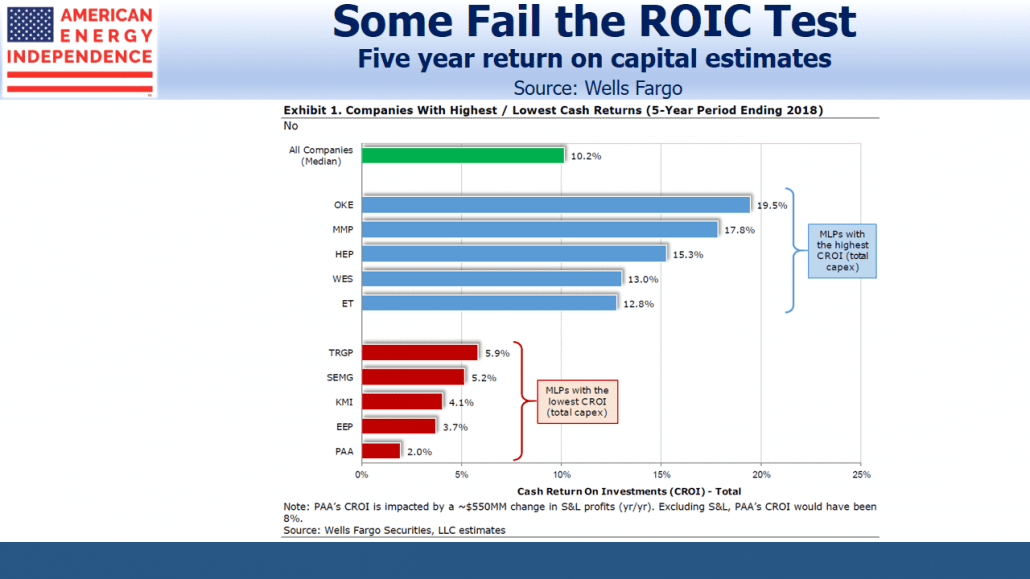
Pipeline Companies Five Year Return on Capital

One solution to poor capital allocation decisions is to favor public companies with a significant private equity investor. At first this might seem odd. Private Equity (PE) has delivered mediocre results for investors (see a recent WSJ article, Private-Equity Firms Are Raising Bigger and Bigger Funds. They Often Don’t Deliver). The problem for PE investors is the ubiquitous “2 and 20” fee structure, which is a big drag on returns and has created some fabulous fortunes. However, most PE managers are financially more astute than the typical pipeline company finance department. The best apply rigorous financial analysis, and investing alongside them can be an attractive proposition.
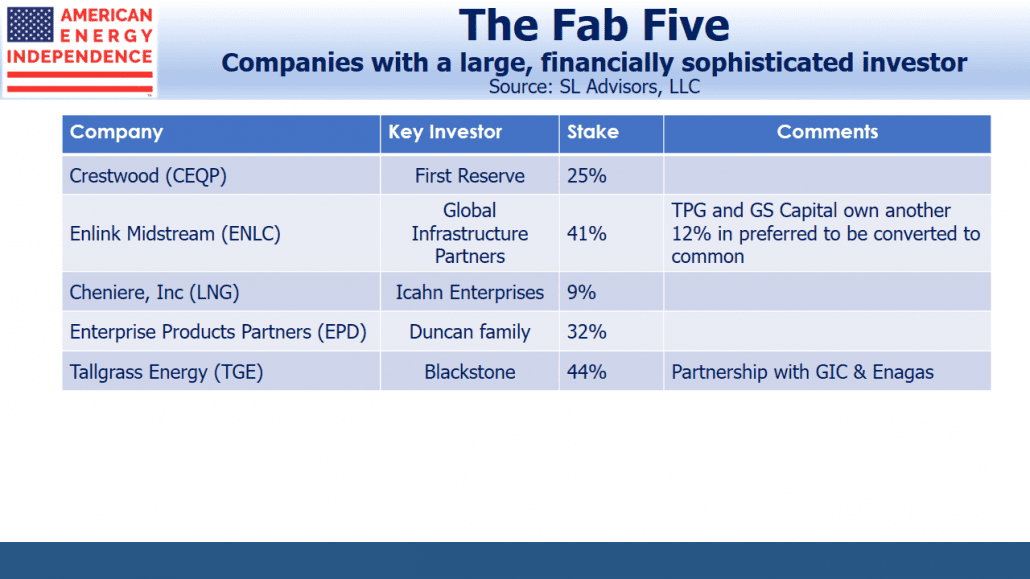
Pipeline companies with a large private investor

Having a PE partner doesn’t guarantee good judgment, but it does assure that when such decisions are being made, there will be a voice demanding a profitable spread between ROIC versus WACC. Private equity is all about capital efficiency and achieving an attractive IRR. Many energy companies could benefit from greater financial discipline. A few already have such a partner, reflecting the more optimistic outlook PE investors have of the sector compared with public market valuations.

Blackstone and its affiliates own 44% of Tallgrass Energy (TGE). Investors in TGE are in effect co-investing alongside Blackstone, without having to pay Blackstone a fee. It’s appealing to all TGE holders to know that capital allocation decisions require Blackstone’s support.

Crestwood (CEQP) is a similar situation, with their private equity partner First Reserve, who own 25% of CEQP and has also invested in JVs with CEQP on mutually beneficial terms.

Activists can also play a constructive role. In 2016 Carl Icahn pushed Cheniere’s (LNG) CEO Charif Souki out of the company. That’s one solution to the principal-agent problem. Souki is a colorful character (see Coals to Newcastle), but Icahn disagreed with LNG’s investments in oil companies, which were not linked to their core business of exporting liquefied natural gas. In an interview with CNBC, Icahn explained why, and also vented his frustration with Souki’s compensation. The subsequent improved capital allocation and focus on executing their core business plan has seen LNG stock rise from $39 at the time of Icahn’s intervention to $66 today, without paying a dividend.

Enterprise Products Partners (EPD) has a well-regarded reputation for prudent management. Growth projects are funded internally. The Duncan family owns a third of the company and controls EPD, helping align shareholder interests with managements.

Global Infrastructure Partners recently invested in Enlink Midstream (ENLC), and currently owns 41%. Texas Pacific Group and Goldman together own 12% in preferred securities which are convertible into common equity. It’s too early to judge the impact of their ownership, but encouragingly ENLC’s CEO Mike Garberding was previously the CFO. We think it’s highly likely that capital discipline will become apparent at ENLC.

Significant equity ownership by management doesn’t always lead to good decisions. Rich Kinder continued to add to his already significant holding in Kinder Morgan (KMI), even as it lost two thirds of its value from 2015-16. KMI investors could have benefitted from an influential outsider. Energy Transfer (ET) is also heavily owned by management, but trades at a steep valuation discount because CEO Kelcy Warren has shown a willingness to exploit his investors if he can (see Will Energy Transfer Act with Integrity?).

Prior to their simplification, the significant insider ownership at Plains may have led the GP to place too much leverage at the MLP level, leading to unsustainable dividends at the MLP before consolidation. In some cases, management teams whose interests weren’t aligned with investors under the old GP-MLP model have not yet altered their behavior to acknowledge the alignment of interests that simplification brings.

The addition of PE investors makes creating value for all stockholders a higher priority.  This requires disciplined capital allocation.  While Rich Kinder, Kelcy Warren, and the insiders at Plains still own significant stakes, they are holdovers from a different model of wealth creation.  Under their old structure, the GP directed the MLP’s activities while receiving preferential economics through Incentive Distribution Rights (IDRs).  Growing the MLP increased IDRs even if it diluted returns for MLP investors.

Kinder’s simplification was almost five years ago, and yet their continued use of DCF and EBITDA in evaluating their Enhanced Oil Recovery (EOR) business betrays that they still haven’t updated their thinking. Depleting assets such as these reduce the return earned by equity holders, while the GP and his IDRs are largely immune. As a simplified, single entity KMI still hasn’t shown that it understands its long term ROIC for the EOR business.

Plains is using flawed math for capital allocation decisions.  And, Kelcy may be back on the hunt for acquisitions to continue building his pipeline empire at ET.

The energy sector has been roundly criticized for overinvesting. Investors who favor companies where the rigor of PE analysis is applied to future projects could find that better capital allocation decisions follow. In our portfolios, we are biased towards companies likely to choose their investments wisely.

We invest in CEQP, ENCL, EPD,  ET, LNG, KMI, TGE, PAA via Plains GP Holdings.

SL Advisors is the sub-advisor to the Catalyst MLP & Infrastructure Fund.  To learn more about the Fund,  please click here.

SL Advisors is also the advisor to an ETF (USAIETF.com).


Oil and Gas Growth Powered by U.S.

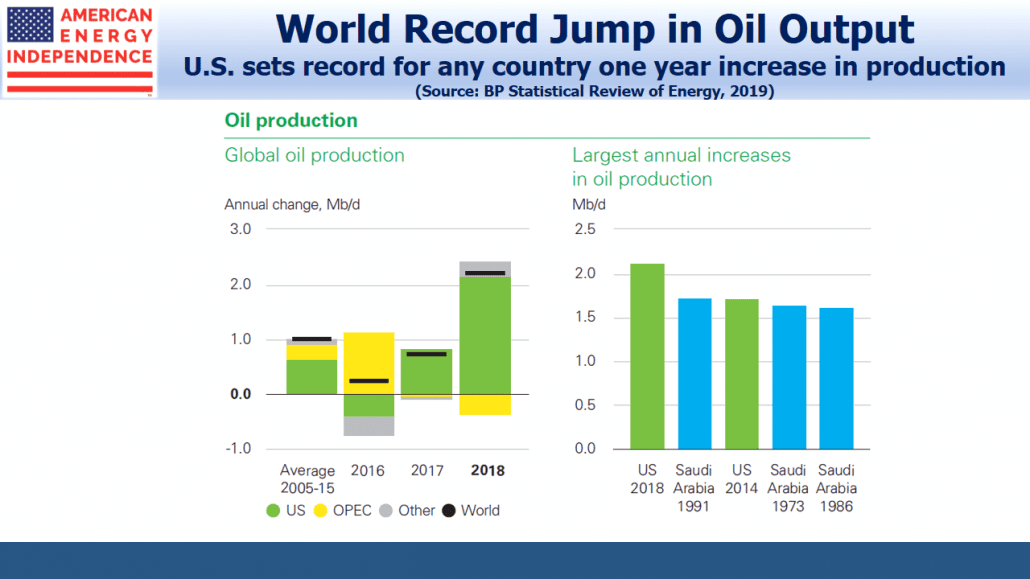
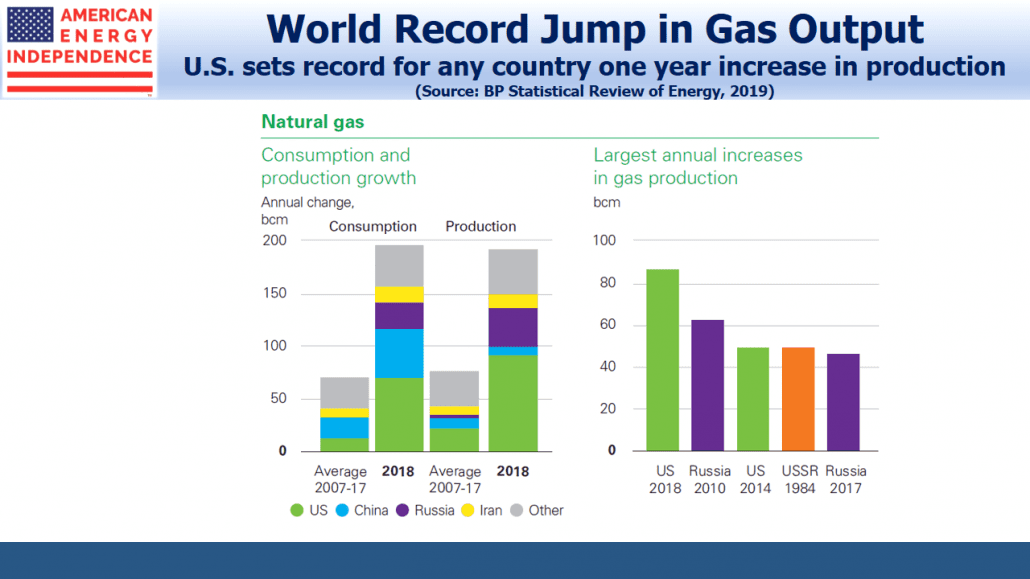
Last year the U.S. set a new world record for annual increase in production of oil and gas by any country in history. The recently-released BP Statistical Review of World Energy 2019 highlights these and many other useful facts.

U.S. Sets Record in Oil Production

U.S. sets World Record in Natural Gas Production

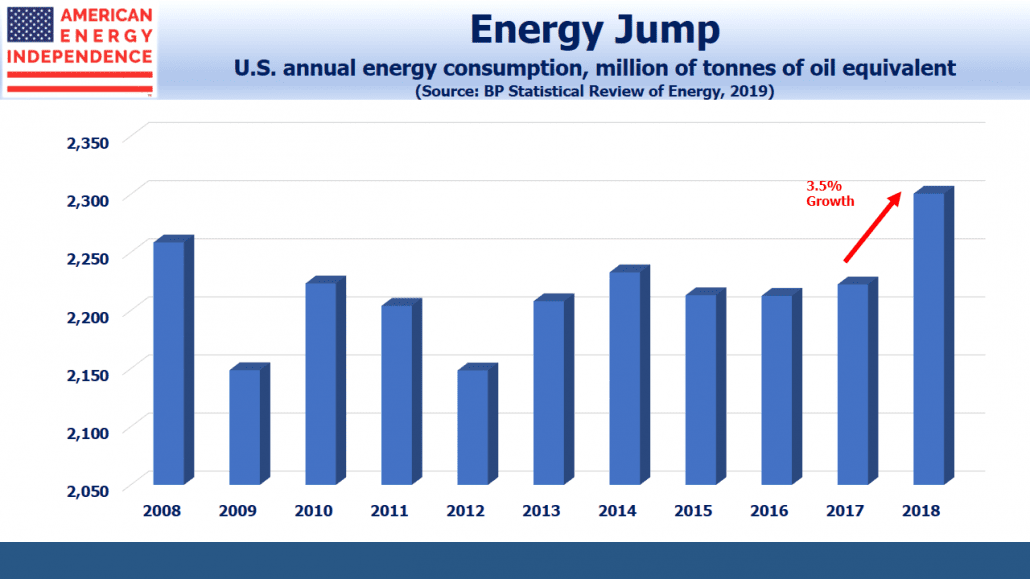
Total U.S. energy consumption rose by 3.5% last year, the fastest in 30 years and a surprising jump following a decade of no growth. Growth in population and GDP have normally been offset by lower energy intensity and improving efficiency. But periods of extreme weather (both excessive heat and cold) boosted energy demand, as well increased use of ethane for America’s resurgent petrochemicals industry.

US Annual Energy Consumption

The U.S. was one fifth of the 2018 increase in global energy consumption, with China and India together representing half. Climate change and CO2 emissions figured prominently in the report. Developed countries desire lower emissions and emerging countries higher living standards. China consumes 42% more energy than the U.S., a gap that will grow in the decades ahead. The resolution of these conflicting goals dominates the outcome.

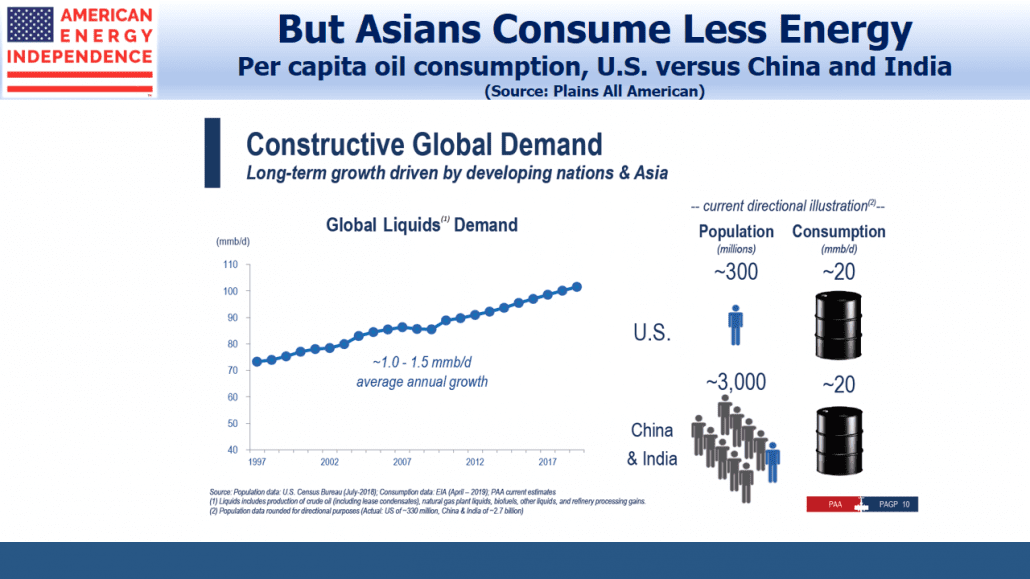
Per Capita Oil Consumption US v China and India

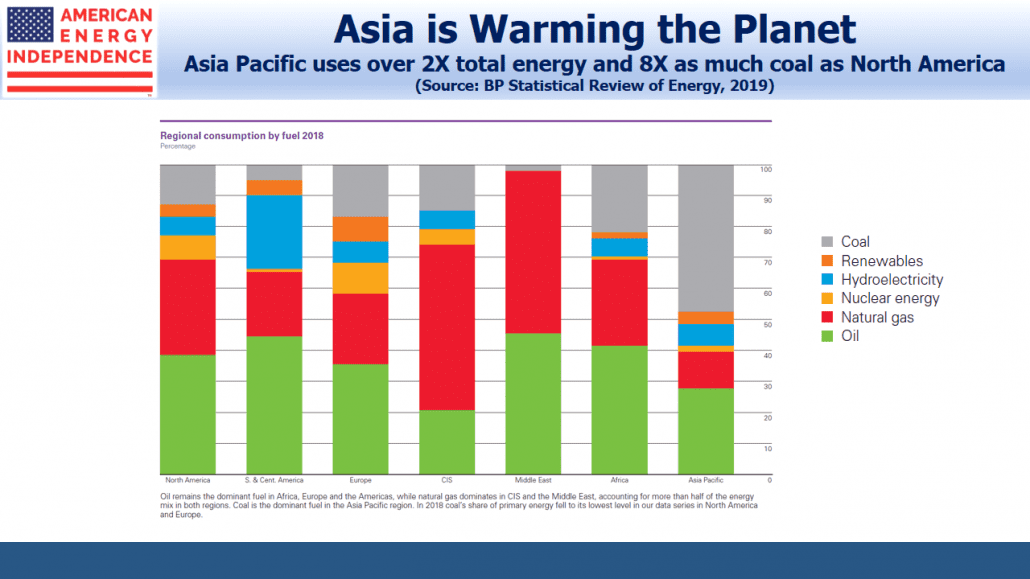
So it’s worth noting that the Asia-Pacific region energy consumption is more than double North America’s, and half of this comes from coal. The difference in coal volumes is by a factor of 8X. China alone consumes 6X as much coal as the U.S. But to illustrate unmet energy demand, China and India’s per capita consumption of crude oil is only 10% that of the U.S.

World Energy Consumption by Fuel

Until we confront these twin issues, little else that’s done to reduce emissions will have much impact.

Global carbon emissions grew by 600 million tons, or around 2%, the fastest for many years. This is the equivalent of increasing the global passenger car fleet by a third. Last week, India’s Adani Mining won Australian regulatory approval to begin developing one of the world’s largest untapped coalmines. Its critics contend that this project alone will eventually add 700 million tons of CO2 emissions, exceeding last year’s global increase from all sources. This is where India’s desire for more energy to raise living standards manifests itself. New York’s environmental extremists opposing a new natural gas pipeline might consider where the real problem lies.

Increased use of renewables alone will not solve the issues of climate change. BP notes that simply maintaining carbon emissions from the power sector at 2015 levels would have required growth in renewables generation at more than double the actual rate. The additional output is equal to all of the U.S. and China’s 2018 energy output from renewables.

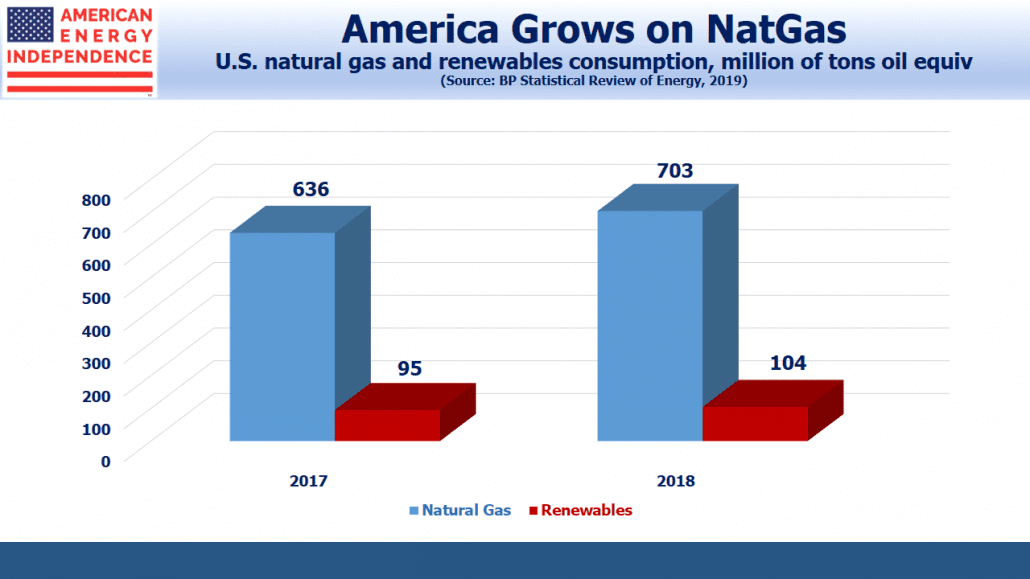
US Natural Gas and Renewables Consumption

Natural gas provided 43% of the additional power the world consumed, more than twice that provided by renewables. For all the excitement about increasing use of solar and wind, their share rose by 1.4%. 84.7% of the world’s energy came from fossil fuels in 2018, versus 85.1% in 2017. As Bill Gates and others have pointed out, R&D should be directed towards making the 85% less carbon intensive, rather than trying to replace what obviously works.

Netpower is developing the ability to generate electricity from natural gas with no emissions, which would represent a significant breakthrough if successful.

It’s still possible to find writers warning of a production collapse because of shale’s chronic unprofitability.  An article on Seeking Alpha (see Here’s Why Oil Stocks Are Priced For Armageddon) or Bethany Mclean’s Saudi America: The Truth About Fracking and How It’s Changing the World both reflect a simplistic view. Exxon Mobil (XOM), now the biggest driller in the Permian, clearly finds it profitable. Anadarko had two suitors for its Permian assets. Volumes keep growing, in defiance of some writers’ claims to better understand the economics.

BP’s report showed that the 2.2 Million Barrels per Day (MMB/D) of increased global crude oil production came from the U.S., a point echoed in Plains All American’s (PAA) Investor Day.

The path to lower global emissions requires far more use of nuclear power, far less coal use in China and India, and more R&D into using existing energy sources more efficiently. Otherwise, investments in seawalls and flood mitigation will be a safer bet.

We are invested in PAA, via Plains GP Holdings.

SL Advisors is the sub-advisor to the Catalyst MLP & Infrastructure Fund.  To learn more about the Fund,  please click here.

SL Advisors is also the advisor to an ETF (USAIETF.com).


Plain Talk, Fuzzy Math

Plains All American (PAA) held their investor day last week. Continued growth in output from the Permian in West Texas is driving new pipeline construction, for which PAA is at the forefront. Limited pipeline capacity has hurt economics for some drillers that have resorted to trucks to move their crude, which is far more expensive.

PAA’s Supply and Logistics (S&L) business thrives on infrastructure constraints, since it allows them to exploit basis differentials using spare capacity on their pipeline network. From 2014-17 S&L EBITDA collapsed by 90%, as spare capacity came online. It has since rebounded to $450MM, around two thirds of its 2014 peak.

One analyst asked about the impact of new pipelines, both on the S&L business (where PAA expects to see EBITDA drop 50% next year) as well as on existing pipelines which face possible cannibalization of demand:

“You’re creating your own weather when you think of the S&L impact…there’s a lot of moving parts here…Loss of marketing, loss of basin flows, loss of potentially some spot barrels on Bridgetex”

Executives wouldn’t be drawn into discussing the impact in more detail, which was a pity because an investor day is supposed to offer an opportunity to dig more deeply into a company’s business. The response was:

“The guidance for this year fully reflects our views of how that impact is…we’ll give guidance later in the year for 2020… I don’t think we’re going to specifically work towards guidance during this meeting today, that’s not the intent.”

This interaction captures the conundrum facing investors. The Shale Revolution’s dramatic increase in oil and gas production isn’t yet profiting midstream infrastructure investors. One reason is fear that the industry will overbuild, pressuring pipeline tariffs and leading to projects that fail to cover their cost of capital.

PAA laudably tried to demonstrate financial discipline with two slides illustrating how they think about their cost of capital versus their return on invested capital. For any company, the spread between these two is the main source of profits.

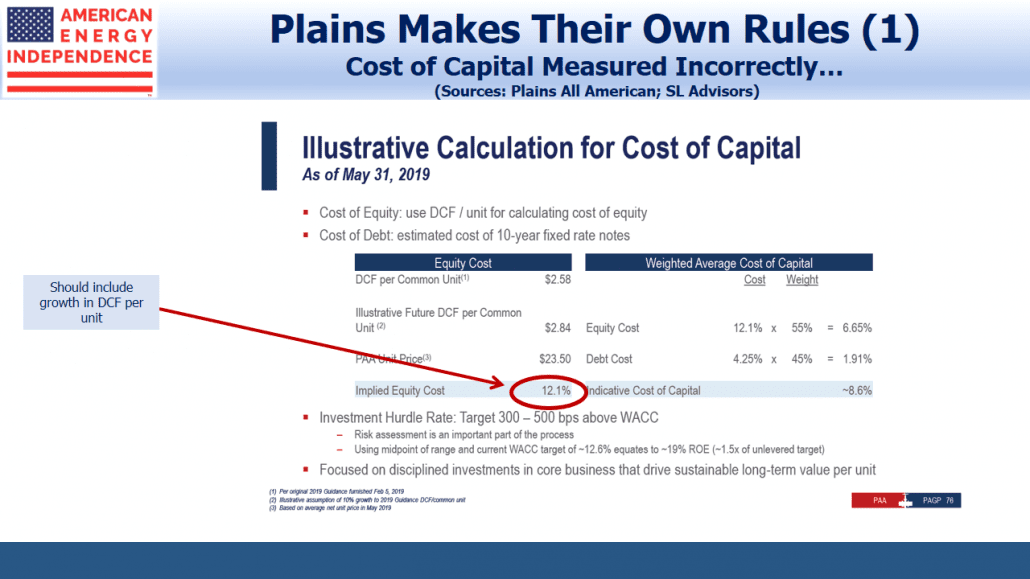
Cost of Capital PAA

So it was disappointing to see errors and omissions. Distributable Cash Flow (DCF) as a cost of equity was based simply on the current DCF yield without adding anticipated long term growth, though investors are told to expect such growth of 10% this year and presumably further growth beyond.

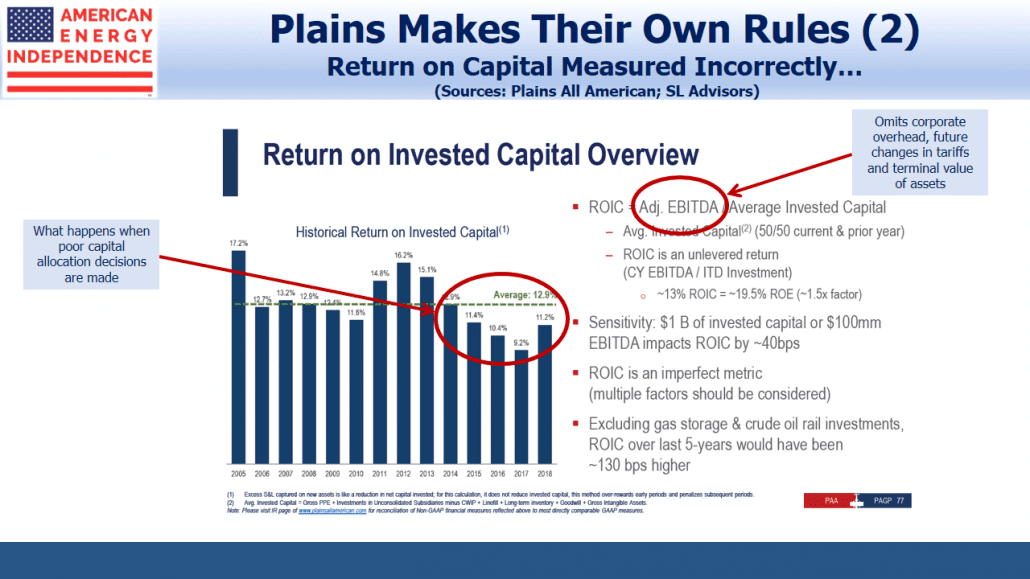
Return on Invested Capital PAA

The problem in using current EBITDA as the basis for assessing projects is that it doesn’t reflect the long term return on assets with years of useful life and fluctuating tariffs. It omits corporate overhead, maintenance, cost for potential delays and cost overruns. Most investors calculate the net present value of cashflows from a proposed investment, discounted using a rate appropriate to the risk.

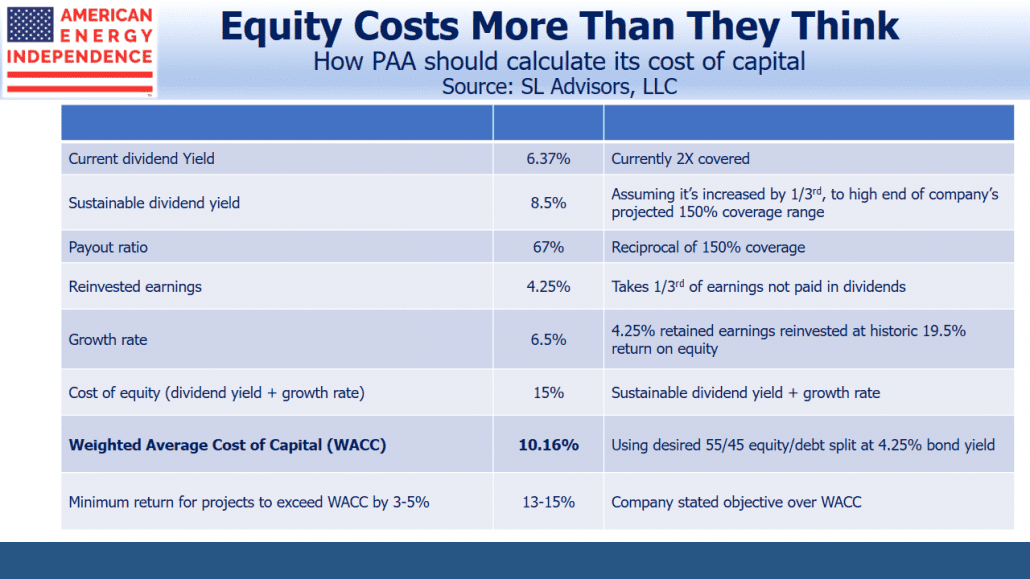
How PAA Should Calculate its Cost of Capital

PAA isn’t calculating their cost of equity properly. More correct would be to use the dividend yield plus long term expected growth rate. The growth rate is derived from the portion of retained earnings not paid out (i.e.  1 minus the payout ratio) times the return on equity, which PAA shows has historically been 19.5%.

Although they’re targeting 130-150% coverage of their distribution, it’s currently 2X. Raising the dividend such that it was 150% covered would give them a yield of 8.5% (versus 6.37% currently). 150% coverage  equals a 67% payout ratio. 1 minus the payout ratio, or 33%, times their 19.5% ROE, implies a 6.5% growth rate, which should be added to the projected 8.5% dividend yield.

So PAA’s own figures and assumptions suggest their cost of equity is really around 15%, not the 12.1% they presented. PAA’s Weighted Average Cost of Capital (WACC), using their desired 55/45 equity/debt split and with a 4.25% interest rate on their debt, is almost 10.2%, 1.6% higher than they presented.

Since they seek an investment return of 3-5% above their WACC, any project needs a return of 13-15%. Riskier projects need an even higher return than this. The Alpha Crude Connector acquisition failed to meet this hurdle.

This minimum return on new projects is further illustrated through their desired leverage of 3-3.5X Debt:EBITDA. Assuming they continue to finance their investments with 45% debt, anything new must have an EBITDA multiple (i.e. cost of investment divided by EBITDA) of no higher than 7X. 3.25 leverage (the midpoint of their 3-3.5 range) divided by 45% debt share of finance is 7.2, which equates to around 14% (1 divided by 7.2), the midpoint of the required return we calculated based on their WACC.

The 55/45 ratio between equity and debt could be unsustainable if EBITDA falls. For example, a manageable 4X Debt:EBITDA leverage ratio would become an unsustainable 8X if EBITDA later dropped by half. Building in the possibility of lower tariffs in the future means debt should be less than 45% of the capital, which raises the WACC since equity is more expensive.

It’s also why you want to own strategic assets that don’t face huge drop-offs in revenues after initial contracts expire.

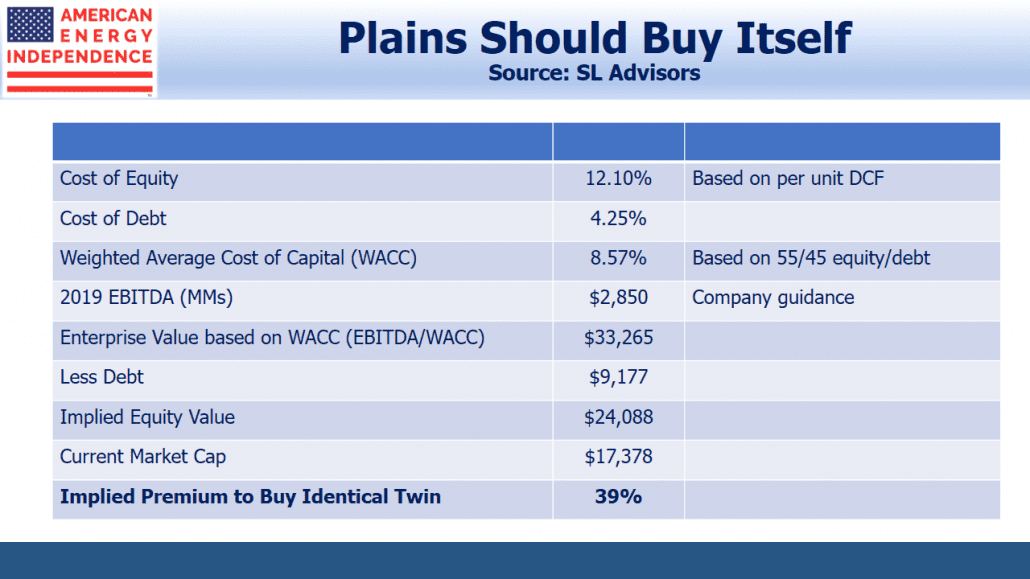
The flaw in PAA’s math can be illustrated by showing that they’d be willing to raise capital at today’s cost to buy an identical enterprise to their own, with identical EBITDA. Using their own cost of capital and 2019 EBITDA, they’d value this twin at over $33BN. Adjusting for debt, the twin’s equity would be worth $24BN, compared with PAA’s current market cap of only $17BN. Their math allows that PAA could pay up to a 39% premium to buy a business identical to what they own before the acquisition would no longer be accretive.

This is why investors are usually unenthusiastic when management teams announce another growth project. PAA, like most of its peers, should be more willing to repurchase shares.

The stock’s poor performance over the past five years is due to poor capital allocation decisions, probably driven by faulty logic such as described here.

No sell-side analyst pointed this out, but the shareholders who have lived it understand the flaws in PAA’ internal investment process.

Meanwhile, PAA is a cheap stock, trading at just 8X cash flows that are growing, assuming management is more prudent with investors’ money than over the past five years. The industry’s fortunes will turn on correctly calculating the spread between cost of, versus the return on, invested capital.

We are invested in PAA, via Plains GP Holdings.

SL Advisors is the sub-advisor to the Catalyst MLP & Infrastructure Fund.  To learn more about the Fund,  please click here.

SL Advisors is also the advisor to an ETF (USAIETF.com).


Can Trump Manage the Economic Cycle?

The current economic recovery, launched out of the cauldron of the 2008-09 financial crisis, continues to percolate. Directly following the 2016 presidential election, many stunned observers forecast numerous types of disaster. So far, those dire predictions have been wrong, although the future always provides lots to worry about

The cancellation of tariffs with Mexico fits the Trumpian pattern of seizing what’s on offer and declaring victory – not difficult when no lines had been publicly drawn in the sand. The president’s 2020 re-election campaign remains an important element in U.S. economic policy (see The Trump Put).

Tariffs on Mexican imports would have been disruptive to sectors such as autos, given the integrated supply chains made possible by NAFTA. Republicans in Congress were considering blocking them. The protracted dispute with China has dampened growth somewhat, but the consequent political pressure has, oddly, fallen more on the Fed than the White House.

Six months ago, Fed chair Jerome Powell carelessly allowed that multiple rate hikes might be coming: “Maybe we’ll be raising our estimate of the neutral rate and we’ll just go to that, or maybe we’ll keep our neutral rate here and then go one or two rate increases beyond it.” (see Bond Market Looks Past Fed).

Those hawkish comments were quickly walked back, while Trump has continued to call for lower rates.  Some view this as challenging the Fed’s independence. Ironically, much of the justification for lower rates lies with the constraints being placed on trade with China, policies implemented by the White House. Last week Powell said, “We do not know how or when these issues will be resolved.” He continued, “We are closely monitoring the implications of these developments for the US economic outlook.”

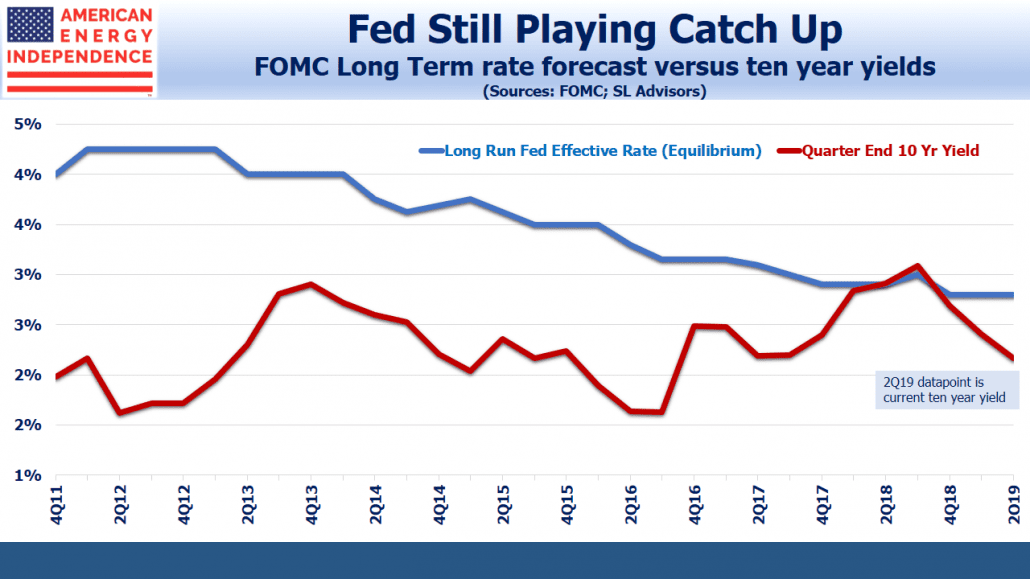
Once again, the Federal Open Market Committee’s (FOMC) “blue dots” are exposing how far behind the market they are. The FOMC’s long run equilibrium rate for the Fed Funds rate remains at 2.8%. Ten year treasury yields, a decent proxy for the average expected short term rate over the next decade, are much lower, at 2.17%.

FOMC Forecast vs 10YT Yield

For years the Fed has been lowering their policy guidance, lagging a process well anticipated by bond investors. Futures markets are predicting almost three rate cuts over the next year, while FOMC projections are for unchanged policy.

On current form, it’s likely the Fed will “independently” grant Trump’s desired rate cuts. Don’t be surprised if Chinese trade tensions are then resolved in time for the election. It seems to be how things work nowadays.

SL Advisors is the sub-advisor to the Catalyst MLP & Infrastructure Fund.  To learn more about the Fund,  please click here.

SL Advisors is also the advisor to an ETF (USAIETF.com).


Miscounting America’s Crude

Wednesday’s report on crude oil stocks from the Energy Information Administration (EIA) showed a sharp jump in storage of 1 million barrels per day (MMB/D). Given the already fragile mood around tariffs slowing GDP growth, crude oil prices predictably slumped.

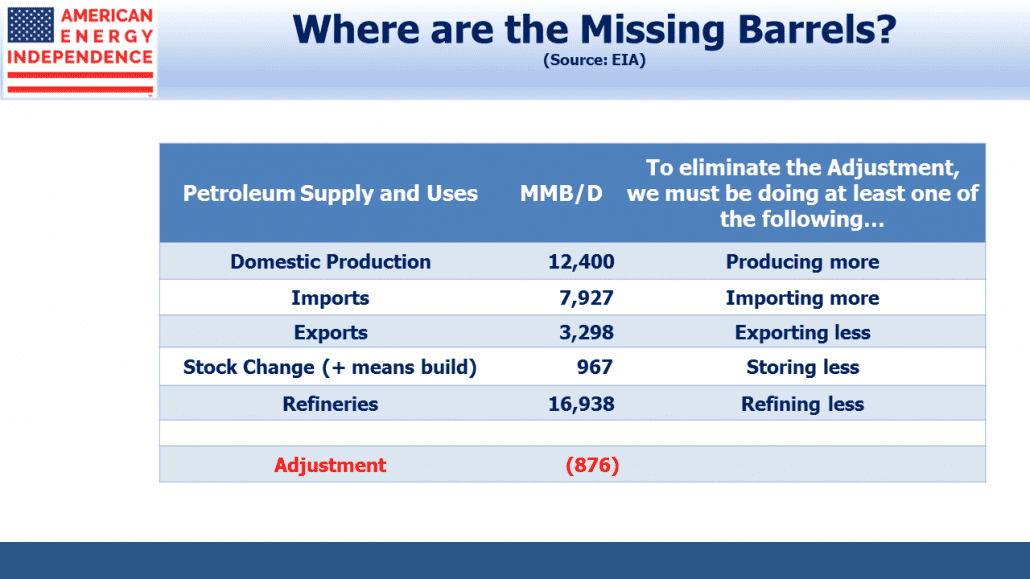
Interestingly though, over the past year the “Adjustment”, or fudge factor which is used to make the numbers add up, has grown substantially.

In simple terms, the EIA counts production, exports, imports, change in storage and refinery usage. This should pick up every barrel of oil moving through the U.S. It must frustrate the EIA’s number crunchers that the figures never foot, so they use a balancing item which used to be called “Unaccounted for Crude Oil”, nowadays simply the Adjustment. Since June 2018, the Adjustment has almost tripled.

Over the past year, crude oil used by U.S. refineries has been stable. Because much of America’s increased production is light crude from the Permian ill-suited to domestic refineries, imports have also remained unchanged. Higher exports have absorbed most of the increase in output.

The Adjustment exists solely because one of the other figures is wrong. So we’re refining more, exporting more, importing less, storing less or producing more than reported. Of these five different items, some should be easier to measure than others. The refinery figure seems unlikely to be far wrong; refineries must know what they’re using and there are 135 refineries in the U.S. from which to gather information.

Similarly, imports must surely be correct since the government licenses imports, and counting exports would also seem reasonably straightforward – the number of points of exports (cross-border pipelines and crude-loading export facilities) are known and not that numerous.

However, in reviewing the EIA’s methodology for calculating exports, they rely heavily on data from the U.S. Customs Border Protection (CBP) as well as figures from Statistics Canada (since exports to Canada don’t require a U.S. export license). The EIA runs the data through estimation models that they believe improve its accuracy. In some cases they’re using monthly data, even though their report is weekly.

There are many types of petroleum product beyond crude oil, including finished motor gasoline, kerosene, distillate and residual fuel oil among others. And the granting of an export license need not coincide with the physical shipment of the product. So it’s a more complex task than you might suppose.

Storage would also seem straightforward. Storage terminals are hard to miss. So the 967 thousand barrels per day (MB/D) build in storage ought to be reliable. Since the prior week saw a 41 MB/D decrease in storage, crude traders inferred softening demand.

But storage has its own complexity, since crude oil sitting on a tanker awaiting unloading is, in effect, floating storage. A possibility suggested by one sell-side firm is that floating storage was drawn down sharply. This presumes that several million barrels of crude was in tankers bobbing within U.S. territorial waters, already counted as imported but not yet unloaded. If true, this would mean the apparent jump in onshore storage was offset by a drawdown in floating storage, making the report far less bearish.

While this could explain the sudden, one-time shift in the storage figure, the Adjustment was the same last week, which undercuts the logic behind this explanation.

This brings us back to production, currently estimated at 12.4 MMB/D. Of the line items in the EIA’s report, it seems to us that this one is most plausibly the source of the growing Adjustment. There are around a million wells in the U.S. producing crude oil, from some decades old dribbling out a few barrels a day to new Permian wells producing 10 MB/D or more. We think it’s likely that the EIA is somehow undercounting crude oil output.

Flaring of associated natural gas in the Permian recently hit 661 million cubic feet per day (MMCF/D), up sharply from the previous high late last year of 450 MMCF/D. This reflects growing crude oil production. The continued shortage of take away infrastructure in the region to handle the natural gas that is extracted with the crude oil is why there’s more flaring.

Nobody really knows why the EIA’s weekly report includes an error term that is growing embarrassingly large. Robert Merriam, director of the office of petroleum and biofuels statistics at the EIA, admitted, “There’s something more systematic going on that our surveys aren’t capturing. We have some theories on what that may be and we’re trying to look into it.”

Undercounting crude oil production seems the most likely explanation. If so, this would reinforce a couple of important themes:

1) The U.S. continues to gain market share in world energy markets

2) Growing volumes even with moderate pricing defy those who argue that much of our shale activity is unprofitable

Oil and gas production continue to surprise to the upside, which can only be good for midstream energy infrastructure.

SL Advisors is the sub-advisor to the Catalyst MLP & Infrastructure Fund.  To learn more about the Fund,  please click here.

SL Advisors is also the advisor to an ETF (USAIETF.com).


Stocks Will Trump Tariffs

A couple of months ago we noted in Blinded By The Bonds the paltry yields available on long term debt. Since the 2008 financial crisis, the main driver of returns has been capital appreciation, since current income has been so low. Sure enough, over the last couple of months ten year treasuries have dipped another 0.3%, to around 2.1%. German ten year bunds now “yield” -0.20%. For an institution, the alternative is to hold currency in a vault. The cost of physical safekeeping of cash explains why investors are paying the German government to look after their assets.

The fall in long term yields reflects growing expectations that the Fed will cut short term rates. JPMorgan is forecasting two reductions in the Fed Funds rate by year-end. Yield curve historians fret that the inverted curve warns of a pending recession. It depends on the Fed. The bond market is telling them they have the wrong short term rate. The Federal Open Market Committee’s (FOMC) transparent process has removed all mystique.  Who remembers William Greider’s 1989 Secrets of the Temple: How the Federal Reserve Runs the Country? Or Bob Woodward’s 2000 volume Maestro: Greenspan’s Fed And The American Boom. The transition from deity to technocrat in FOMC leadership is complete.

We now see a bunch of government economists with no more information than the better private sector economists trying to figure it out. The mental dexterity to switch from raising rates (the FOMC’s posture through 4Q18) to cutting may take a year. The odds of a recession depend on the FOMC’s humble acceptance that they have little unique insight. Crowdsourcing monetary policy, relying on the signal from bond yields is the logical evolution. The FOMC faces a Behavioral Finance problem – over confidence, combined with anchoring to their previously held beliefs. The economy’s growth path will turn on how well they adapt their behavior.

Trade friction is a growing cause of concern. On this, we’d simply note that when President Trump moves into re-election mode, China’s then-current proposal will be seized and another victory for America claimed. Trump can’t control the market, but a president who Tweets the Dow’s milestones (even when they’re a return to old highs) is unlikely to let policy get in the way of boosting stocks (see The Trump Put). Tariffs are only an issue for 2019. The way bonds are moving, Trump may claim further credit for persuading the Fed to lower rates.

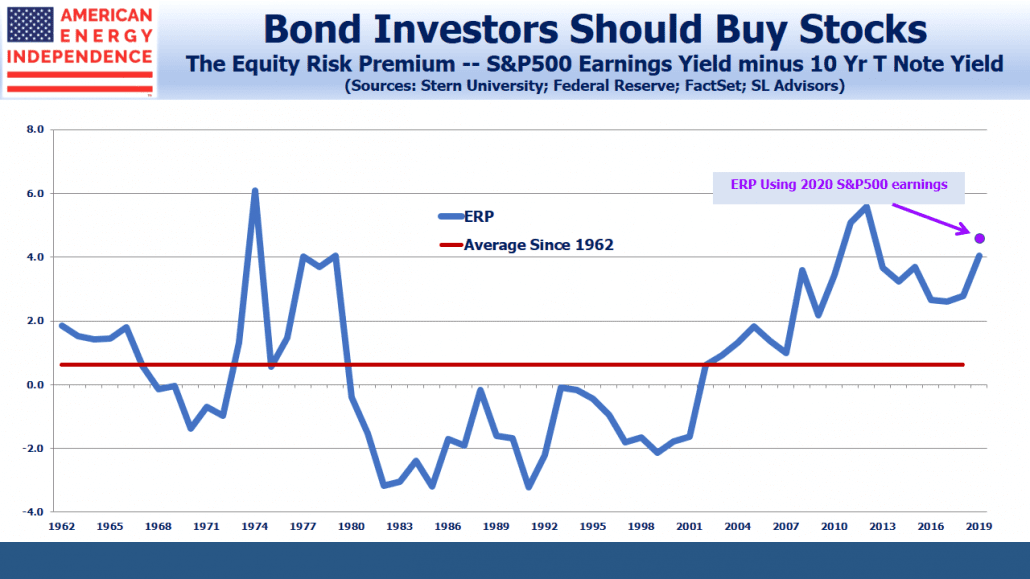
Falling bond yields and stock market weakness once again highlight the Equity Risk Premium (ERP), which is the difference between the earnings yield on the S&P500 and ten year treasuries. This starkly reveals the superior choice stocks offer versus bonds. At just over 4.0, the ERP is at a level reached only three times since 1962 (in 1979, 2011 and 2012). In each case, subsequent equity returns were quite satisfactory. Moreover, Factset is forecasting 11% S&P500 earnings growth, so the 2020 ERP looks even more compelling.

Equity Risk Premium

There will always be surprises. The biggest potential problem we see is Iran, where U.S. policy seems to have an undefined objective while steadily denying Iran access to sell its oil. It resembles U.S. policy towards Japan prior to World War II, when we denied them access to oil imports. As tensions rise in the Gulf, a military miscalculation is possible. Iran’s options are unclear. Although there are many more compelling reasons to be invested in midstream energy infrastructure, holding U.S. energy assets during a Middle East war would be a better bet than many.

SL Advisors is the sub-advisor to the Catalyst MLP & Infrastructure Fund.  To learn more about the Fund,  please click here.

SL Advisors is also the advisor to an ETF (USAIETF.com).


Pipelines Show Improving Risk Return

AMERICA IS IN THE MIDST OF AN ENERGY REVOLUTION.

By capitalizing on American technology, ingenuity, and frontier spirit, the Shale Revolution—driven by horizontal drilling and fracking—is turning the world’s energy markets upside down.


ETF Mutual Fund


Pipelines Moving Up and Left: More Return With Less Risk

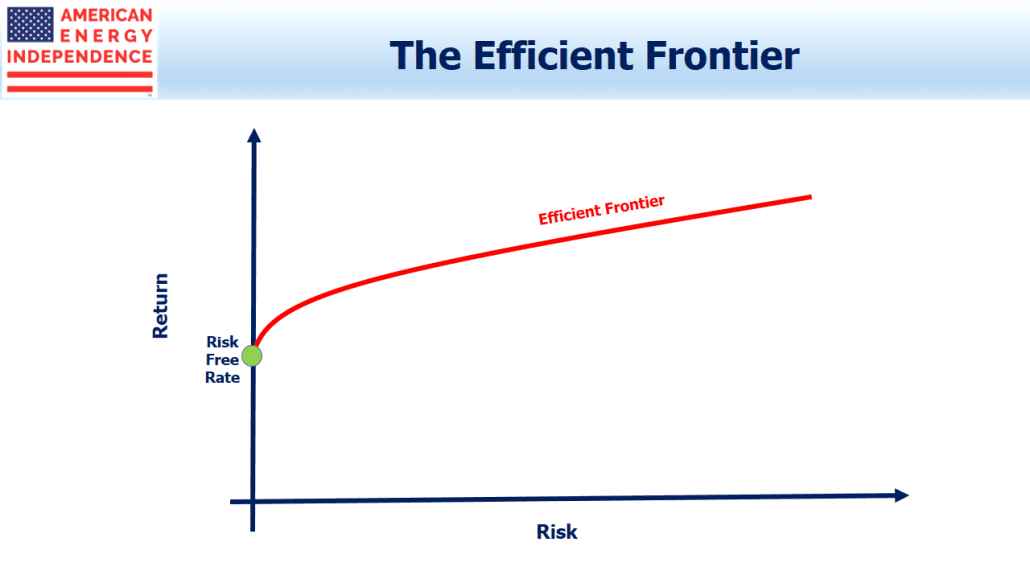
The Capital Asset Pricing Model (CAPM) is a widely accepted theoretical framework for valuing securities. An important feature is the Efficient Frontier. This reflects the concept that, although there’s an almost infinite number of portfolios that an investor can hold (think of all the individual stocks and bonds out there), a small number of these portfolios offer a combination of return and risk that’s better than most.

Efficient Frontier

For example, if two portfolios had the same risk, the one with the higher return would be preferable. We can always figure out with hindsight what was the efficient portfolio — identifying the right one going forward is more difficult.

CAPM is a useful theoretical framework but has its shortcomings. One of the biggest is the idea that more risky investments deliver a higher return. It seems intuitively self-evident, but there’s plenty of research to show it’s not true. Beta, a measure of how risky a stock is compared to the market (which has a Beta of 1.0), suggests that high beta stocks (Beta > 1.0) should deliver higher returns than the market. Otherwise, investors wouldn’t own high beta stocks because they wouldn’t be getting sufficiently compensated for the increased risk.

The real world often fails to conform to neat algebraic solutions, and it turns out that low beta stocks do better. They don’t move as much and offer less excitement. Low Beta stocks receive less coverage on CNBC, since traders want movement. But they are Aesop’s tortoise, reaching the finish line ahead of their more energetic competition.

This weakness in CAPM is called the Low Beta Anomaly, and for those interested in learning more you can read Why the Tortoise Beats the Hare.

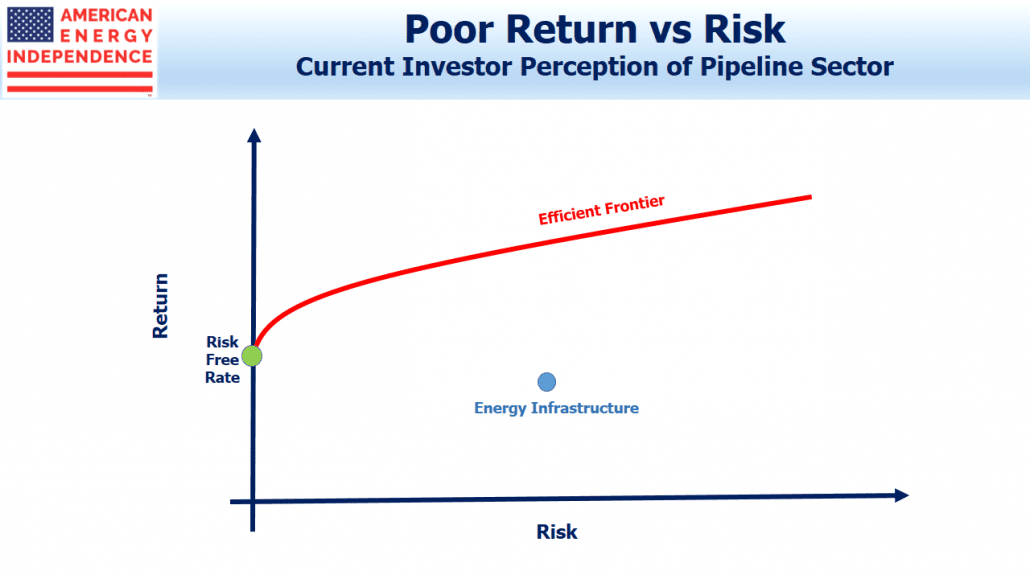
Returning to the Efficient Frontier, although we can’t be certain what investments provide the most CAPM efficiency, we can make informed assumptions about whether they’re becoming more or less attractive within this framework. Investors complain about heightened volatility in midstream, and likely assume more of the same in assessing the sector. For many, Energy infrastructure sits well within the Efficient Frontier boundary, making it unattractive.

Investor Perspective of Pipeline Sector

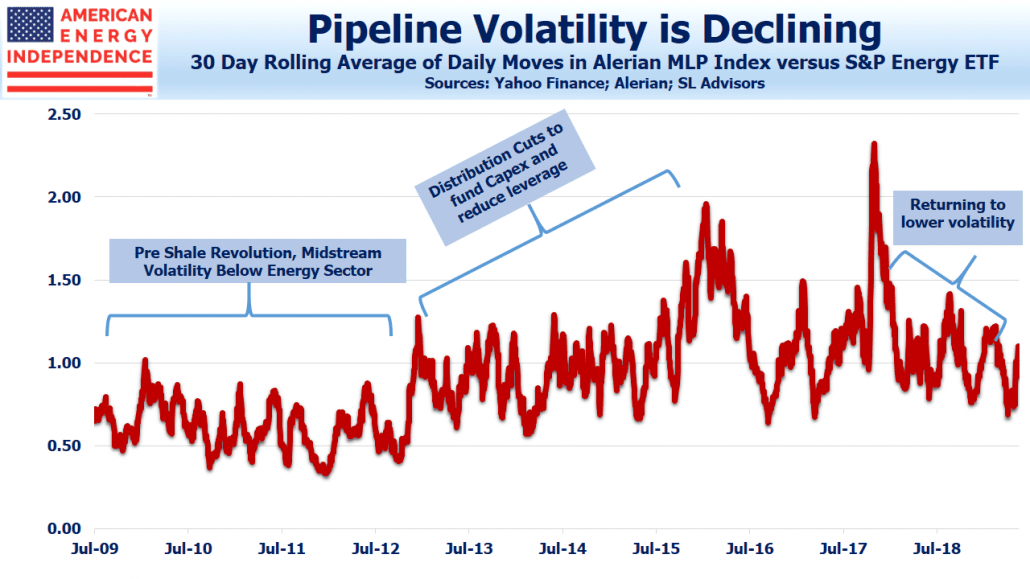
But Energy Infrastructure, as we wrote last week (see Pipeline Stocks Get That Warm Feeling Again), is becoming less volatile, especially when compared with broad energy as represented by the S&P Energy ETF (XLE). On the Efficient Frontier chart, this is moving it to the left, meaning it’s becoming less risky.

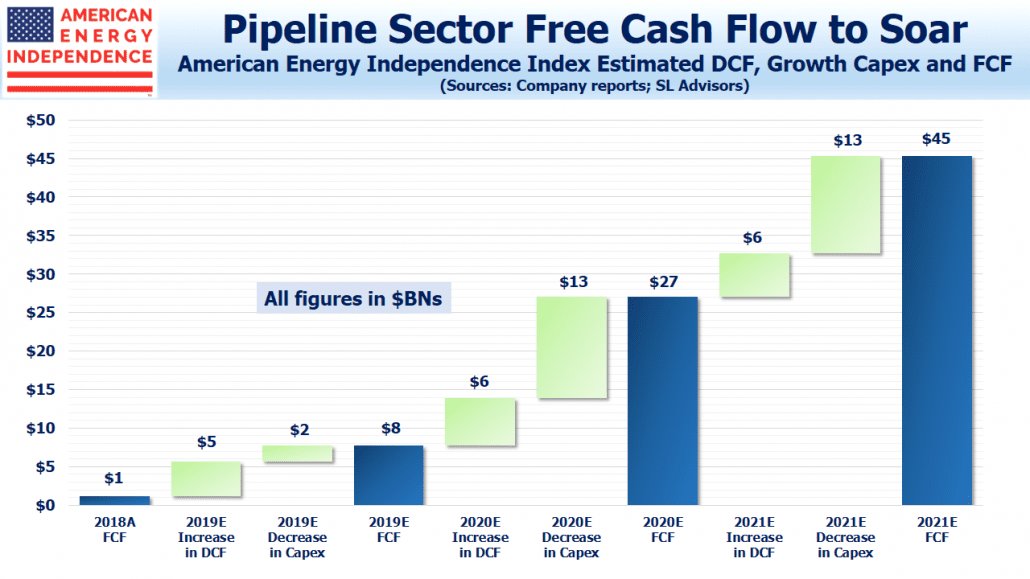
Returns are also improving, as defined by Free Cash Flow (FCF) generation. We wrote about this a few weeks ago (see The Coming Pipeline Cash Gusher). The members of the broad-based American Energy Independence Index generated just $1BN in FCF last year, which is an inconsequential return on around $540BN in market cap. However, a combination of lower spending on new projects (lower growth capex) plus improving cash flow from existing assets (higher Distributable Cash Flow, DCF) is set to boost sector FCF significantly over the next three years. By 2021 the $45BN in FCF we estimate would produce a FCF yield of over 8%, higher than the S&P500.

Pipeline Sector Free Cash Flow

Making volatility forecasts is an imprecise task, and most investors will be satisfied with using historical data. This shows decreasing volatility, or risk. But it’s certainly possible to make return forecasts and they don’t need to have any relationship with recent history. Rising FCF should persuade investors that their return assumption for the sector can be revised up.

In the context of CAPM, higher return with less risk mean that the sector is shifting up and to the left, making it more attractive. The Efficient Frontier is a theoretical concept, and investments selected from along that line can all be judged efficient, with the different combination of return and risk reflecting investor preference.

Improving Return and Risk

As this virtuous combination of rising return with falling volatility becomes apparent, we think some investors will conclude that midstream energy infrastructure lies beyond the Efficient Frontier. This should attract inflows from investors who use this type of framework to assess opportunities.

When CAPM provides a buy signal, the much-sought generalist investor will have finally turned to pipelines. Over the next couple of years, the sector should benefit from this development.

SL Advisors is the sub-advisor to the Catalyst MLP & Infrastructure Fund.  To learn more about the Fund,  please click here.

SL Advisors is also the advisor to an ETF (USAIETF.com).


Why You Should Only Buy China Through the S&P500

Last week’s article by Jason Zweig (see Think Before You Fish for Bargains in Chinese Stocks) caught my eye, because it warns against investing in Chinese stocks with the expectation of high GDP growth driving high equity returns. A major reason investors allocate to emerging economies is because they expect that relationship to reward them, although there’s plenty of evidence that it doesn’t work.

Zweig references a 2004 academic paper (Economic growth and equity returns) which highlighted one important reason: GDP growth can be driven by technological innovation among new, private companies. This does nothing for current investors in public equities. Technological improvements are usually good for consumers but less often for public companies, unless they can exploit their advantage without meaningful competition. The true driver of returns comes from earnings paid out as dividends, and the return on retained earnings that are reinvested back in the business. Chinese public companies have been poor at the latter.

Moreover, the market cap of the MSCI China stock index has grown largely through new equity issuance. So global investors who allocate passively based on market size are induced to increase their China exposure, even though returns on invested capital have been poor.

A 2010 paper from MSCI Barra (Is There a Link Between GDP Growth and Equity Returns?) similarly found no meaningful connection between the two.

Jason Zweig generously concludes that Emerging Markets (EM) investing can still make sense if a country’s market looks cheap. But if GDP growth doesn’t correlate with equity returns, the justification for an EM investment becomes weak. What’s left is a tactical move based on what looks like temporarily weak pricing. That’s not a long term strategy for most people.

American investors are accustomed to a market with the world’s toughest rules all designed to promote fairness. Protecting investors from bad actors lowers the overall cost of equity, which does boost GDP growth. But it’s easy to assume that America’s standards are global, which they are not. I remember some years ago chatting with a senior regulator from the Reserve Bank of India. I asked him how many insider trading cases are typically prosecuted in a year, to which he replied, “None. There is no insider trading in India.”

Or the hedge fund friend who described how two or three Mumbai-based hedge funds would trade a small local stock amongst themselves, generating volume and a higher price. This would attract, “the New York hedge funds” in search of a rising stock with good liquidity. Having hooked one, the local hedge funds would dump the stock on the naive foreigner (see The Hedge Fund Mirage, pg 42).

An emerging market doesn’t mean the participants are unsophisticated – in fact, the comparative absence of rules mandates more highly attuned street smarts than is required in developed markets.

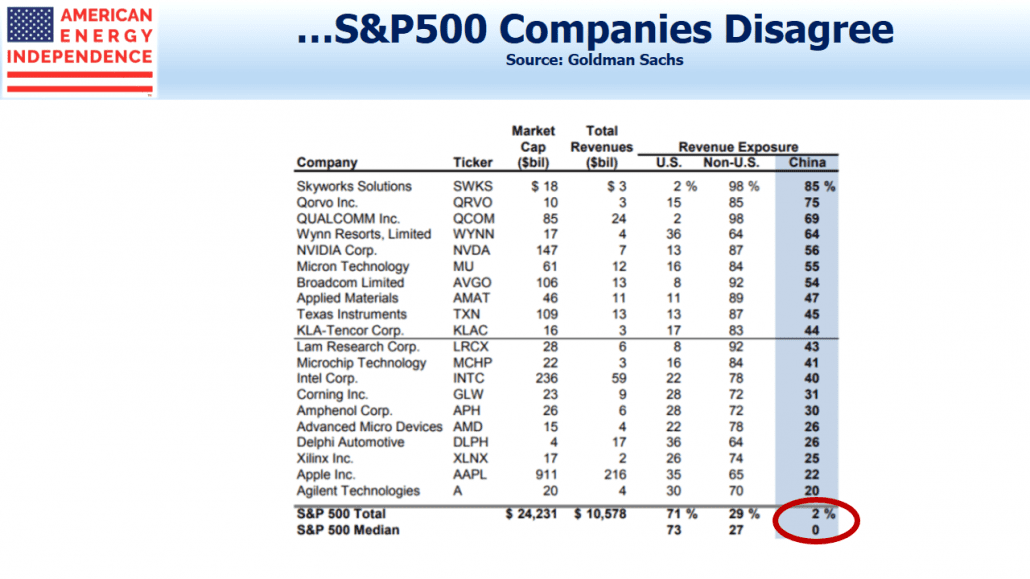
Almost every company in the S&P500 does business in China and other emerging economies. They are infinitely better suited to allocate their capital where returns are highest. They’re far better equipped to protect their property and future cashflows from nefarious activity. This means that an investment in a broad portfolio of U.S. stocks includes exposure to the growth of emerging economies. And the portion of that portfolio’s overall EM exposure is the aggregate of hundreds of capital allocation decisions by the senior executives of those companies.

China's Global Market Cap

Blackrock published a paper last year suggesting that China’s 8% global weighting should drive an investor’s China allocation. But this seems too simplistic. The S&P500 derives 2% of its revenues from China. 500 management teams from America’s biggest companies have collectively arrived at 2% as the optimal exposure. An investor who deviates from this 2% figure needs a good reason. Size of market is not one of them, because Jason Zweig’s article shows that most of the growth in China’s equity market cap has come from new issuance, not appreciation. Blackrock’s suggestion ignores the conclusion of hundreds of companies doing business there that have settled on 2%. And when they collectively decide to go to 3%, your exposure will change without you having to think too hard about it.

SP500 China Exposure

Relying on the S&P500 to determine your EM exposure must surely be better than simplistically relying on market cap or trying to figure it out yourself. Simple can be better, and in investing it usually is. Invest in America’s global companies. Let them allocate to EM for you. Stay away from EM funds. You’ll sleep better, and the research shows you’ll get better results too.

SL Advisors is the sub-advisor to the Catalyst MLP & Infrastructure Fund.  To learn more about the Fund,  please click here.

SL Advisors is also the advisor to an ETF (USAIETF.com).


Pipeline Stocks Get That Warm Feeling Again

A common concern of both existing and potential investors in energy infrastructure is the relatively high volatility of recent years. Many recall the “toll-model” of pipelines that was the basis of their appeal prior to 2014. As we have often written, the Shale Revolution broke the MLP model, as companies with very high payout ratios and hitherto minimal growth projects set about adding infrastructure. Oil in North Dakota, natural gas in Pennsylvania and increasing volumes of crude in west Texas required new investments (see It’s the Distributions, Stupid). The income-seeking investors originally attracted by high yields wound up in growth businesses that prioritized reducing leverage and funding projects over maintaining distributions.

Our theory is that this one-time alienation of the core investor base was highly disruptive and led to a period of heightened volatility. The shift in MLP business model from income generating to growth coincided with a sharp downturn in the energy sector. Investors worried about the profitability of upstream exploration and production companies showed similar concern over midstream. Even though EBITDA grew and leverage fell for pipeline stocks during this period, the sector moved with the energy sector.

There are signs that this period of heightened volatility is coming to a close. When energy markets bottomed in early 2016, the average daily percentage move of the Alerian MLP index reached almost 2.0X that of the S&P Energy Sector ETF (XLE). In late 2017 the ratio was briefly even higher. Since then, this relationship has improved dramatically in favor of these toll-like business models, falling by more than half and approaching the range that prevailed 7+ years ago.

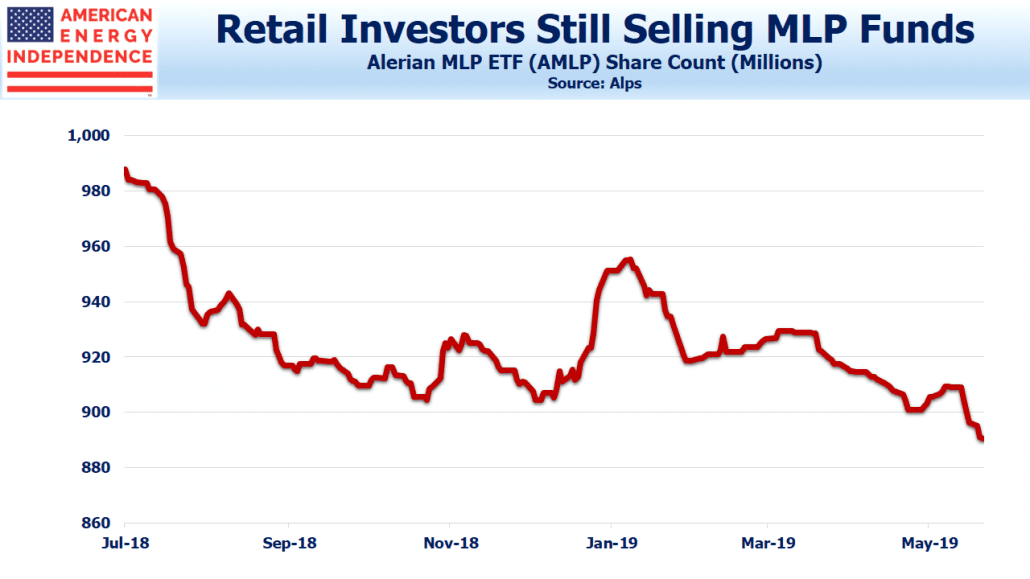
This shift is even more dramatic than it seems, because the Alerian MLP index has been steadily losing components, rendering it less diversified and therefore more prone to sharp moves than it would otherwise be. Investors continue to exit mutual funds and ETFs tied to MLPs, as shown by the steady drop in shares outstanding for the Alerian MLP ETF.

Pipelines Beating SP500

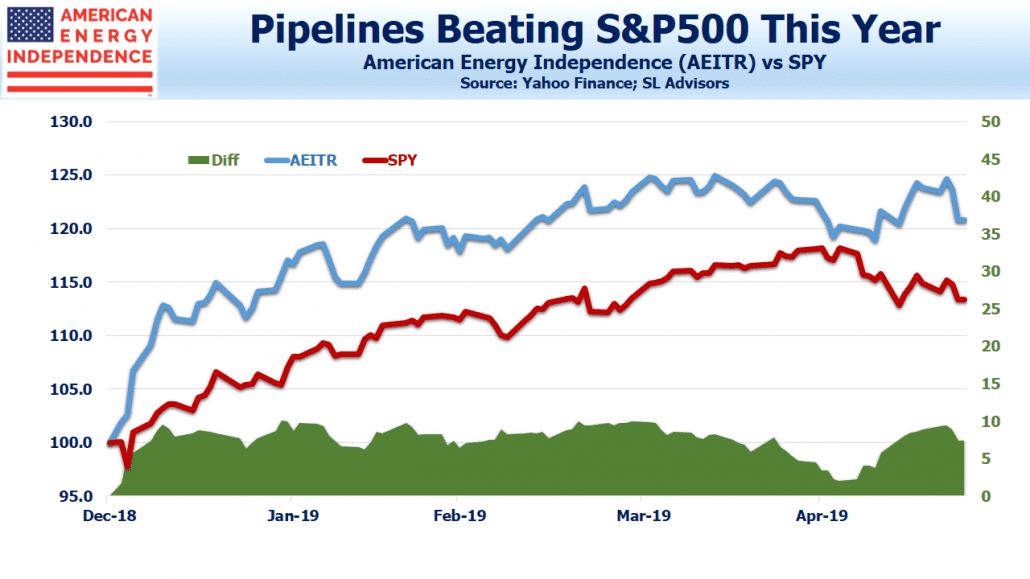
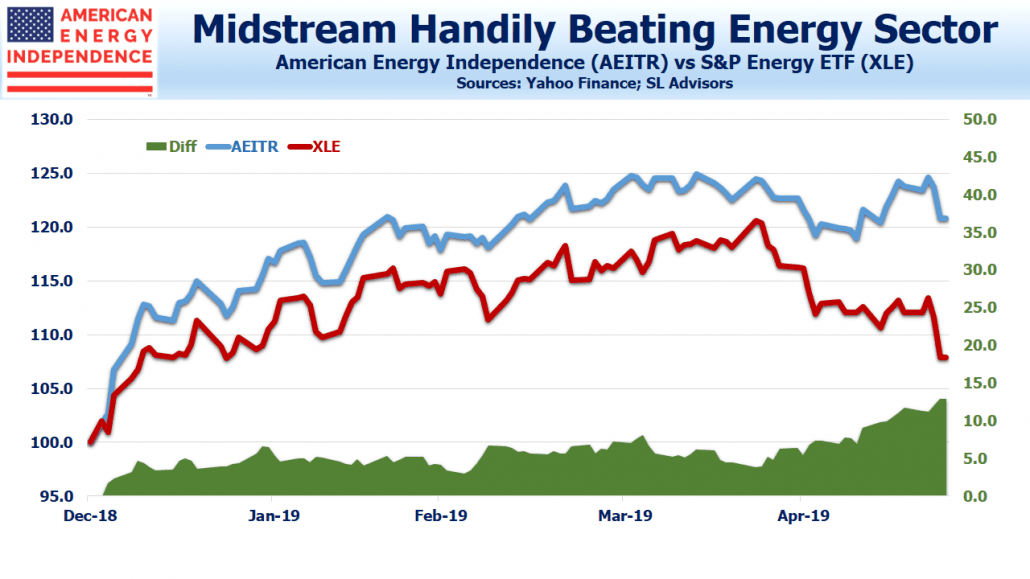
Nonetheless, relative performance for the sector more broadly defined to include corporations has held up very well. The American Energy Independence Index (80% corporations and 20% MLPs, more reflective of the sector’s market cap of 2/3rds corporations) has retained its solid lead over the S&P500 this year, and is substantially ahead of XLE, especially following last week’s market weakness.

Midstream beating XLE

A plausible explanation is that, although retail investors are shunning MLP-only funds, institutional buyers are beginning to commit capital to pipeline corporations. Converting from MLPs to corporations was driven by a desire for a broader, more stable investor base. Although there are fewer MLPs remaining, they include conservatively run companies such as Enterprise Products Partners (EPD) and Magellan Midstream (MMP). There are some good MLPs to own.  However, some investors are starting to conclude that MLPs are too small a subset to command a sector allocation, and they’re more appropriate within a diversified portfolio that includes corporations.

Retail Investors selling MLPs

The relative volatility of midstream infrastructure is reverting back to the lower levels that prevailed before the Shale Revolution triggered the need for large infrastructure investments. Moreover, free cash flow is set to jump over the next three years (see The Coming Pipeline Cash Gusher). This will continue to attract generalist investors interested in attractively valued stocks with declining volatility.

The pipeline sector is showing good momentum to continue its outperformance, driven by institutional buyers gradually replacing the retail holders of narrow, MLP-only funds.

We are invested in EPD and MMP. We are short AMLP.

SL Advisors is the sub-advisor to the Catalyst MLP & Infrastructure Fund.  To learn more about the Fund,  please click here.

SL Advisors is also the advisor to an ETF (USAIETF.com).