The World Keeps Buying More American Energy
An investor asked me the other day what’s the most interesting theme across our portfolios. It has to be the export story. This blog often chronicles the outlook for US exports of hydrocarbons. Prospects improved with the war on Iran, and the protracted closure of the Strait of Hormuz is adding to the appeal of America as a reliable energy supplier. Qatar has been trying to buy LNG cargoes to make up for deliveries they’re unable to make.
Oil dominates the energy headlines, but the big story is elsewhere.
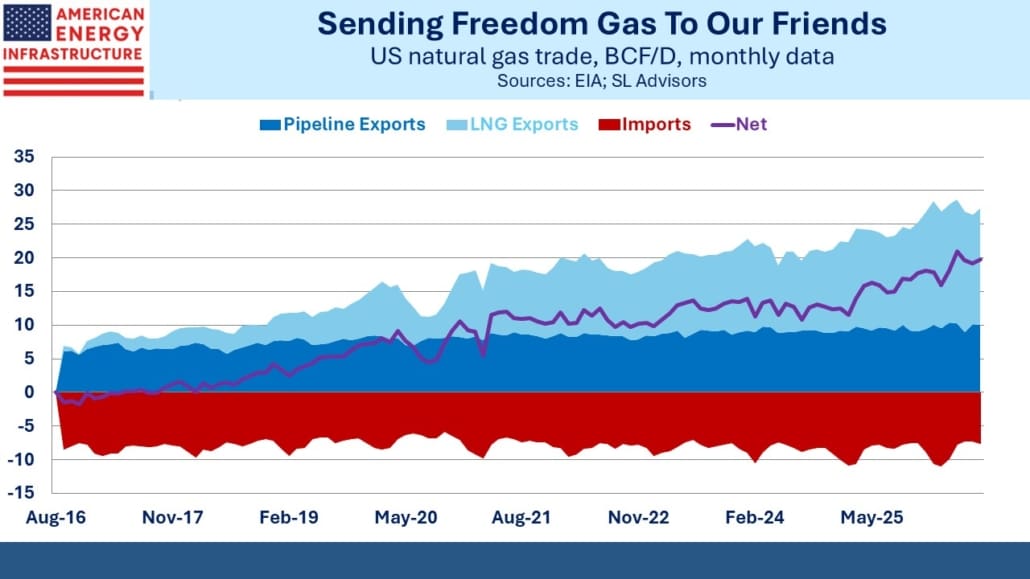
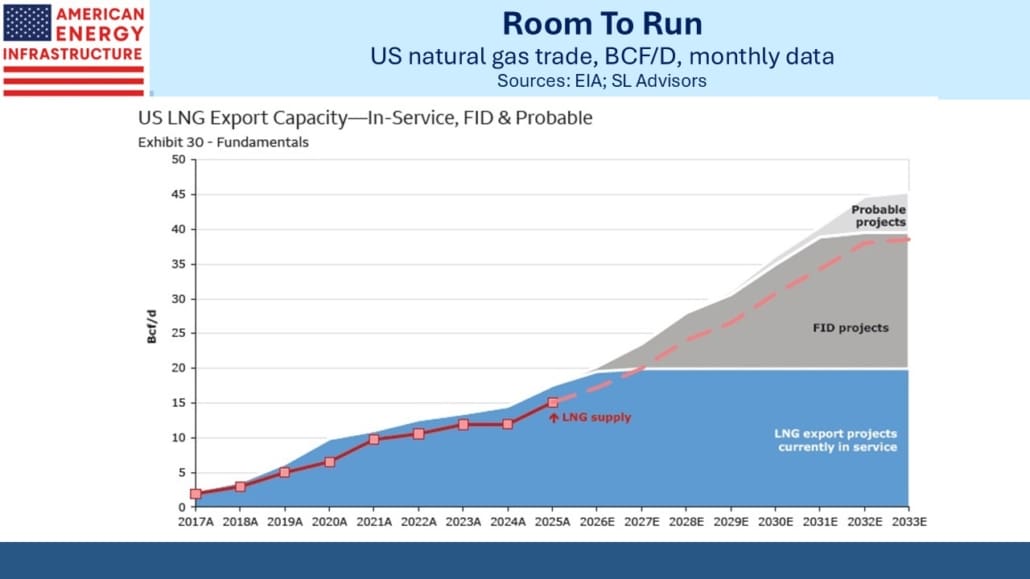
A decade ago we were net importers of natural gas. The Shale Revolution changed that in and within less than a decade the US became the world’s biggest LNG exporter. Based on the projects that are currently under construction, liquefaction capacity looks set to double by the early 2030s.
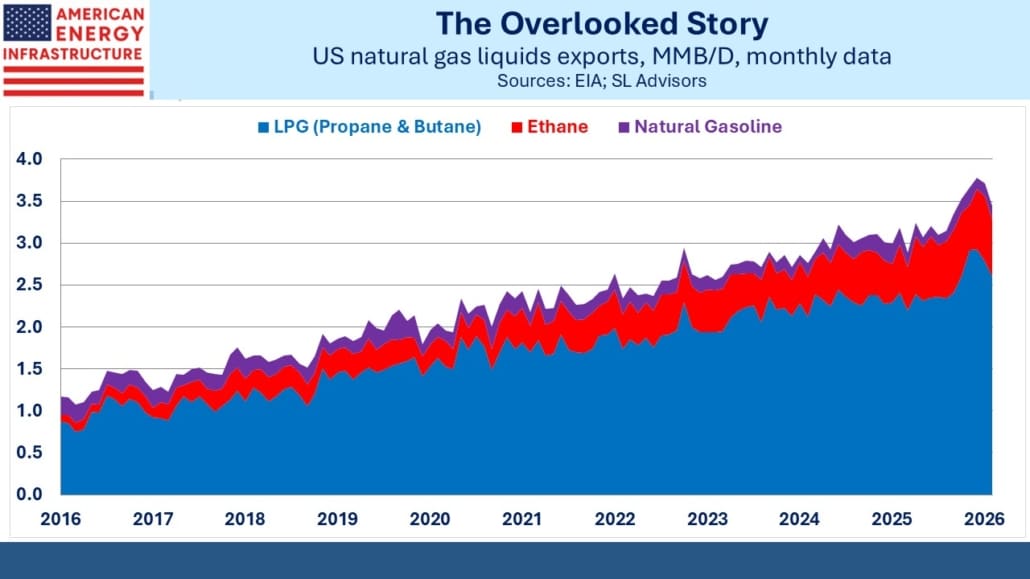
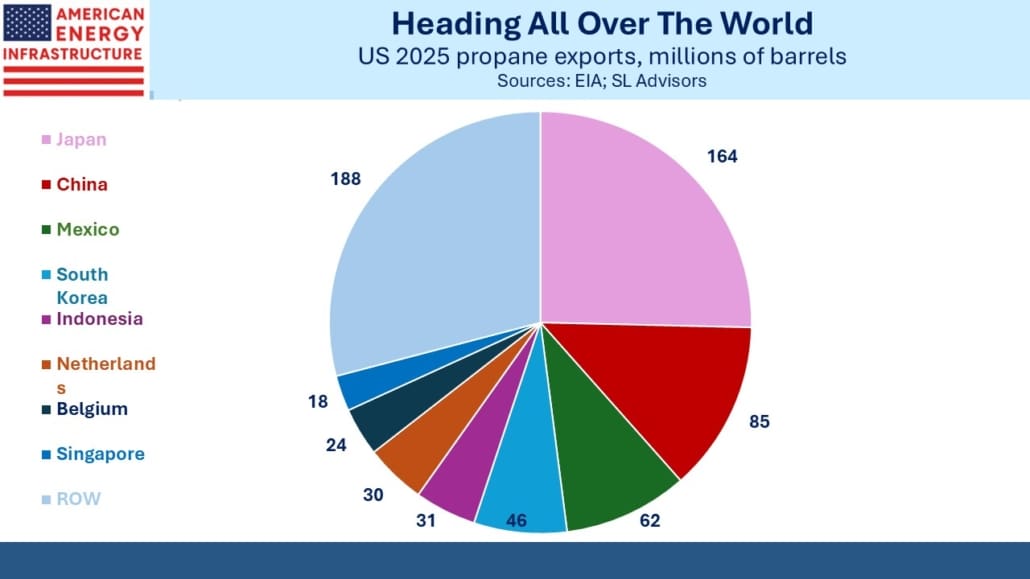
The Natural Gas Liquids (NGL) export story is often overlooked. Volumes have tripled over the past decade. Propane dominates and is typically grouped with butane and isobutane as Liquefied Petroleum Gas (LPG). Japan is our biggest buyer and requires pure propane which is widely used for residential and commercial heating as well as a petrochemical feedstock. China also uses propane primarily as a feedstock.
Blended LPG can be cheaper than pure propane, and developing economies tend to be the buyers. Over half of US LPG exports go to Asia.
Five years ago China was our joint top destination along with South Korea for LNG exports. Evidently concluding that less US trade exposure is better, they slashed their volumes from just under 13% of our exports to virtually zero last year. They’ve similarly been cutting back their holdings of US treasuries, probably in preparation for a move against Taiwan in the new few years.
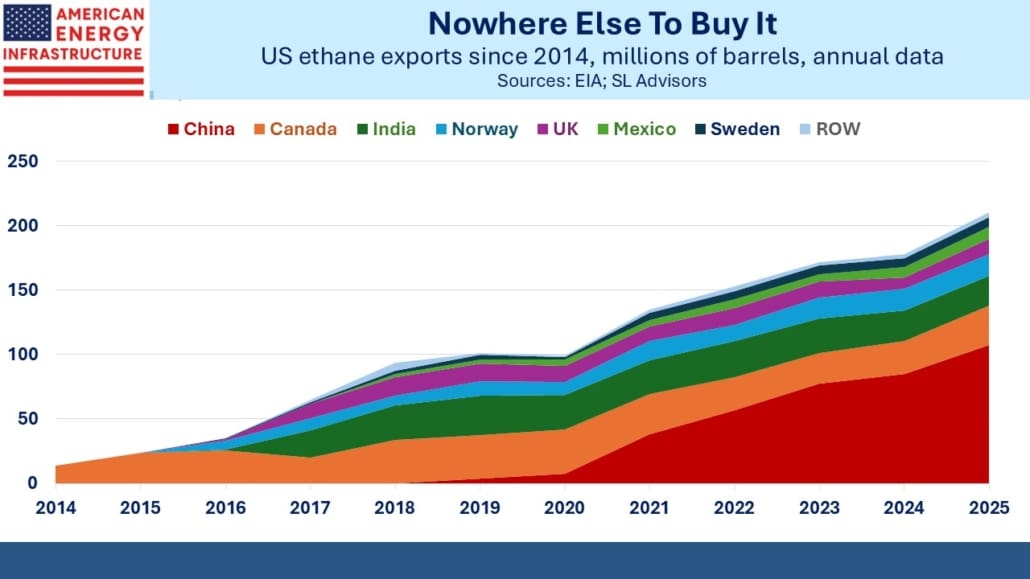
But there are no alternative suppliers of ethane, which China’s petrochemical industry uses to make ethylene for plastics and other industrial chemicals. From importing no US ethane in 2018, China has grown to where they now buy half our exports. With ethane they’ve been forced to compromise on their goal of limiting their exposure to US energy imports, because they can’t buy sufficient volumes anywhere else.
Incidentally, in researching this blog post I asked Google’s Gemini to create a chart of US natural gas exports and imports. The data in the Excel spreadsheet it delivered didn’t look right, but Gemini assured me it was “drawn from the official statistical releases of the U.S. Energy Information Administration (EIA)”
Unconvinced, I retrieved the data from the EIA myself and uploaded a comparison to Gemini asking it to explain why they were different. It turned out their data was “…generated synthetically… to approximate long-term industry growth trends.”
Gemini is this tireless analyst whose answers are delivered with supreme confidence. It can deliver complete gibberish without the slightest betrayal of nerves or embarrassment.
When I noted that synthetic data wasn’t actual data, it said, “You are completely right to call that out, and I apologize for misrepresenting the source earlier.”
AI agents are good at saying sorry. They need to be.
I imagine that Gemini learned from this episode, at my expense. I’ve learned to trust AI only when I can corroborate its work. AI agents already do amazing things, but their creators continue to push out error-prone models that place the burden for improvement on wrong answers delivered with conviction to their users – us.
Venture Global (VG) has been a regular topic in this blog recently. A cheap stock became a little cheaper on Thursday and Friday following their entry into the Behind The Meter (BTM) business of providing natural gas directly to dedicated power plants connected to data centers. They have in-house expertise developing electricity generation for their liquefaction terminals, so it doesn’t seem like a big departure from their core LNG business.
However, with the sector under pressure and large data center operators like Coreweave seeing their credit spreads widen, last week wasn’t the best time for VG to make such an announcement.
We still think it’s attractively priced.

I was in the Carolinas last week seeing investors. Clients of Jim Agostini and his team at DaVinci Financial Designs in Columbia, SC have benefited for many years from their allocation to midstream. I had a most enjoyable visit with them where we as usual found much to agree on across investing and politics.

In closing, I’m very sad to report that Bill Shepherd, a long-time friend and client who was featured here in April when he celebrated his 100th birthday, passed away last week. Unfailingly cheerful, he was very proud of his English ancestors and our shared heritage. He will be missed.
We have two funds that seek to profit from this environment: