Betting On High LNG Prices
Venture Global (VG) reported 3Q26 earnings of $2.5BN last Tuesday, making its $30BN market cap look oddly cheap. A one-time interest rate swap gain of $1.4BN was significant, but even adjusting for that the stock closed at less than 7X annualized earnings following their quarterly release. After a day’s consideration, analyst forecasts and the stock price duly rose, finishing the week with a market cap of $33BN. Their FY EBITDA guidance of $10-10.3BN sits comfortably ahead of Cheniere’s $8.75-9.25BN, which nonetheless is worth almost twice as much.
Cheniere still has more liquefaction capacity, projecting 56-58 million tonnes for next year. Both companies continue to add capacity, with VG expecting to exit next year at 35-40 Million Tonnes per Annum (MTPA) with a long-term goal to reach 100 MTPA by 2030.
The reputational hit from VG’s conveniently timed delay in LNG shipments when Russia invaded Ukraine (see Nothing Ventured, Nothing Gained) left many buyers wary and has meant Cheniere can charge slightly higher liquefaction fees, which are typically in the $2-2.50 range per Million BTUs (MMBTUs).
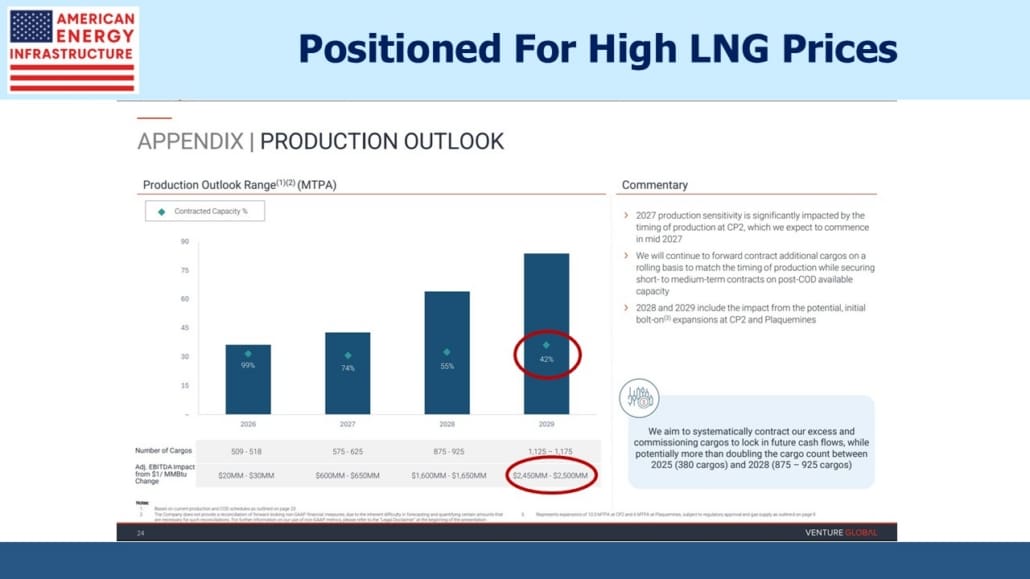
The big difference between the two companies is that VG is more willing to retain capacity for themselves, which pays big dividends at times like this when European and Asian benchmarks are so much higher than the US Henry Hub. Cheniere has presold 95% of their liquefaction capacity through 2035, which creates a lot of cash flow certainty.
For the remainder of this year VG is expecting to earn $21-22 per MMBTUs on uncommitted liquefaction capacity, which shows how profitable that strategy is currently. VG is 74% contracted just for next year. For 2029, they’re 42% contracted. A $1 per MMBTU change in their liquefaction fee is worth $20-30MM for the remainder of this year, but a whopping $2.45-2.5BN by 2029. It’s this uncertainty that causes VG to trade at a substantial discount to Cheniere.
VG does plan to contract out substantial amounts of capacity. But the stock will always represent more of a bet on the future spread between international and domestic gas prices than Cheniere.
Spiro Dounis at Citi just raised his price target from $17 to $20, projecting a more than 50% one year return. There aren’t many $33BN stocks with that kind of upside potential.
Qatar lost their first LNG customer last week. Poland’s Orlen SA canceled a 1 MTPA agreement that was supposed to run through 2034. They evidently tired of Qatar’s ongoing delivery failures, which have continued long enough to allow Orlen’s exercise of their cancelation option. If other buyers similarly use the extended force majeure to exit their agreements, it will cast further doubt on Qatar’s expansion plans to add over 80% to existing liquefaction capacity.
QatarEnergy continues to seek long term purchase agreements with US suppliers, with NextDecade currently negotiating to provide 2 MTPA from TraIn 6 at their Rio Grande facility. Trains 1-5 are under construction, but Train 6 hasn’t yet received final investment decision. A deal with Qatar would probably be enough to get that project approved.
Qatar’s deal spree with Cheniere and Venture Global suggests they’re lining up alternative supply to address buyers’ fears of future disruptions. Qatar may also plan to trade those shipments, reasoning that a future closure of the Strait of Hormuz would allow them to profit from higher global prices the way VG has done this year.
Moreover, it’s Qatar’s planned expansion that is driving the fears of an LNG supply glut, causing some analysts even now to overlook the upside in US exporters. If those expansion plans are shelved, the glut fears will evaporate making the deals Qatar recently signed to buy from the US worth a lot more. They’ve quickly become America’s biggest LNG buyer, with interesting optionality as a result.
For those following NextDecade and their progress building their Rio Grande liquefaction facility in SW Texas, here’s a brief video.
Last week the sector rebounded, having offered an entry point following the election swoon. This was in spite of ten year treasury yields jumping 23 bps due to further bad inflation numbers. The sector’s resilience to weaker bond prices was in marked contrast to September.
As we noted in The Blue Wave there’s little discernible relationship between energy sector returns and the party in power, even though its executives and investors tend to be Republican.
Some Republicans wrongly blame popular opposition to AI for their drubbing (it was the economy, stupid). It does strengthen the case for Behind The Meter (BTM) solutions to power generation, since data centers will need to operate without affecting local electricity prices.
TC Energy (TRP) is joining Williams Companies and Energy Transfer in providing BTM solutions. They recently disclosed a doubling of their capex backlog to C$40BN of which C$15BN is in their Power & Energy Solutions segment. BTM is coming to Canada too.
We have two funds that seek to profit from this environment: