Awash In Oil
Apparently, the senior executives of Exxon and Chevron weren’t the only ones worried about inadequate oil inventories causing prices to spike (see Is Crude At A Tipping Point?). The White House heard the message, and ships are once again moving freely through the Strait of Hormuz.
The world is suddenly awash with oil, which by Thursday was trading below its pre-war level. Angolan crude, usually favored by Chinese buyers, has been trading at nearly $10 below the Brent benchmark. Weak Asian demand is seeing more crude redirected to Europe. The “dark fleet” of tankers traversing the Strait has been so numerous that one oil trader said he’d stopped participating in the “complex and expensive trade” because of oversupply.
Investors are always searching for opportunities that are indifferent to the market’s direction. Midstream energy infrastructure scratches the itch, handily beating the S&P500 YTD regardless of the gyrations in commodity prices. So far in June, crude is down $19, the AI-laden S&P500 is -2.9% and the American Energy Infrastructure Index is +3.3%. Wagering on continued demand growth for US hydrocarbons offers better odds than trying to predict oil prices.
US LNG exports are running at 100% of capacity, with the US Energy Information Administration (EIA) estimating June shipments of 17-17.2 Billion Cubic Feet per Day (BCF/D). Qatar expects their Ras Laffen facility to be running within a few weeks, but the Iranians took out two of the 14 processing units representing around 17% of capacity in March. It’ll be several years before Qatar’s export volumes return to their pre-war level.
The growth outlook for midstream companies remains strong. At JPMorgan’s recent energy conference they concluded that Williams Companies could grow as much as 10% pa over the next 8-10 years, since hyperscaler power demand looks robust even beyond the next five years.
Energy Transfer expects to come in at or above the high end of their 2026 EBITDA guidance of $18.2-18.6BN. They see modest 3-4% distribution growth as they reinvest cash into accretive projects.
Cheniere is still on track to hit Distributable Cash Flow (DCF) per share of $30 by the end of the decade. Their liquefaction capacity is 96% contracted for the next ten years. It seems cheap to us.
The Permian in west Texas and New Mexico has long been valued for its oil production, with associated gas an unavoidable byproduct. Inadequate takeaway infrastructure still results in some gas being flared although the volume flared per unit of oil produced is down 10% over the past couple of years. Nonetheless, the Waha hub price for gas remains depressed versus the Henry Hub benchmark.
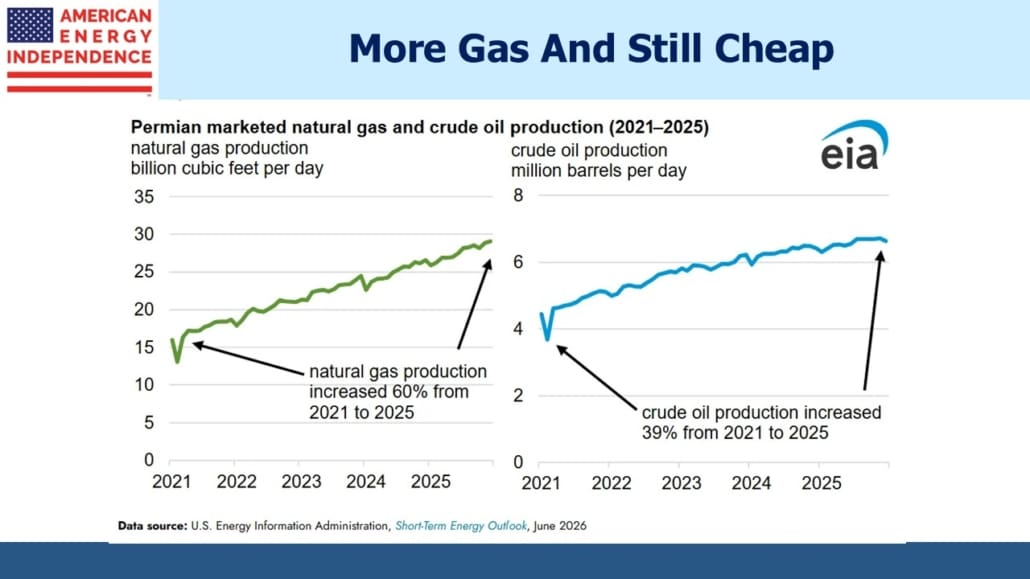
Oil wells tend to become more “gassy” over time. The low price for Permian gas hasn’t hurt production, which has grown faster than crude oil over the past five years. Abundant cheap gas is likely to remain the biggest source of American electricity generation, keeping prices here lower than in many other parts of the world.
Transco is the gas pipeline network that WMB operates in the eastern US. It can trace its roots back to the 1950s and was built to bring gas from Texas up to New York City and population centers in between.
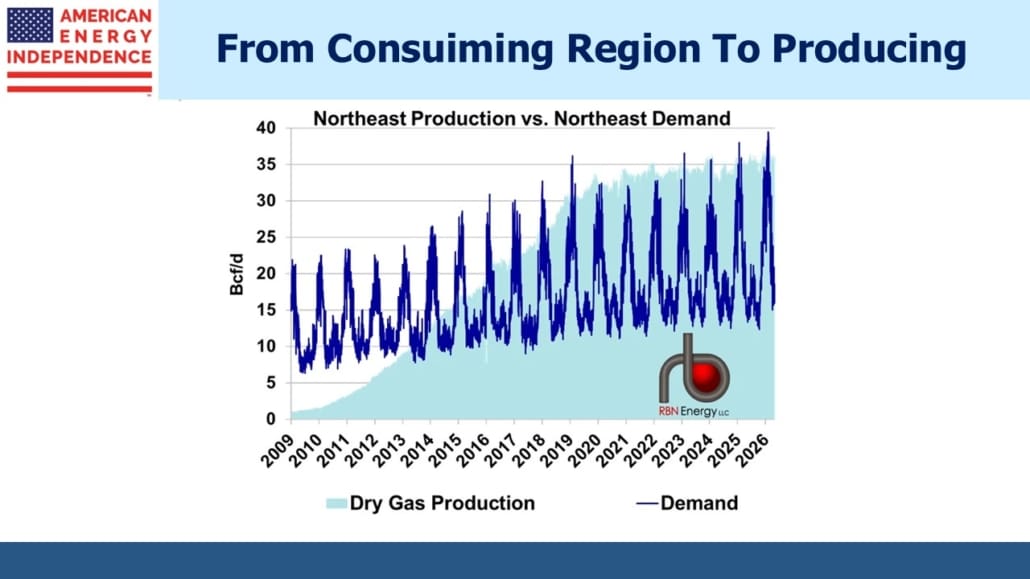
The shale revolution changed that as the northeast region saw gas production grow across Ohio, Pennsylvania and West Virginia, but not in New York where similarly favorable geology confronted left wing politics. In recent years, takeaway capacity has become a constraint on further growth.
The Mountain Valley pipeline was finally completed in 2023 albeit six years late and $6.6BN over budget. This was thanks to progressives weaponizing the legal system with endless challenges and is a good reason why the industry is unenthusiastic about complex projects that cross state lines.
But there’s still room for big projects if they rely on adding to existing capacity. Politicians in New England and New York have dropped longstanding opposition to expanded gas infrastructure in the region, which is why WMB restarted their North East Supply Enhancement project and Enbridge is working on their Algonquin Gas Transmission Enhancement project.
Poorly conceived energy policies in the region have led to high electricity prices. This realization, helped by President Trump’s cancelation of offshore wind, have made both projects possible, representing another source of demand growth for US natural gas output.

From outside the country, media coverage can present a harsh picture of America, turning on allies and deporting immigrants. The World Cup has drawn over a million fans to the country. As Peggy Noonan shows in her column, it’s an opportunity for visitors to see the country at its best, and they are.
Countless social media posts highlight the hospitable friendliness that greets so many people. One German visitor said, “the people are amazing, so welcoming, the culture is amazing.” A British woman asked to be adopted “by anyone in the USA as soon as possible.”
Another tourist said, “I would trade my Canadian passport for American citizenship without hesitating a single second.”
This is no surprise to those of us who live here, but it is heartening to see so many positive reactions.
Your blogger spent time with a group of eight from England including two close friends from high school. They are traveling the country to watch England. They’ve already visited Dallas, Boston and New Jersey where we watched England v Panama. They’re off to Atlanta next. They are loving America.
That the country where football was invented has won the World Cup only once (in 1966) remains for many one of history’s biggest injustices. England’s national team has a sorry record with late-stage penalty shootouts going back over three decades. Gareth Southgate, who missed a crucial penalty as a player in 1996 went on to coach England and led them to the European Cup Final in 2021, where they lost the shootout to Italy.
Penalty kicks inspired the team’s unofficial anthem (Football’s Coming Home) and even a west end play, both inadequate to soothe the emotional pain. Nonetheless, every four years we England fans wear the cross of St George and believe that football is, this time, coming home.
We have two have funds that seek to profit from this environment: