Will Gas Demand Boost Prices?
By 2035 the demand for US natural gas will reach 163 Billion Cubic Feet per Day (BCF/D) according to Wells Fargo, an increase of half from last year. The twin drivers of this will be power generation whose natural gas consumption will rise from 36 BCF/D to 61 BCF/D, and exports, mostly Liquefied Natural Gas (LNG), which will go from 16 BCF/D to 42 BCF/D.
An appealing feature of natural gas is that it’s hard to move – generally only via pipeline or LNG tanker. The supporting infrastructure requires long term contracts, since an LNG export terminal can only export LNG. And because construction takes years, there’s good visibility around the resulting cashflows.
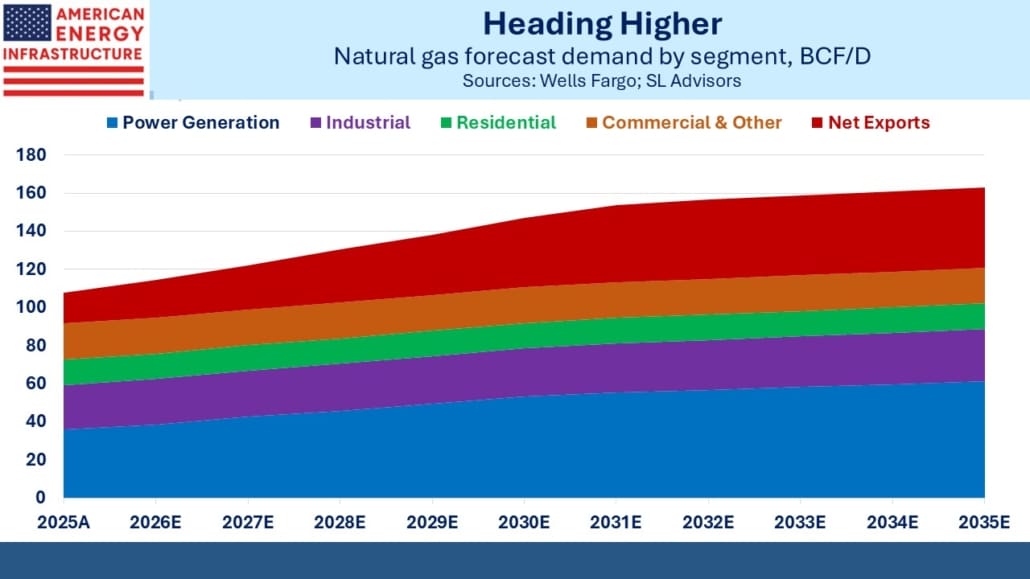
For example, Cheniere has pre-sold 95% of its liquefaction through 2035. Most of the gas pipelines being built over the next couple of years are in pro-energy Texas where frivolous lawsuits from climate extremists are ineffective.
Power demand doesn’t offer quite the same long term visibility, but hyperscalers are signing 5-10 year contracts for gas to feed dedicated power plants for their data centers. In cases where this set-up bypasses the grid it’s known as Behind The Meter (BTM), to avoid growing public opposition to AI and its upward pressure on electricity prices.
Forecasts of growing gas demand are not controversial. The US Energy Information Administration has issued similar projections.
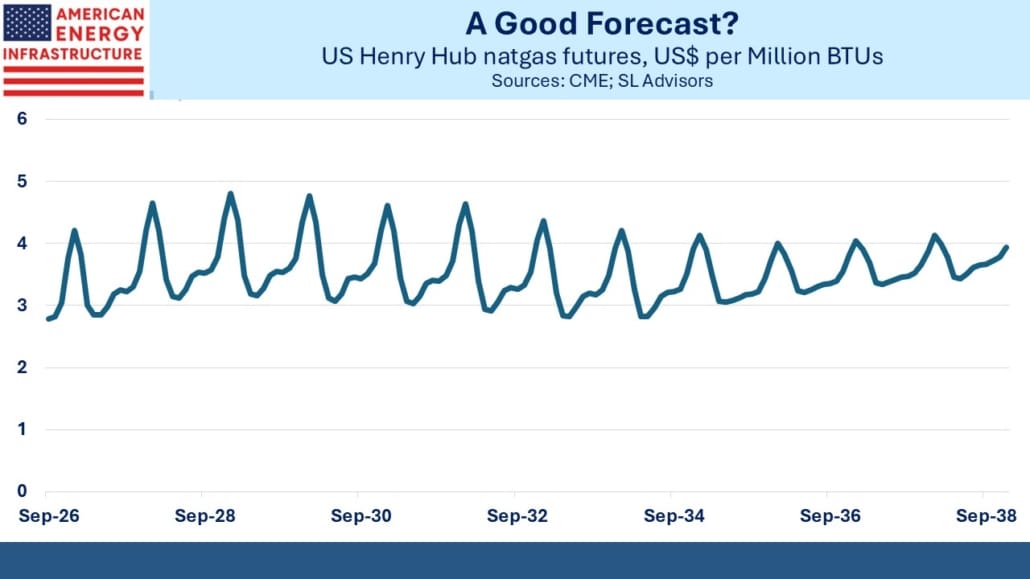
Hiding in plain sight is the natural gas futures curve, incongruously forecasting no appreciable change in prices over the next decade when demand will rise by 50%. This anomaly didn’t just appear – demand forecasts have been moving higher for a couple of years with no discernible impact on the futures curve.
Market prices drive a lot of business plans. Gas E&P companies are routinely valued by calculating the net asset value of their proved reserves based on futures prices. Companies that have contracted to buy LNG from US exporters like Cheniere or Venture Global begin their financial modeling with futures prices although certainly run multiple scenarios. The hyperscalers signing BTM power deals underpinned by natural gas presumably use the futures curve as well.
A lot of consumption in the years ahead is assuming, or hoping, that today’s prices of <$3 per Million BTUs (MMBTUs) will still prevail. And while prudent risk management suggests that business projections contemplate higher prices, no meaningful hedging has taken place.
We know this because over half the open interest in natural gas futures is concentrated in the next six months. The July 2028 contract has open interest of under 3,000 contracts, equivalent to around 28 BCF which is less than 1% of projected monthly demand.
Oil and gas producers are generally more active in hedging than are buyers of refined products such as utilities or airlines. This makes sense because gas producer Range Resources (RRC) for example is exposed to gas prices on over two thirds of its revenues (the rest is natural gas liquids and crude oil). Their hedging tends to focus on the next 12-24 months. By contrast, United Airlines can pass on higher jet fuel costs to passengers and modify their schedule, as they have this year.
This asymmetry between price risk tolerance for producers versus consumers probably puts downward pressure on futures, even though price changes for every molecule of hydrocarbons produced and consumed create gains and losses in equal measure.
Virtually all the projected consumption of gas over the next decade is exposed to higher prices, and while buyers can build a price cushion in their financial models, they can’t immunize against it.
This is a point made by Matthew Smith of Chronometer Partners in an interview with Patrick O’Shaughnessy on his Colossus podcast. Smith believes that the consensus demand projections are unattainable without sharply higher prices and perhaps some moderation of projected demand growth.
With natural gas providing over 40% of America’s electricity, households are among the biggest losers. He sees hyperscalers and LNG exporters causing a squeeze within a few years.
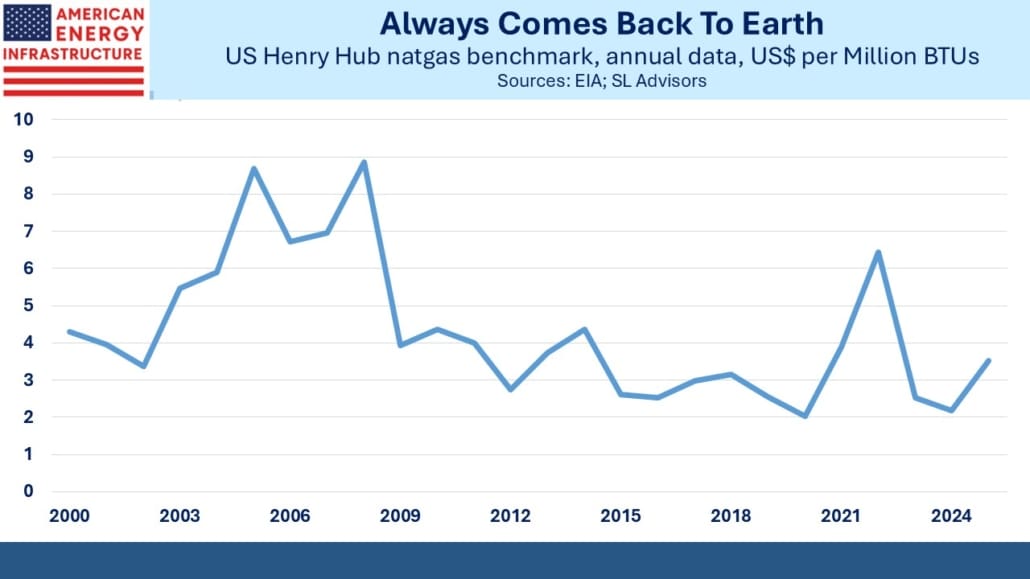
Smith’s view is not new. Bullish natural gas positions have been relieving traders of their capital for years as prices have remained stubbornly anchored around $3 for much of the past decade. Nonetheless, after annual consumption growth of 2-4 BCF/D over the past several years we’re entering a period of 7+ BCF/D annually through 2030. This might be the moment.
JPMorgan calculates that RRC is valued at 81% of the NAV of its total reserves and 64% of its proved developed reserves. Gas prices seem more likely to rise than fall given the demand outlook, boosting RRC’s stock price, although this may take a while. Our trader Larry, upon learning that Smith expects higher prices by 2028, said to remind him next year.
But over that timeframe and longer the outlook for natural gas producers, and the volume-driven infrastructure companies that support them, looks encouraging.
We have two have funds that seek to profit from this environment: