The Shale Revolution Up Close
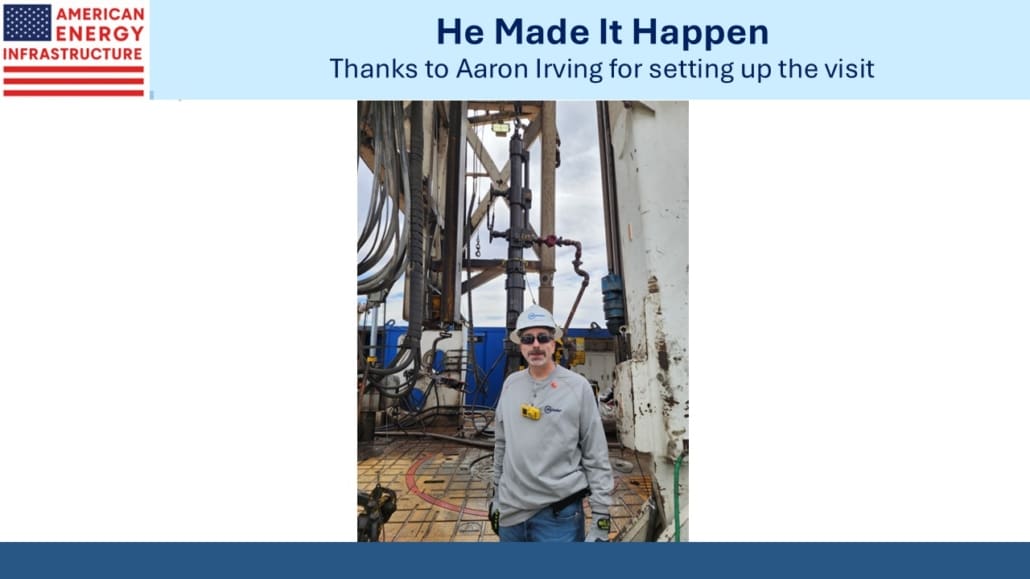
I’ve always wanted to visit an oil rig. It’s not easy. They don’t want every investor showing up and being a nuisance, distracting workers and getting in the way. Fortunately, Aaron Irving of Carlsbad, NM, a long-time investor, kindly offered to set up a visit through a friend of his, Arsenio Jones (EHS Field Supervisor) at Matador Resources.
It was a memorable day.
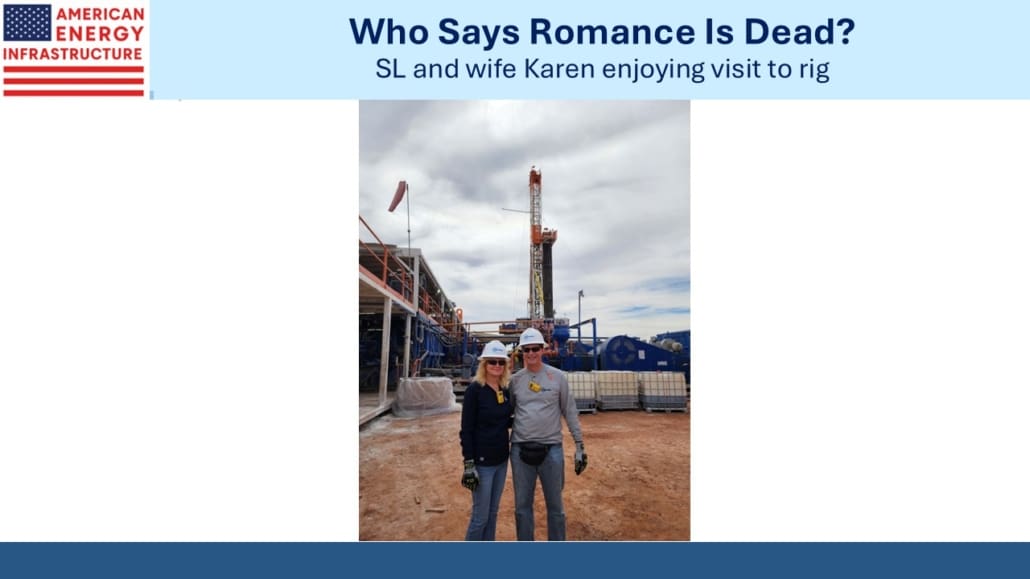
Oil and gas exploration isn’t conveniently located. In our case, after flying to El Paso my wife and I drove three hours to Carlsbad and then Arsenio drove us a further 45 minutes through scrubland to a patch of cleared dirt with an enormous drill sitting on it. On the way Arsenio gave us background on the site we’d be visiting and what life is like working in the oil business.
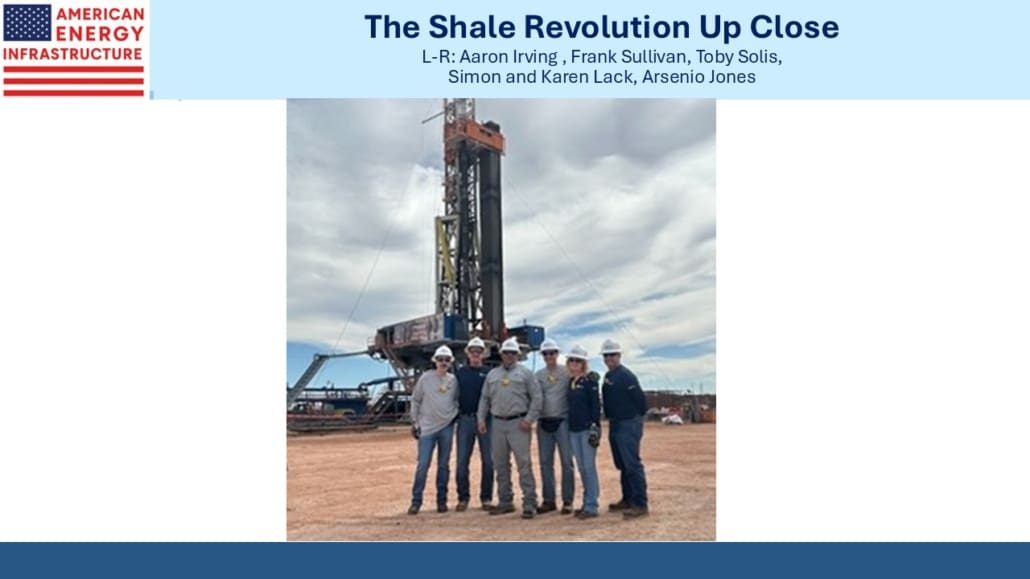
We had previously been told to show up in steel-capped boots and jeans. Upon arrival we were each kitted out with a fire-retardant sweater, personalized hard hat, ear plugs (drilling is noisy), safety goggles, gloves (splashed oil is apparently hard to remove) and a hydrogen sulfide (H2S) detector.
Loose jewelry had to be removed. We received two safety briefings. Anyone is empowered to call a “safety time out”. I hoped I wouldn’t need to. If someone needs urgent medical care, calling 911 will likely result in a helicopter being dispatched; such is the distance to the nearest hospital.
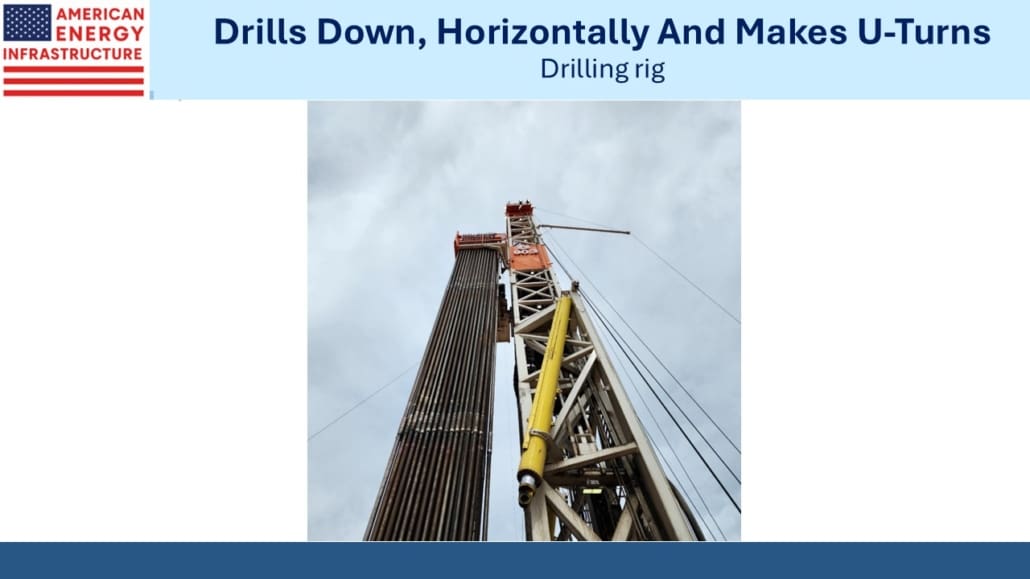
This is the Shale Revolution up close. On the site we visited, Matador was drilling a series of wells in different directions. Computer screens in the control center displayed numerous metrics. The current well had been drilled to over 20,000 feet. Then it turned horizontal before making a U-turn near the border of their assigned area.
Privately-owned mineral rights are unique to the US. We take for granted that oil found in your backyard is yours, but I’ve yet to come across another country where this is the case. Mineral rights can be sold separately from the land ownership. What I hadn’t appreciated was that mineral rights can be further spliced at different depths. So, an E&P company may have rights to 100% of the hydrocarbons down to 15,000 feet and only 60% for the next five thousand feet.
Boundaries are interesting too. A well might go within 150 feet of the boundary. But once fracked, it may inadvertently draw in oil and gas from across the boundary, depending on the geology. Being the first to drill near a boundary is generally a good idea.
It’s a world of enormous pressure — 3-5,000 pounds per square inch (psi) at the surface to circulate drilling mud down to the drill bit. Pressures can be 5-7,000 psi or more where the drill bit is operating. And weight; a drilling rig can weigh 2-3 million pounds.
It is physical work with heavy equipment, but it’s run by thoughtful people with engineering degrees. They’ve watched Landman and if real life was as dramatic as portrayed in the show, they’d be doing something else.
Toby Solis (Field Operations Manager) explained how important it is to be able to think in three dimensions, to visualize what’s happening several miles below ground. Toby is built like a linebacker and has two degrees, apparently often challenging new hires with math problems to test their aptitude.
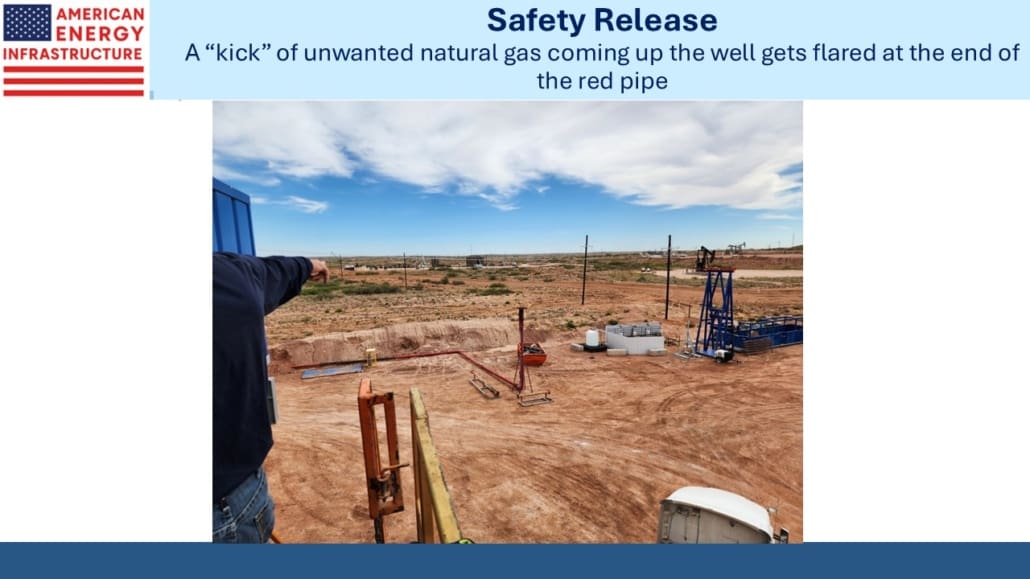
On the day we visited the crew was preparing to pour the cement casing for the well. Imagine two steel tubes one inside the other running along a section of the well. The cement is poured down the inner tube and pressure applied from the wellhead to force it back up through the gap between the inner and outer tubes. It sets to create a concrete casing for the well.
Apparently, sugar added to the stored cement stops it from hardening before use. So the site takes deliveries from food distributor Sysco. By superstitious custom, a hard hat is never wiped clean but is allowed to retain its wear and tear. Only our group of visitors wore conspicuously clean hats.
Hydraulic fracturing (“fracking”) involves firing holes about 0.4″ in diameter along a section of the well. Then water mixed with fracking fluid and sand is pumped in at pressure high enough to create millions of fractures in the surrounding rock. The grains of sand prop these open, and when the wellhead pressure is relaxed, oil flows back up along with the water that was used to release it. They want the oil but if it’s like most wells in the region it’ll produce gas too, increasing in quantity as the well matures.
I was familiar with the process from having studied the sector for many years, but it was absorbing to be on-site and see the preparation.
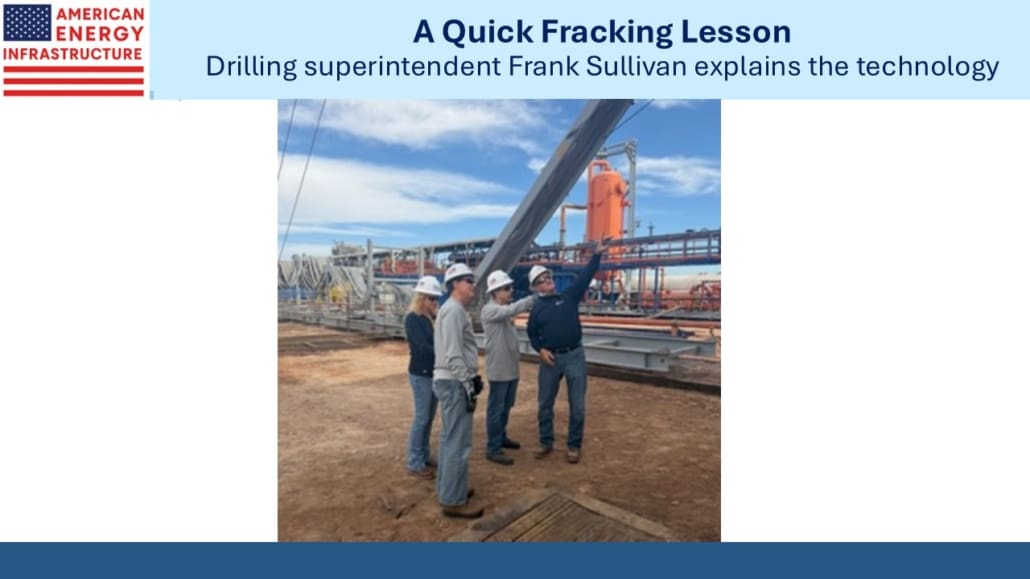
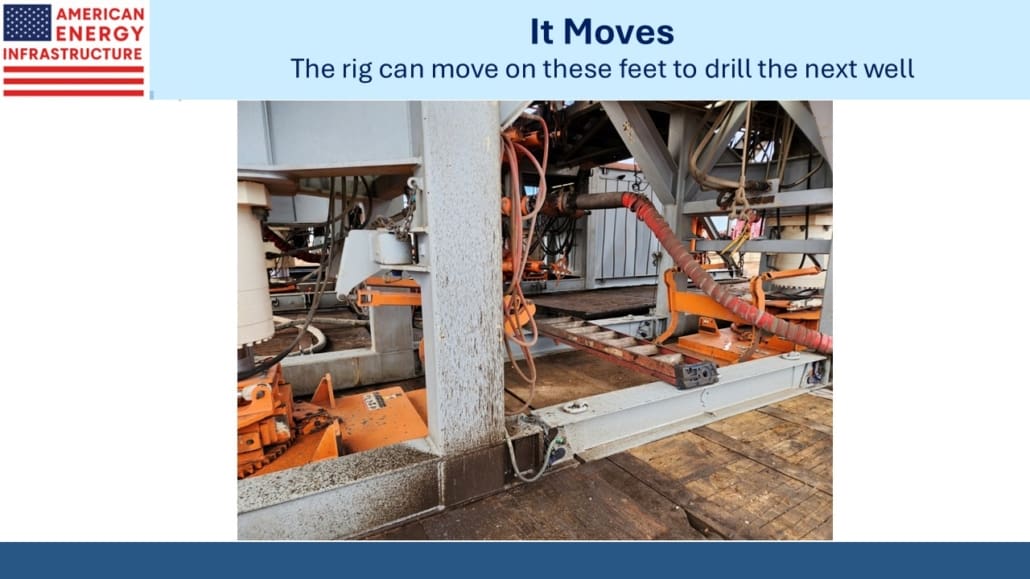
As Frank Sullivan (Drilling Superintendent) explained, the rig can be disassembled and put together again nearby within about three days. It can also move slowly, on feet. The rig we saw was destined to move just 30-40 feet away to drill another well in a few days.
The crew members typically work twelve-hour shifts for two weeks, staying in nearby “man-camps”. They can then return home for two weeks. I chatted with one technician who was monitoring activity. He was once an auto mechanic before switching careers. To stay current on advances in technology, continuing education is part of his job.
Pay in the oil patch can be good. A new engineering undergrad can earn $100K in starting salary, in a region where there are few equivalent opportunities. Even a high school graduate can command almost as much and pay can rise quickly for those who demonstrate aptitude for the job.
Baker Hughes reports that there are 580 land rigs operating across the US. They are the result of the Shale Revolution, which was created in America and refined by people like those we met from Matador. They may not give it much thought, but strategically these highly skilled workers armed with engineering degrees and evolving technology have made the US energy dominant.
Voters may complain about the price of gasoline or diesel, but high oil prices benefit the domestic energy sector to a degree that almost offsets the drag from increased fuel prices across the rest of the economy. And we have among the world’s cheapest electricity thanks to natural gas whose price remains among the lowest in the world.
Frank Sullivan, Toby Solis and Arsenio Jones are leaders at Matador, a company that is playing a vital role in boosting America’s competitiveness. They are an impressive group, choreographing heavy equipment with technology to unlock resources miles below ground. They spoke warmly of CEO Joseph Foran (“Mr. Joe”) who has earned their respect through regular visits just to check in and see how they’re all doing. Other members of the executive team do the same.
Having spent a day with Frank, Toby and Arsenio, they represent the best of America, helping drive living standards ever higher with affordable energy. They are a fine example of what makes this country so relentlessly successful, making America great, one well at a time.
We have two funds that seek to profit from this environment: