Still Not High
Although drivers are feeling it at the pump, crude oil prices and therefore gasoline have so far not approached the most dire predictions. We’re enduring the worst supply disruption in history in terms of volume, with an estimated 500 million barrels having been drawn down from global stockpiles.
Moreover, it’s become apparent that Iran’s asymmetric threat to Persian Gulf shipping is invulnerable to US military action short of a ground invasion. This means Iran has a big say in when maritime traffic resumes, and they have a newfound ability to cause disruption in the future when the US fleet has left the region.
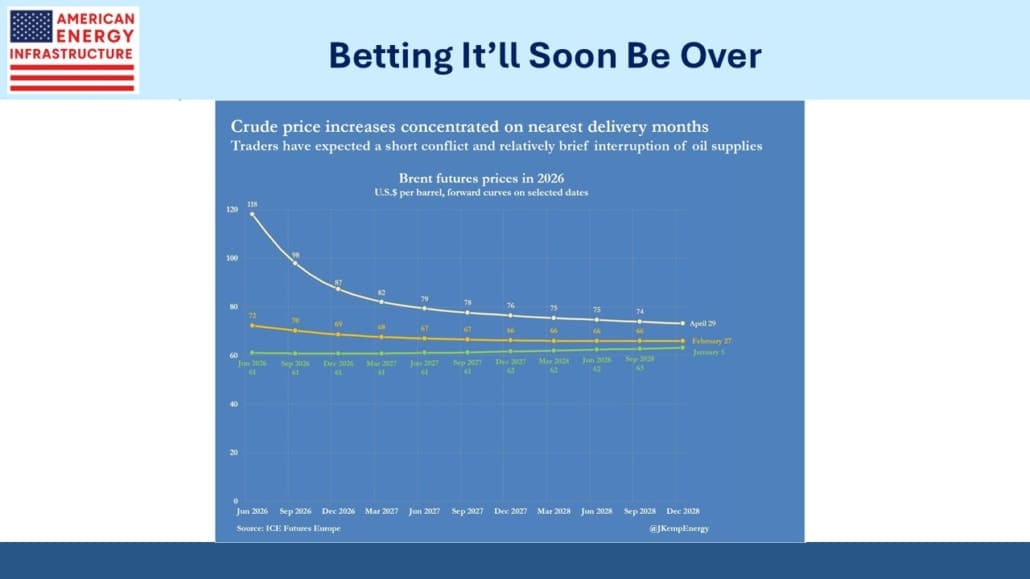
But the worst has not happened, at least not yet. European airlines no longer fear running out of jet fuel by the end of June. US gasoline prices have caused some grumbling but little more. Higher propane costs have not caused widespread hunger among the Asian households who rely on it for cooking.
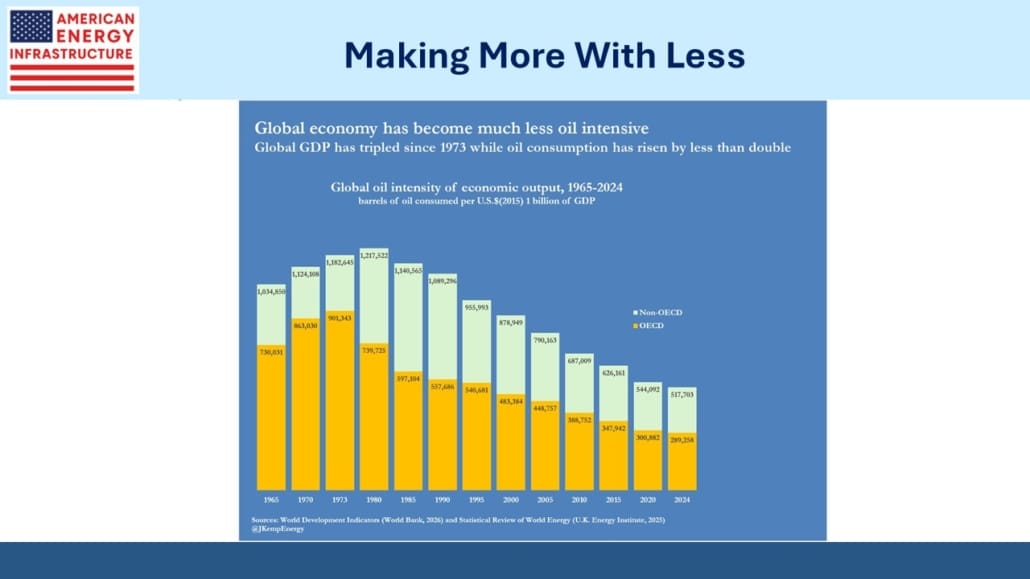
The global economy has consistently reduced its energy intensity through improved productivity.
China has been less impacted than many observers expected. They have not drawn down on their strategic reserve but have stopped building inventories which likely reduced demand by 0.7-1.0 Million Barrels per Day (MMB/D). Their imports have fallen by 2.8 MMB/D, but through a combination of modestly higher domestic production, banning exports and the halt in inventories noted above they have softened the impact.
China has built its energy resilience to give it greater flexibility over Taiwan. These preparations have already shown some benefits.
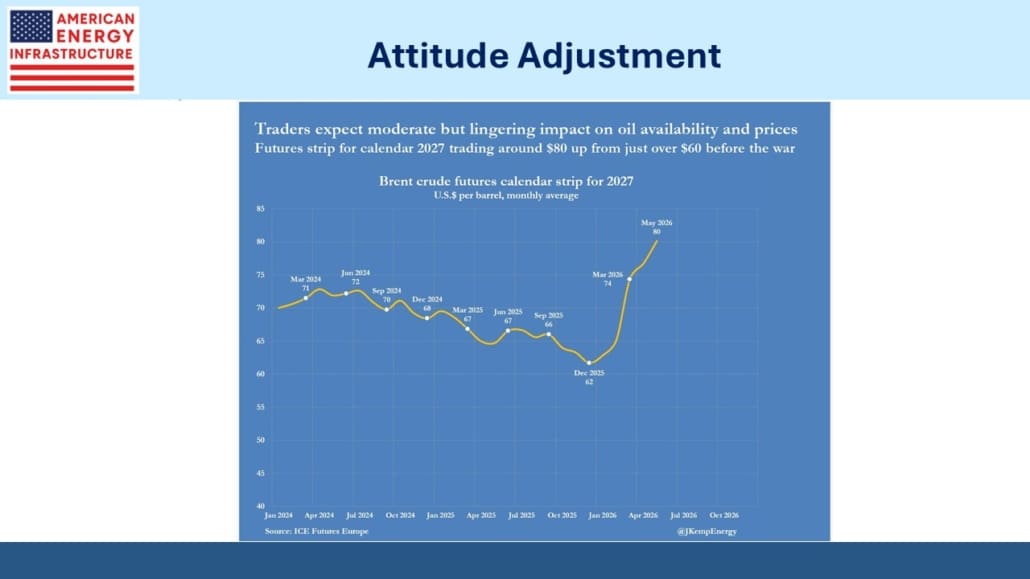
Although the market has avoided a blow-out spike, prices increasingly reflect a long-term impact. The 2027 strip price (i.e. the average of the 2027 futures prices) is now around $18 above its pre-war level, approximately matching the increase in spot prices. A couple of months ago there was a more pronounced downward slope, implying a more rapid return to the status quo ante. If crude prices do average $80 next year, domestic criticism of Trump’s decision to go to war will be more pronounced.
We continue to think that the threat to shipping through the Strait will remain for the foreseeable future. The US has no appetite to invade Iran, which will therefore retain its ability to threaten ships using drones and missiles.
Attendees at last week’s industry conference often commented that longer term oil and gas prices are surprisingly low given the likelihood of continued supply disruption.
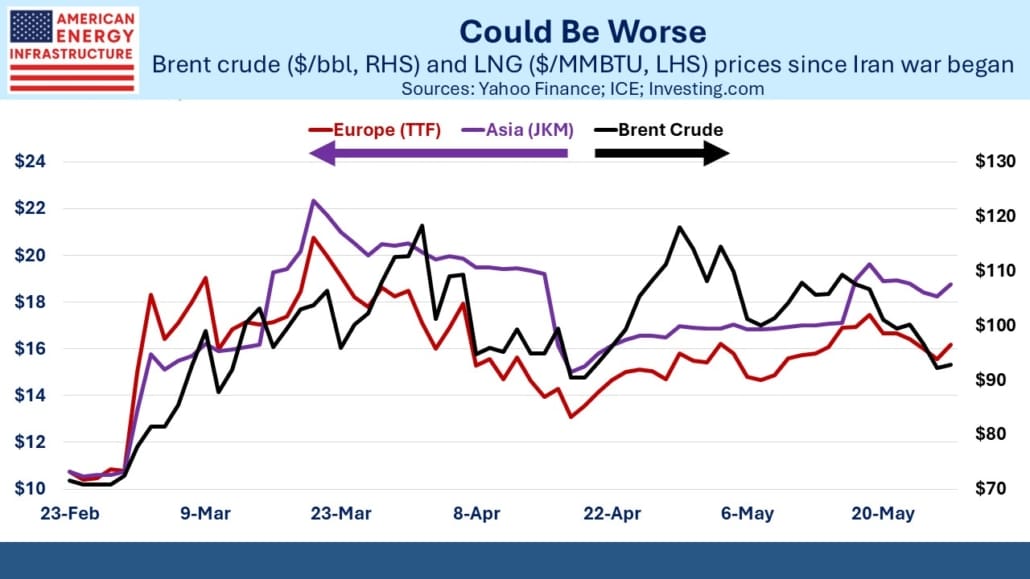
Global LNG prices briefly doubled from their pre-war levels and remain up by 50% (Europe) and 70% (Asia). By contrast, crude prices jumped by two thirds but have slipped back to +25%. There are fewer supply choices for LNG than crude. The US, already the world’s biggest LNG exporter, is adding capacity.
Since the world is enduring its second bout of energy insecurity in four years (the first being Russia’s 2022 invasion of Ukraine), one might anticipate the adoption of policies to reduce such vulnerability. This could include supply diversification away from the Persian Gulf to the benefit of US oil and gas suppliers. Global LNG prices are more likely to hold on to their gains.
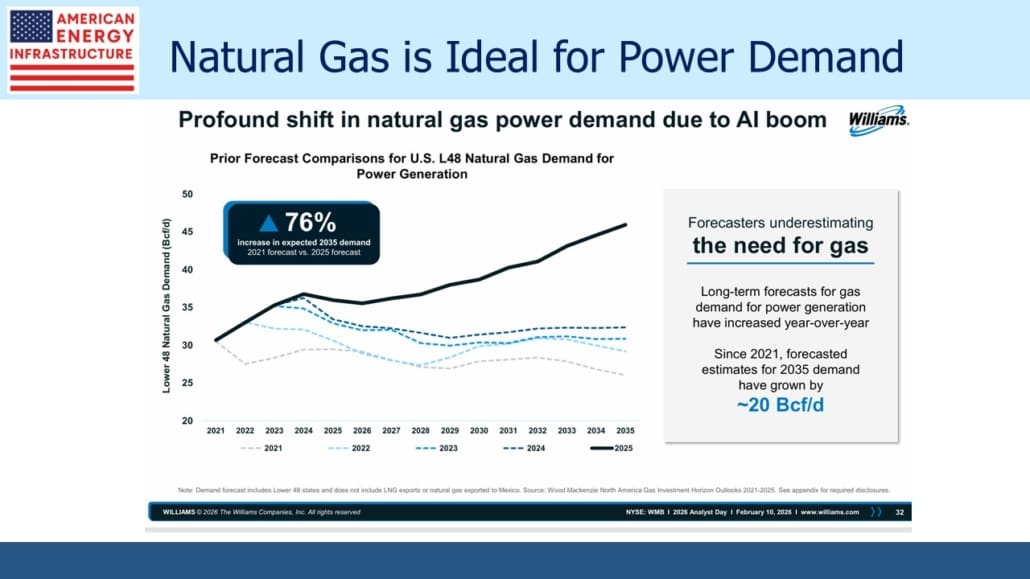
Data centers are moving up voters’ list of issues they care about. Their construction creates few jobs and once operating they eliminate many more. They are routinely blamed for rising electricity prices. This is credible since following two decades of virtually no growth, power demand is set to increase at 10X its historic rate. Forecasts of natural gas demand continue to ratchet higher.
Jim Murchie of Energy Income Partners published an analysis a few months ago where he argued that electricity prices were simply keeping pace with inflation, and that regions with faster inflation were experiencing the biggest hikes in power prices. He felt data centers were being wrongly blamed.
Murchie makes a compelling case. The utility industry is walking a fine line – they want the new business that data centers represent and often describe needed infrastructure upgrades as overdue. PJM, the nation’s biggest grid, blamed data center demand for the jump in prices at their capacity auction which fed into residential bills.
Consumer advocates are vocal in blaming data centers and in one survey three quarters of respondents thought utilities needed more oversight. I’m surprised it wasn’t 100%.
The bottom line is that the political climate will continue to favor behind the meter solutions that minimize the impact of data centers on the grid. This should benefit companies like Williams and Energy Transfer, which are well positioned to supply natural gas directly to dedicated power plants adjacent to data centers.
We have two have funds that seek to profit from this environment: