Still Bullish After The Truce
Last week we were in Tampa and Orlando meeting with investors. It’s always a pleasure to see clients that have been with us for several years, because they’ve invariably had a positive experience. On the drive from Tampa to Orlando on I-4 we passed the exit for DisneyWorld, although sadly didn’t have time on this occasion to visit the Happiest Place on Earth. We will be back.
The signed truce with Iran weighed on energy stocks all week as crude slumped and foreign LNG prices fell. I think over the years our investor base has self-selected to consist mostly of those who aren’t too bothered by short term fluctuations, perhaps in part because we rarely have much useful to say about why the sector did what it did yesterday.
Consequently, the questions from the investors we met last week were focused on the long term outlook.
The Strait will re-open for at least 60 days, and Qatar expects its Ras Laffen LNG export terminal to be operational within a month. This is for the 83% of its capacity still working after an Iranian missile strike in March. There’s still lots of opportunity for hostilities to resume. Some interpret the text of the deal as allowing Iran to eventually charge a toll on ships passing through the Strait.
For now markets are assuming the best.
Nonetheless, Qatar’s reputation for reliability has been shattered by the disruption. Cheniere, Venture Global and NextDecade are among the LNG exporters set to benefit from the comparative safety of Texas and Louisiana, safely out of Iranian missile range.
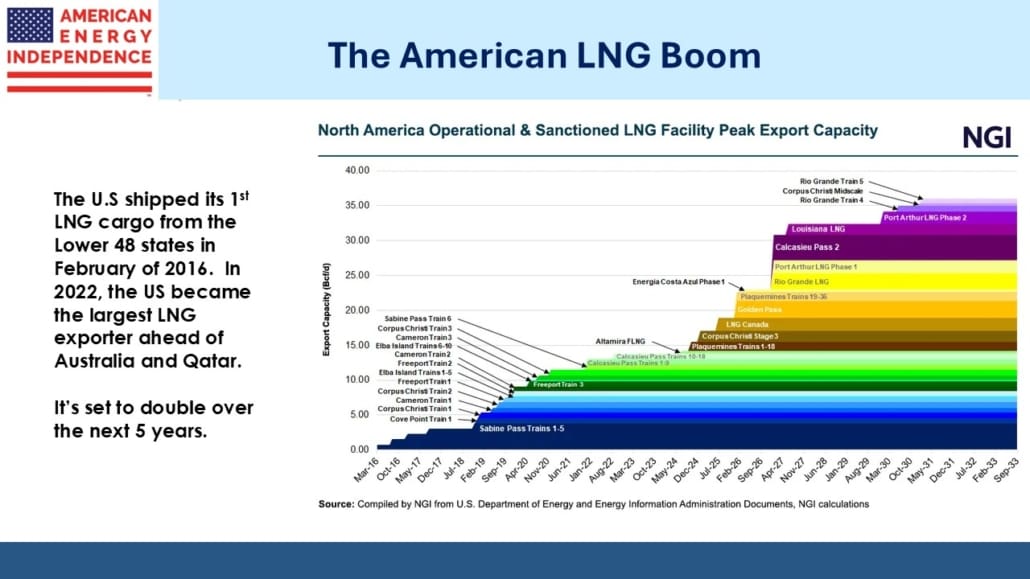
The visibility around additional LNG export capacity assures ongoing demand for natural gas feedstock and related infrastructure.
Discussion often turned to data centers and their demand for electricity. Behind The Meter (BTM) discussions are reported to be widespread by Williams Companies (WMB) and Energy Transfer (ET), the two leading providers of natural gas for such arrangements. So far announced deals aren’t that numerous, but the capex plans for data centers seemingly assure that more will be forthcoming. Cleanview estimates that 59 projects are at various stages of development, with over half of these in energy-friendly Texas. But only around 2% of planned power generation is up and running.
Data centers are the big driver behind the expected increase in electricity demand. Over the past couple of decades it’s been close to flat at 4,000 Terawatt Hours (Twhs) annually, although picked up in recent years and reached 4,200 Twhs last year. Efficiencies have offset population growth. For example, the typical household refrigerator uses 30-40% less electricity than twenty years ago.
Projections are for growth of 35-50% over the next 15 years. Reshoring is another factor as manufacturing companies respond to tariffs and relatively cheap US energy to shift production back home. Increased electrification including market share gains for EVs and heat pumps is another factor, although smaller and more likely in blue states.
The SpaceX IPO was a common topic of conversation, including Elon Musk’s plans to put data enters into orbit. 24 hour access to sunlight and the cold temperatures of outer space sound compelling. Elon Musk’s plans have caught the public’s imagination and shorts have found it’s best not to bet against him. But the realization of such plans must be many years away.
Questions about Small Modular Reactors (SMRs) often come up. While there are many development efforts under way, none are at commercial scale. Google, Meta and Amazon are among those companies funding SMR development.
The challenges include obtaining sufficient quantities of High-Assay Low-Enriched Uranium (HALEU), which is enriched between 5% and 20%. Russia has historically been the biggest supplier.
I used to wonder why the private sector couldn’t emulate the US navy, which relies on SMRs to power aircraft carriers and submarines. Then I ran into a retired nuclear physicist who explained that they run on weapons grade uranium because it’s very energy dense and can run for the entire useful life of the vessel (twenty years or more).
The civilian sector worldwide doesn’t use this type of uranium because of the risk that terrorists might obtain it and make a nuclear bomb. It’s pretty safe on an aircraft carrier.

It’s always interesting to see how many Florida residents didn’t always live there. People are fleeing north east states like Connecticut, New York and New Jersey in search of good public services with no income tax and a more pleasant climate. In spite of what is sometimes suggested, in my experience these new Floridians are reliably Republican, which is why Florida has moved from purple to red in recent years while New Jersey is solid blue.
We have two have funds that seek to profit from this environment: