Reporting On The EIC Investor Conference
Last week SL Advisors partner Henry Hoffman was at the Annual Energy Infrastructure (EIC) CEO and Investor Conference in Ventura, FL. Such events provide an opportunity to meet the executives of the companies we’re invested in. It’s important to avoid being too sold on their prospects – especially now when we have a constructive outlook on the sector. So, Henry brought a jaundiced eye and detailed questions to his meetings. Below are his notes from the conference.
The overarching message across management teams and panel discussions was remarkably consistent: demand growth is accelerating, infrastructure remains constrained, and the opportunity set for well positioned companies continues to expand.
What stood out most was that executives were not talking about a short-lived cyclical spike. The tone was much more about durable, long-term growth supported by LNG exports, AI and data center power demand, disciplined upstream producers, and rising global demand for U.S. hydrocarbons and natural gas liquids.
At Targa Resources, management remained highly bullish on their LPG export footprint and broader Permian to water strategy. The company continues to see attractive returns on incremental projects and plans to keep investing meaningful growth capex.
Importantly, management emphasized that producer discipline in the Permian is making infrastructure planning easier and creating an environment conducive to steady, efficient growth rather than boom and bust development cycles. Targa also discussed future opportunities extending deeper into benches in the Permian, highlighting how innovation continues to drive growth.
Enterprise Products Partners echoed similarly constructive views on LPG demand. Management described butane demand as particularly strong given disruptions tied to the Iran situation, while also noting there are currently no issues placing propane volumes globally.
One comment that stood out was Enterprise describing future growth opportunities as a series of “singles” rather than requiring transformational megaprojects. That framing reinforces the durability of the current cycle. Incremental expansions with attractive returns can steadily compound EBITDA growth over time without dramatically increasing risk.
At Energy Transfer (ET), CFO Dylan Bramhall stated that “gas infrastructure growth strength cannot be overstated.” That may ultimately end up being one of the defining themes of this cycle.
ET management noted that global NGL demand has effectively ratcheted higher following Middle East tensions, though demand was already strong before the conflict. The company’s focus now is increasingly on managing the scale of growth across its system. Energy Transfer characterized the current backdrop as a “multi year growth cycle with great returns,” which aligns with what many investors are increasingly recognizing across the space.
One of the most interesting discussions came from Williams Companies (WMB) CFO John Porter regarding “Behind The Meter” (BTM) power opportunities tied to AI and data center demand growth.
Porter described tremendous demand for BTM deals and suggested there is effectively no shortage of projects under evaluation. He also highlighted strong interest from insurance capital and other institutional investors seeking to participate in these opportunities through joint ventures, largely because these projects can offer stable long duration cash flows paired with relatively low cost of capital.
Williams also remains highly optimistic about broader natural gas demand growth across its pipeline footprint with over $15BN in project backlog that gets overlooked with BTM excitement.
Another important point was WMB’s, with a historically conservative management, being willing to temporarily flex the balance sheet modestly to pursue what they view as an unusually attractive opportunity set, while maintaining visibility toward bringing leverage back down by 2028.
NextDecade Corporation offered one of the more bullish LNG outlooks at the conference. Management noted that commercial demand for Train 6 at Rio Grande LNG was already strong before the Iran conflict and has only strengthened since. The company sees multiple financing pathways for the project, with a clear goal of maximizing cash flow retention and ownership at the parent company level.
Ideally, management would like to retain 100% ownership of Train 6 economics. They indicated that a FERC filing for Train 6 could come shortly, with a potential final investment decision in the second half of 2027 in an upside scenario. Beyond Train 6, management also sounded optimistic about the potential for Trains 7 and 8, with hopes of initiating the filing process before the Trump administration leaves office. That comment underscores how important permitting timelines and regulatory visibility remain for large scale LNG development.
Permitting reform was a recurring topic throughout the conference. In one panel discussion, North Dakota Senator Kevin Cramer and Theodore Roosevelt IV of Barclays Bank discussed the need for meaningful reform across energy infrastructure permitting. The argument was straightforward: the United States has the capital, resource base, and demand profile necessary to lead globally, but infrastructure timelines remain hindered by regulatory delays and permitting complexity.
Mark Weldman, President of PNC, made a related observation that the United States is increasingly falling behind China in power infrastructure development. His point was that the issue is not a shortage of capital availability, but rather permitting friction and overregulation that slows execution.
In a fireside chat, Jamie Welch of Kinetik Holdings Inc. provided particularly interesting commentary on the Permian Basin, especially in New Mexico. He emphasized that New Mexico has effectively no ability to flare additional gas, meaning processing and takeaway infrastructure are increasingly essential. He described the Permian as a “sea of gas” and characterized New Mexico as a “white canvas” because of its relatively limited historical infrastructure base.
That combination potentially creates a very large opportunity set for midstream companies capable of building gathering, processing, and transportation infrastructure in the region. Welch even suggested the potential for a “supercycle” in New Mexico infrastructure development.
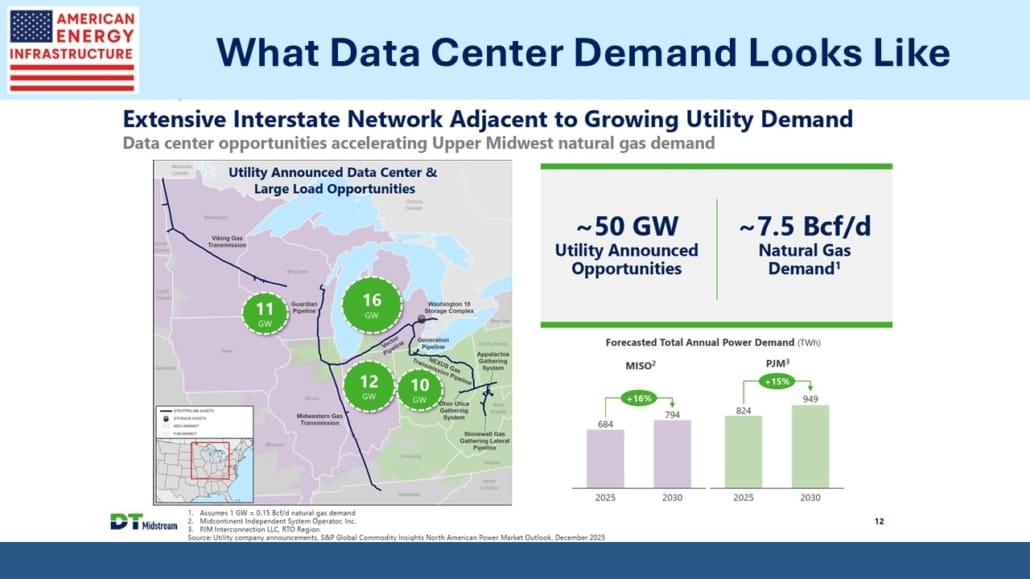
I had dinner with David Slater, President and CEO at DTM, hosted by Wells Fargo’s Michael Blum. David went around the table asking for suggestions on what the company should prioritize. One person said buybacks, another said dividends, and another focused on announcing new projects. When it came to me, sitting next to him, I said the priority should be maximizing returns on incremental invested capital and continuing to build high quality, appreciating assets with a focus on maximizing terminal value over time. Another attendee immediately pushed back and argued they should aggressively chase the data center opportunity. David then turned to the table and said, “I agree with Henry.” He then said, “I think of this as the “Halo Trade,” and it is exactly the theme I am focused on.”
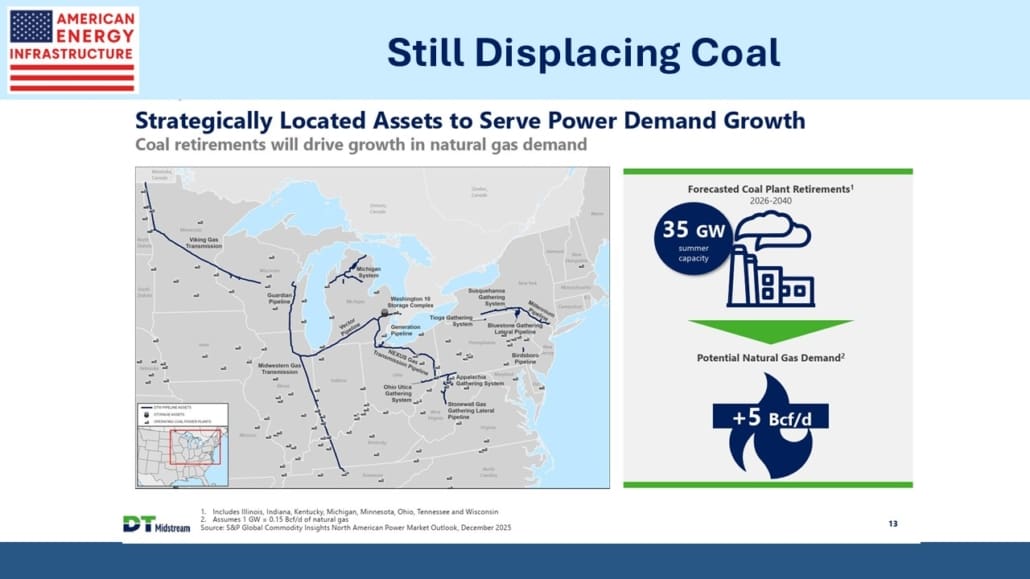
The biggest takeaway from EIC 2026 was that the growth runway for U.S. energy infrastructure continues to lengthen rather than shorten.
LNG exports continue to expand. LPG and NGL demand remain exceptionally strong. AI and data center related power demand are creating entirely new infrastructure opportunities. Meanwhile, producer discipline is supporting more stable and predictable infrastructure investment cycles.
The sector increasingly appears to be transitioning from a traditional commodity driven cycle into a long duration infrastructure buildout story with visible demand growth and attractive returns on capital.
If the industry can achieve meaningful permitting reform, the scale of potential investment opportunities over the next decade could be even larger than the market currently anticipates.
We have two have funds that seek to profit from this environment: