Private Capital Sees A Cheap Public Market
Last week Apollo invested $9BN in Oneok (OKE), who used $4BN to finance their $4.25BN purchase of Brazos Midstream’s Permian Midland Basin G&P assets while using the remaining $5BN to pay down debt.
Apollo’s investment is structurally subordinate to OKE’s debt and entitles them to around 15% of Cashflow From Operations (CFO) but with an IRR cap of 7% for nine years, rising to 7.35% in Year 10 and 7.85% in Year 15. OKE can choose to accelerate paydown on Apollo’s interest.
Because Apollo’s investment is subordinate to all current and future OKE debt, rating agencies will treat it as equity for leverage purposes, getting OKE to 3.25X Debt:EBITDA next year. But its cost to OKE is lower than its estimated cost of equity which we think is 8-9% (JPMorgan uses a 9.25% discount rate in their NPV estimate). So this looks like an attractive source of financing. They’re financing the acquisition of a cash-flow generative asset without diluting equity owners while also reducing leverage — not easily done.
Apollo is accepting a fixed return on an investment that has a greater claim on cashflows than common equity holders but is still subordinate to everything else. The risk of OKE’s cashflows collapsing so as to threaten its ability to pay the fixed return they’ve agreed is de minimis, but Apollo retains none of the upside of an equity investor and has no board representation or liquidation preference.
Nonetheless, Apollo must regard this hybrid investment as more debt-like than equity because of the high probability of earning their agreed upon IRR.
Oneok is only the most recent example of private equity investing in publicly traded midstream businesses. In July Apollo joined Blackstone and KKR when they invested $5.34BN in a Williams Companies subsidiary providing behind the meter solutions to data centers.
In 2024, Blackstone invested $3.5BN in EQT via a hybrid structure with a fixed return.
Transactions are often driven by a differing perception of risk/return by the two counterparties involved. Apollo’s investment in OKE accepts what rating agencies regard as near-equity risk for a bond-like return. By contrast, Apollo regards the risk as more bond-like. Although they are subordinate in the capital structure to everything except common equity, the reliability of the operating cashflows supporting their return justify it.
More broadly, private equity firms are offering this type of financing to midstream companies because the sector itself is cheap relative to its risks. Leverage defined as Debt:EBITDA has fallen over the past decade from 4-4.5X to 3-3.5X. Capex projects are more reliably underpinned by contracted demand and are generally in energy-friendly states like Texas. Distributable cash flow yields of 9-10% are around 2X distributions. If the midstream sector was valued 20% higher, their consequent lower cost of capital would make them less appealing to private equity. This is a group of investors that thinks the sector is cheap.
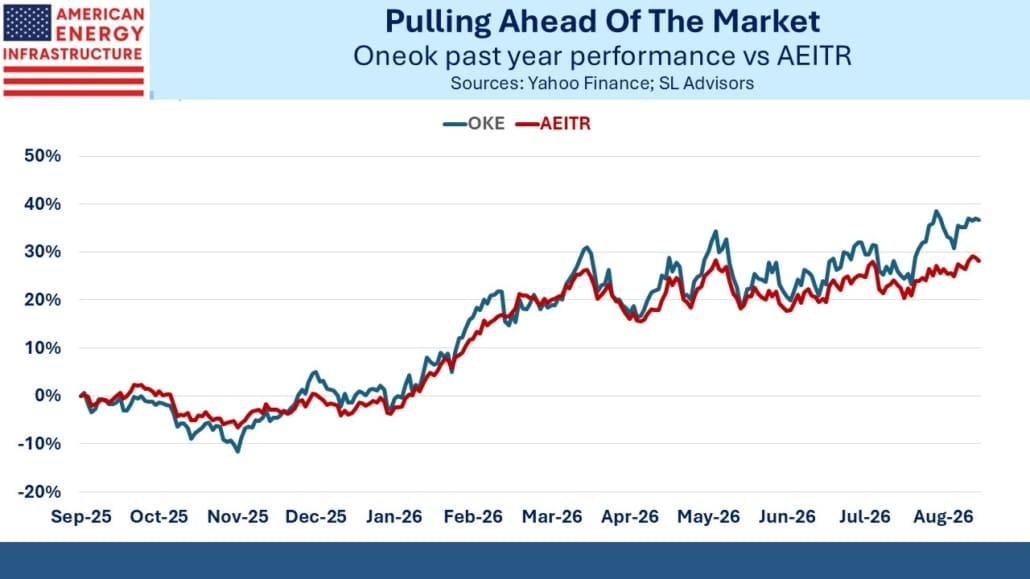
Following the Brazos announcement, Spiro Dounis who covers the midstream sector for Citigroup, raised his price target for OKE from $97 to $108. Dounis sees the acquisition supporting 6% p.a. cash flow growth over the next several years. Oneok has recently pulled ahead of the American Energy Infrastructure Index after roughly tracking it for most of the year.
The other day an investor asked me “why now” for midstream. Regular readers of this blog may think it’s always a good time to invest in the sector – we aren’t known for trying to call the top.
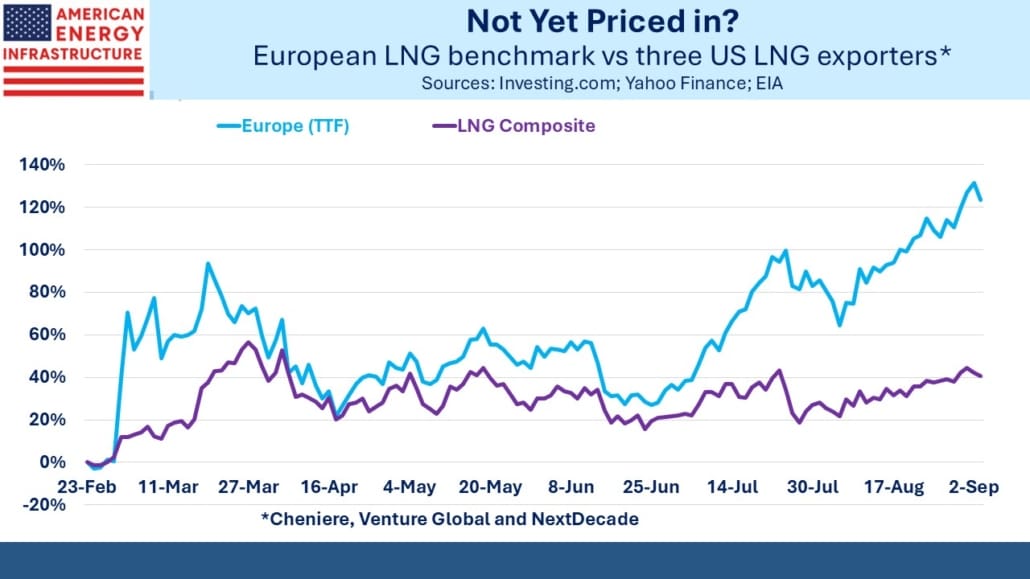
One of the strongest reasons to invest now is that the sector continues to underprice the benefits to US exporters of the continued closure of the Strait of Hormuz and the shredding of Qatar’s reputation as a reliable supplier of LNG.
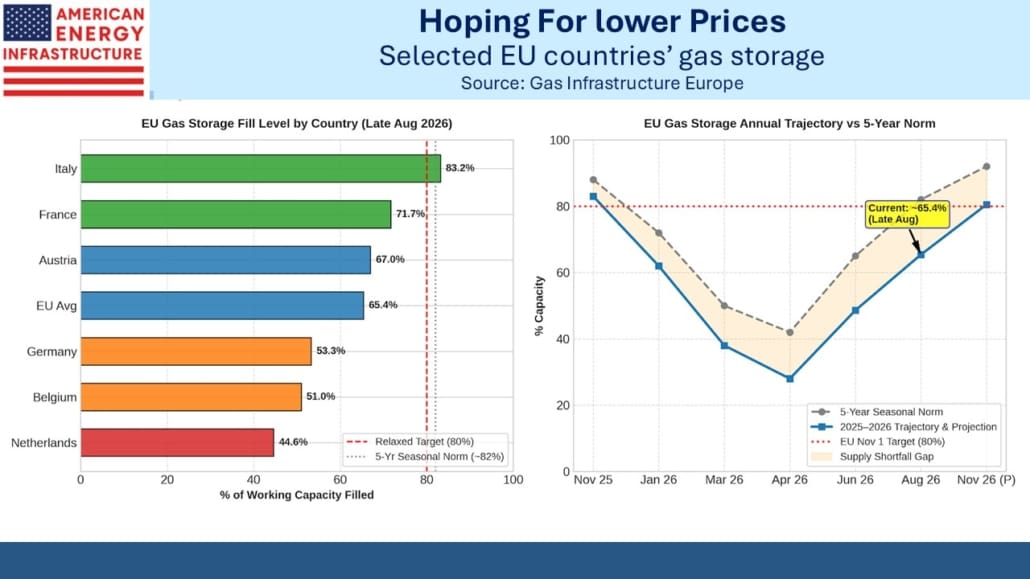
EU gas storage levels continue to run well below target. The EU has a decentralized approach that sets broad storage goals while delegating execution responsibilities to operators in each country. Clearly Dutch buyers are more relaxed or have greater risk tolerance than Italian buyers.
The TTF European benchmark is higher than immediately following the initial US/Israel attack on Iran. LNG shipments are not getting out. The LNG carriers are specialized ships, and their owners aren’t willing to expose them to Iranian missiles. By contrast, US Energy Secretary Chris Wright reported that 17 million barrels of crude oil exited the Strait of Hormuz on Monday, with US Navy support. It’s why oil markets are reasonably balanced.
The continued rally in global LNG prices offers a near term opportunity to Venture Global, and to a lesser extent to Cheniere whose liquefaction capacity is largely pre-sold. But the Iranian threat will remain as long as hydrocarbons are shipped out of the Persian Gulf, benefiting these two exporters as well as NextDecade.
The long term benefit to US energy exporters of being favored because nobody is likely to fire at their terminals remains underappreciated by investors. That’s the reason to invest now.
We have two funds that seek to profit from this environment: