Not Yet A Crisis
It’s not easy to make the Persian Gulf safe for commercial shipping. On Wednesday a Thai vessel was hit by three “unidentified projectiles” near the Strait of Hormuz and caught fire. Several other vessels were hit towards the end of the week. In total 22 civilian ships have been hit in the Persian Gulf since the start of the war.
Iran has also had some success targeting US military and diplomatic assets. The NYTimes calculated 17 such attacks, including on the US Navy’s Fifth Fleet headquarters in Manama, Bahrain. The Pentagon estimated the cost of damage in Bahrain alone at $200million.
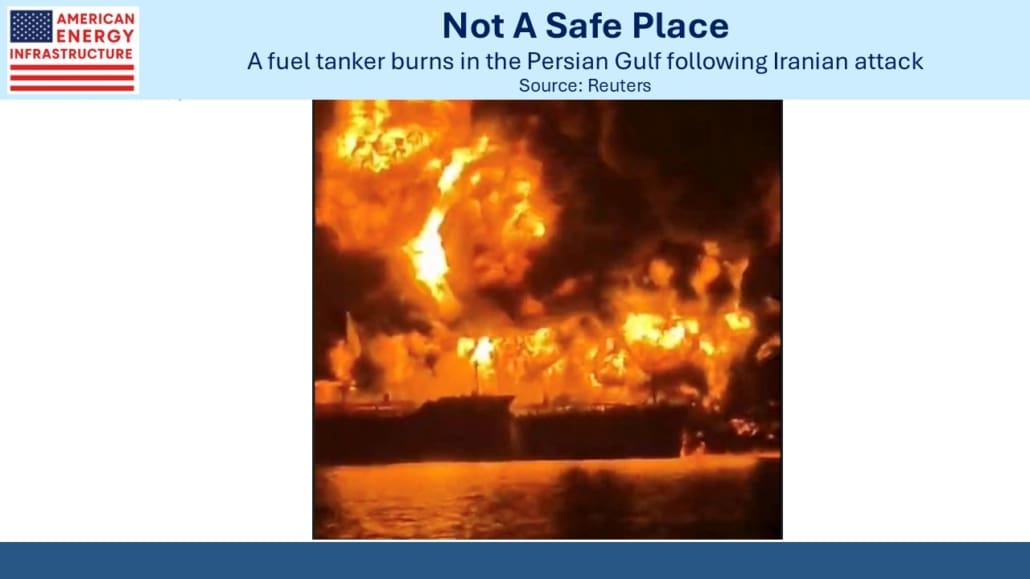
The US is running out of military targets to hit in Iran, and drone strikes are reportedly down 90% from the peak. But they’ll need to be almost completely eliminated in order for commercial ships to feel safe resuming transit. Drones are especially hard to intercept when traveling relatively short distances such as from the Iranian Persian Gulf coast to ships or infrastructure on the other side. They can often reach their targets within minutes, allowing little time for defenders to react.
Tactics are changing rapidly. Ukraine has teams in the region advising Gulf states on how to stop the Iranian Shaheed drones, variations of which Russia has been using. Maritime traffic around Yemen has still not recovered to its 2023 levels, when Houthi rebels began targeting ships. Suez canal traffic is down 60% over this time.
In recent days shipping activity has dropped again, reflecting fears of resumed Houthi rebel attacks. Shipowners are protective of their assets and crews, with little tolerance for operating in war zones.
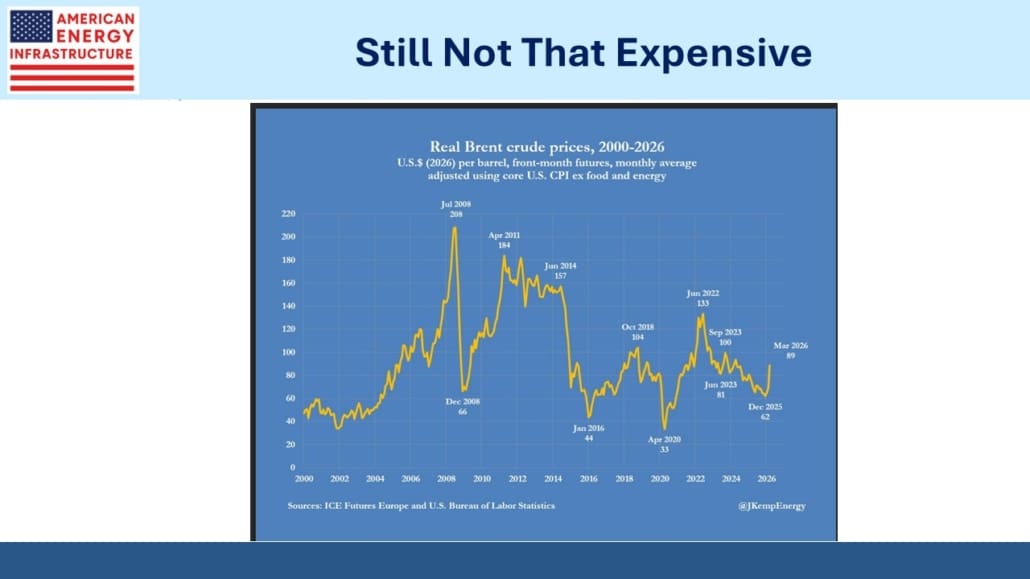
Crude oil prices sank following Monday’s wild market but edged up later in the week. But adjusted for inflation, they are below the average of the past quarter century, and still well below the levels hit in 2022. Energy analyst John Kemp argues that this reflects complacency among many market participants about how long the disruption will last. He points to May 2027 oil futures which have risen by $15, less than half the increase in May 2026 futures.
Global LNG prices remain elevated. Qatar’s closure of its LNG liquefaction facility in Ras Laffan almost two weeks ago caught European and Asian importers exposed. Even though LNG trade is still only 14% of global consumption, replacing those canceled cargoes is hard.
Cheniere and Venture Global (VG) are among those best positioned to profit from higher European and Asian prices, by using uncommitted liquefaction capacity to sell cheap US gas themselves. VG has outperformed Cheniere because they tend to retain more spare capacity to use opportunistically. Cheniere prefers the stability of visible cashflows. 95% of their liquefaction capacity is committed through 2035.
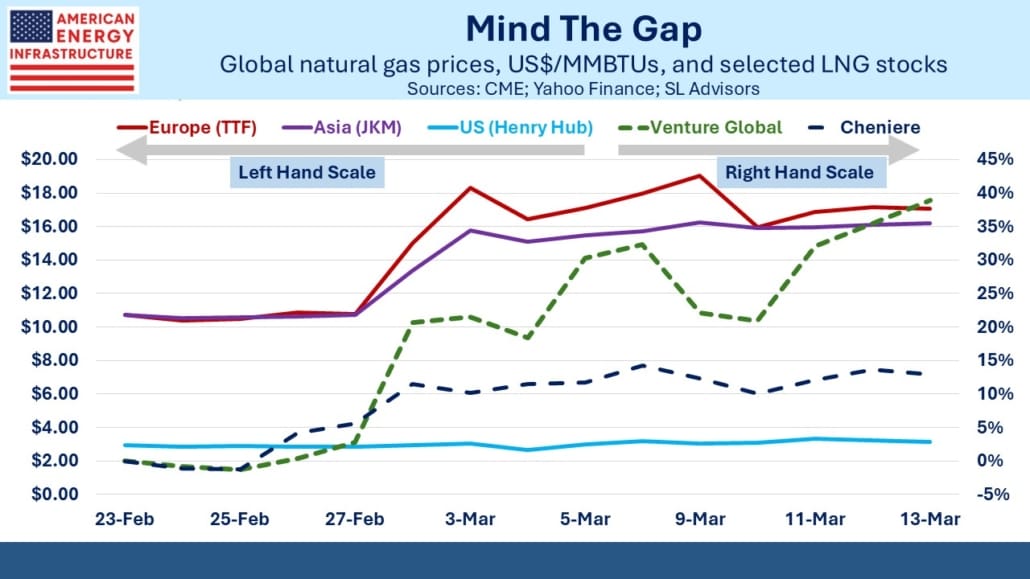
Long term supply contracts are common in the LNG business, but Europe has continued to use them less than others because of their conviction that they won’t need gas in ten or twenty years. By relying on spot market purchases they’ve left themselves more exposed to disruption, which is why the European TTF benchmark has remained above Asian JKM since hostilities began. European energy policies are confused and dysfunctional.
Venture Global (VG) confirmed that LNG deliveries from its Plaquemines export plant under development in Louisiana will begin on October 31, as promised. The significance of this announcement is that four years ago they delayed deliveries when Russia invaded Ukraine, taking advantage of the spike in global prices to earn a windfall estimated at $3.5BN. Arbitration claims followed, with mixed results so far. But it seems VG wants to improve its reputation as a trustworthy supplier.
The effects of the war are rippling across the global economy. TotalEnergies announced their output is down 15%. China’s refiner Sinopec is cutting refining runs by more than 10%. Malaysia may suspend some flights. Gasoline prices are creeping up everywhere.
We continue to think the asymmetric war Iran is waging isn’t yet fully appreciated by markets. We are not yet in an energy crisis. Qatar has not announced when they expect to resume LNG shipments – until the drone attacks stop, they can’t. We think ship owners will need some convincing that the Persian Gulf is safe before anything like normal trade can resume. The US gas business, especially exporters, is in a good position.

Last week, the CFA Naples was privileged to feature Jim Murchie at a Lunch and Learn session. Jim runs Energy Income Partners and knows more about electricity markets than anyone I’ve talked to. He gave a fascinating presentation on the topic. I was the moderator, but my job was really just to let Jim talk because he has so many insights to share.
If you’d like to gain more understanding of electricity, including the real reason prices are rising, read his two informative papers which are here.
We have two have funds that seek to profit from this environment: