Higher For Longer
Trump 1.0 was not kind to energy investors. Although the sector welcomed his pro-energy regulatory approach, it came with a desire for low oil prices. Covid was the final straw as lockdowns forced everyone to stay at home, crushing oil demand and briefly sending crude prices negative. The American Energy Infrastructure Index (AEITR) delivered –6.2% pa during his first term in office.
Joe Biden’s administration was great for energy, much to the chagrin of his supporters. His hostility to fossil fuels tempered capex, boosting cashflows. We paid for it with uncontrolled illegal immigration and a president suffering cognitive deterioration, but +33.8% pa during Biden’s term offered at least some compensation.
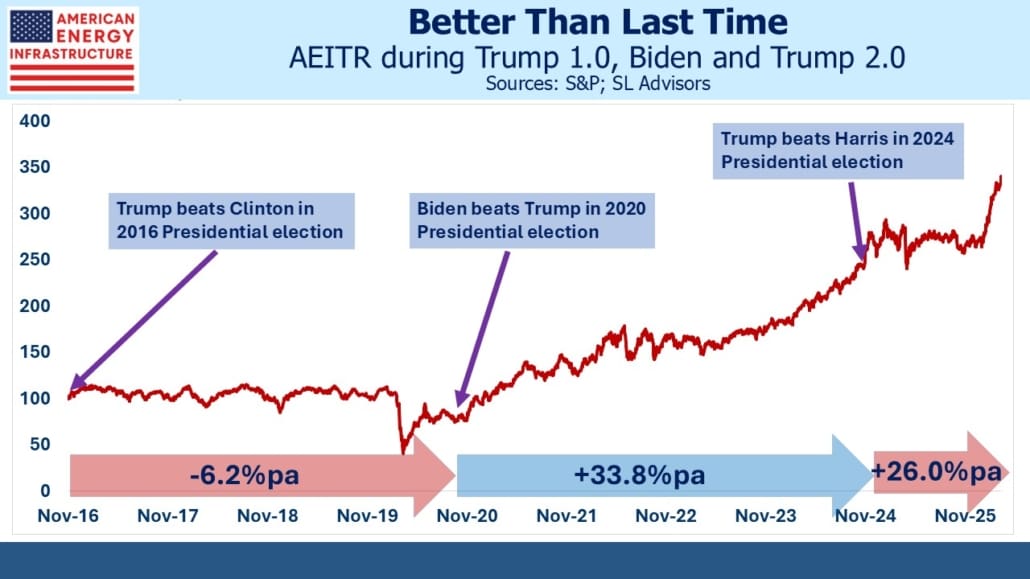
Trump 2.0 is looking more promising. Following a mediocre 2025 midstream started the year strongly, and the Iran war has improved the position of US energy exporters. It probably wasn’t his intention, but the effective closure of the Strait of Hormuz along with attacks on regional energy infrastructure are boosting profits for the sector and rendering Qatar an unreliable exporter of LNG. So far Trump 2.0 has seen a 26.0% pa return on the AEITR.
Analysts have been worrying about oversupply in the LNG market as more liquefaction capacity grows. We have never felt this was a big risk, because the export facilities are backed by long term (ie 20+ years) contracts. If there is oversupply, it would hurt the LNG buyers, such as TotalEnergies or Trafigura.
Qatar’s Ras Laffan LNG facility suffered “extensive damage” following an Iranian missile attack on Wednesday. They had stopped operations two weeks ago due to a drone strike. Restarting takes several weeks and is unlikely before the shooting stops. Expansion plans have been pushed back and nobody knows what the revised plan will look like.
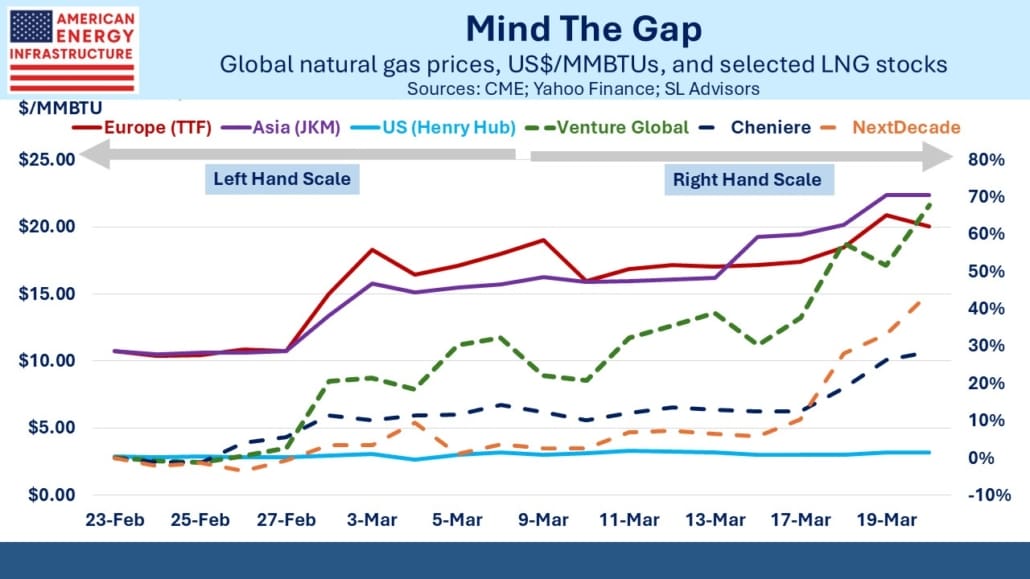
In January Morgan Stanley published On the Crest of a Supply Wave in which they argued that there was too much new LNG coming online. By 2030 Qatar was expected to add 54 Million Tonnes per Annum (MTPA) of LNG exports, second only to the US at 129. Morgan Stanley calculated this would leave a supply overhang of 25 MTPA with demand at 560 and supply at 585.
Forecasts like these have been scrambled by the Iran War. Qatar’s ultimate capacity additions and the world’s appetite to sign additional contracts with a country permanently within Iranian missile and drone range are unlikely to be as robust as before.
On Thursday Morgan Stanley issued Multi-Year Tightening, revising their bearish January outlook. They no longer see any excess supply through at least 2028 and see further upside risk to the non-US benchmarks. Missile strikes damaged two of the 14 trains at Ras Laffan, “…tightening the global market not just for 2026, but also the next several years.”
QatarEnergy announced that they had lost 17% of the facility’s output and repairs would take three to five years.
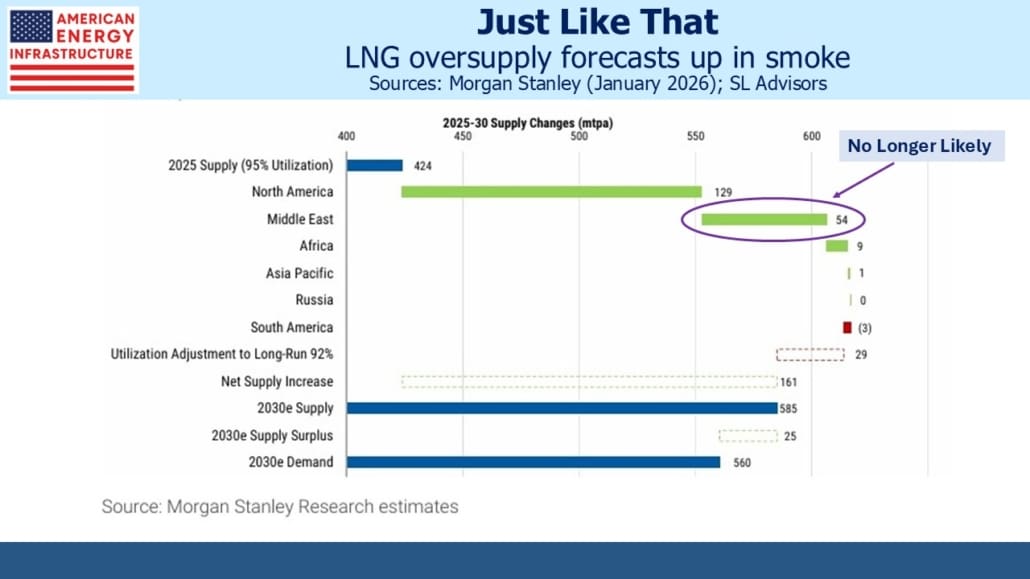
Global LNG prices rallied further last week, as did US LNG stocks. The widening spread between US natural gas and foreign benchmarks in Europe and Asia has increased the opportunity for US LNG exporters to profit. Cheniere, Venture Global and NextDecade are worth more because of recent events, and the global LNG market has changed in a fundamental way.
The mainstream media is focused on oil, although as described above global natural gas prices have moved further. Propane, which in the US is used for backyard BBQs and crop drying, has rallied 20%, almost double the increase in natural gas. Bloomberg incorrectly said that propane is derived from natural gas (methane), suggesting this link was responsible for the jump. It is not.
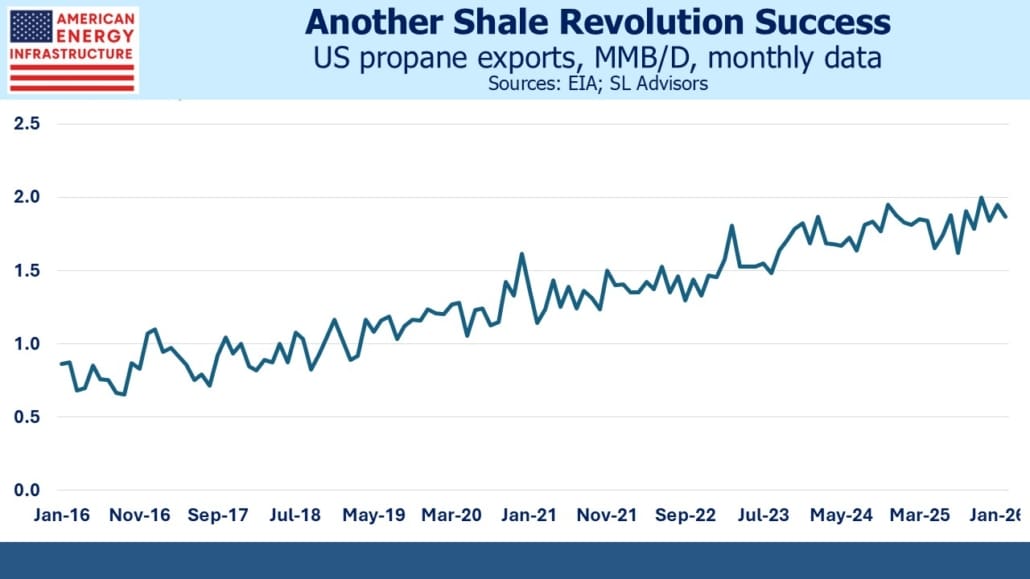
Propane is often found in the same place as natural gas but isn’t produced from it. In the rest of the world, propane is refined from crude oil. The closure of the Strait of Hormuz is making US propane more attractive. Like natural gas exports, propane requires specialized terminals, and so while operators can temporarily run at more than 100% of nameplate capacity, meaningful increases require more infrastructure.
Enterprise Products and Energy Transfer are the two companies most involved in propane exports. They already have expansion projects underway.
Exports are running at about 1.9 Million Barrels per Day (MMB/D), although have at times exceeded 2 MMB/D.
The US is by far the biggest exporter of propane, with small amounts coming from the Persian Gulf which are presumably shut in like crude oil at the moment. China and India are the two biggest importers, where it’s widely used for cooking where retail distribution of natural gas doesn’t exist.
Our propane exports are 60-65% of domestic production, far higher than is the case for natural gas, which explains why domestic propane prices have risen more sharply.
Farmers and outdoor chefs are paying the price, along with homeowners in southwest Florida where the natural gas supply is limited, so we rely on propane for cooking and heating swimming pools.
The outlook for US energy exporters looks encouraging.
We have two have funds that seek to profit from this environment: