Another Way Out?
Few of us give much thought to Syria. The country has no oil, mostly exports asylum seekers to Europe and is now run by religious extremists following a decade of civil war. If you live in America, Syria doesn’t matter.
This simplistic view was challenged last week in a presentation at the Naples Council on World Affairs, which regularly invites experts on geopolitics to give presentations.
Andrew J. Tabler is the Martin J. Gross Senior Fellow in the Linda and Tony Rubin Program on Arab Politics at The Washington Institute, where he focuses on Syria, the Levant, and U.S. Middle East Policy.
Tabler argued that Syria is important because Middle East oil supplies will inevitably have to travel through an as yet unbuilt pipeline to reach the Mediterranean. The cost asymmetry in attacking/defending shipping in the Persian Gulf means that it will never be truly safe.
The US Navy has been very effective in blockading Iran while ensuring safe passage for other ships through the Strait of Hormuz. But this is unsustainably expensive. The missile to shoot down a drone can cost 10-50X as much as its intended target, in addition to which we’re maintaining two carrier groups in the region.
It doesn’t take much to ensure the Strait is “commercially” closed – if insurers won’t provide coverage, ships generally won’t move. It’s this growing realization that will eventually support construction of alternative supply routes out of the Persian Gulf that are harder for Iran to target.
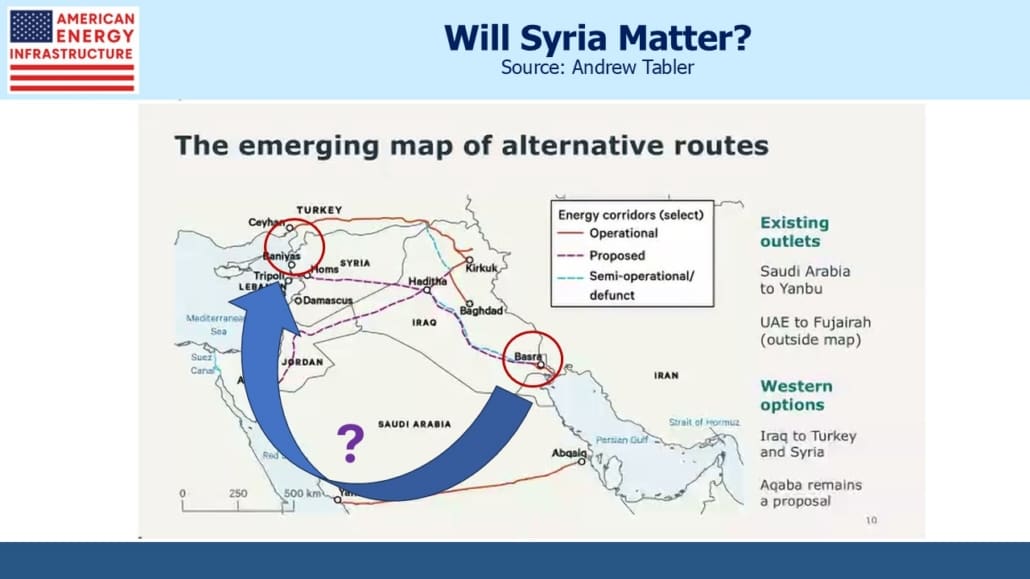
Iraq would clearly benefit from a pipeline from Basra to Baniyas, on Syria’s Mediterranean coast. Kuwait could connect to it. Perhaps even Saudi Arabia. Nothing would be proposed through Israel, and Lebanon is too unstable. Turkey is a possibility but it’s a longer route.
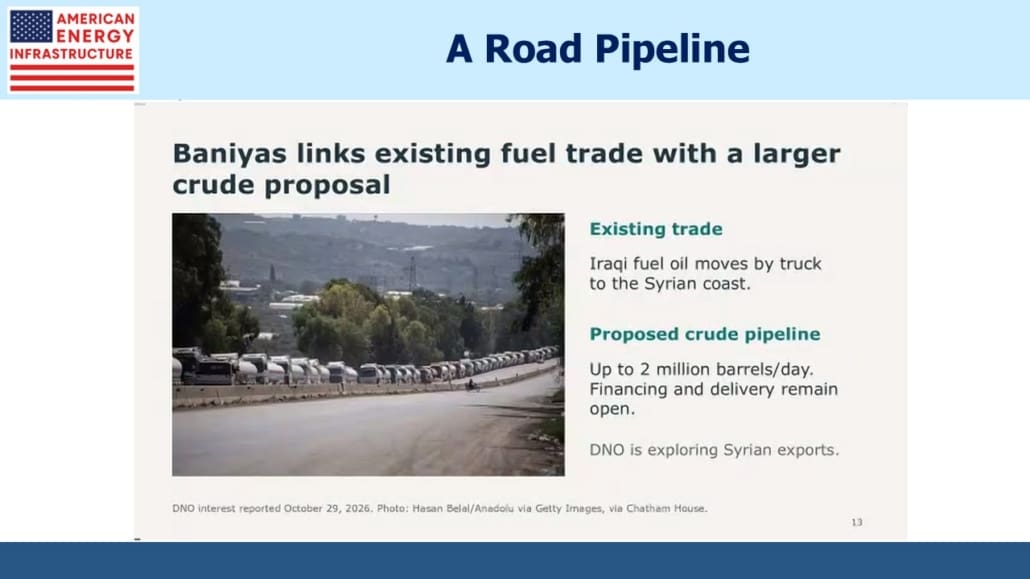
Iraq is already moving crude through Syria via a “road pipeline” — fleets of trucks. This is expensive.
Therefore, Andrew Tabler thinks Syria will be the obvious choice for a new pipeline. He also expects the US to be asked to provide financial support. Perhaps logistical help as well – we have a lot of pipeline expertise in this country.
Areas of southern Iraq and Syria are only loosely under government control, with groups aligned with ISIS still active. Note the missile strikes on Saudi Arabia from southern Iraq a few weeks ago.
Pipeline construction across this region won’t be easy, but Tabler argues it’s why we’re going to care more about Syria in the years ahead.
What about natural gas? Qatar has seen its LNG exports plummet as it keeps extending its force majeure. The owners of LNG tankers are less willing to expose them to Iranian attacks than oil shippers. But physics makes a Syrian gas pipeline unlikely. Any gas that reached the Mediterranean would need to be liquefied at a new LNG export terminal, the same process that Ras Laffen in Qatar is designed for.
Gas is harder to move than oil. No LNG export terminal will get built in Syria. Qatar has no good options. They’re planning to add 85% more liquefaction capacity in Ras Laffen within five years – and yet they’re signing up for shipments of US LNG, presumably to assure future buyers that deliveries won’t be interrupted again.
Almost doubling capacity under such circumstances could never attract private capital. Qatar as a sovereign entity can commit funds without consideration of a stock price. For now, they show every intention of pressing on.
The prospects for US LNG exporters look good.
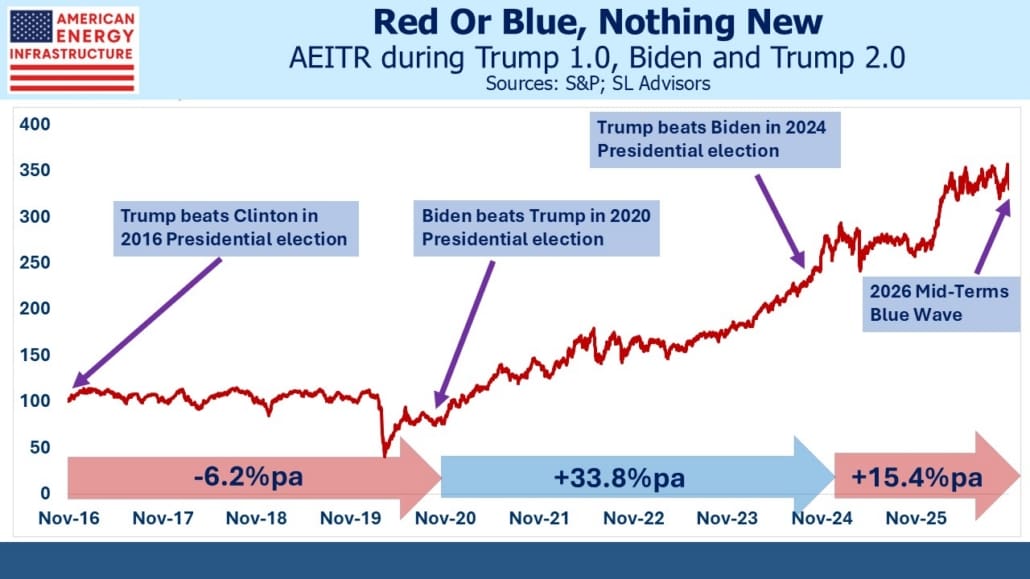
While political analysts are busy writing op-eds, it’s worth remembering the chart above, which shows how relatively unimportant the party in power is to the prospects for midstream energy. Trump 1.0 led to excessive spending and poor returns. The caution that followed under Biden was well rewarded by the market. Trump 2.0 has been better, and not just since we attacked Iran.
Voters have moved on from climate change. Because of the inexorable rise in living standards and energy consumption across emerging countries, it’s their policies that will determine the path of global emissions. The Progressive philosophy to impede the reach of natural gas across regions such as New England has demonstrated that liberal thinking comes with high energy prices. This viewpoint has been marginalized by the focus on affordability, which is where the energy debate sits today.
The fundamental outlook hardly changed for midstream last week. Natural gas production and exports of LNG, LPG and oil will continue to grow. Regardless of how the Iran war plays out, it has highlighted the reliability of the US as a supplier. Earnings continue to reinforce the message of stable growth. The sector remains attractively priced for the long term investor.
We have two funds that seek to profit from this environment: